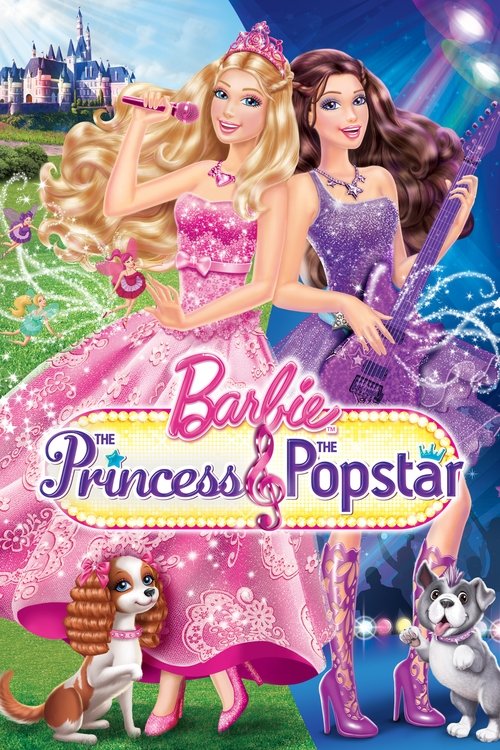
Barbie: The Princess & the Popstar (2012)
Directed by Ezekiel Norton
No — Barbie: The Princess & the Popstar is not woke, scoring 15 out of 100 on our wokeness meter.
Twenty-third in the Barbie line and the second to borrow Mark Twain's prince-and-pauper chassis, this 2012 direct-to-video musical pairs a bored princess with an exhausted popstar and lets them swap places by way of a magic microphone and a magic hairbrush.
Consciousness Markers
Two female leads own the story, rescue the kingdom, and share a warm female friendship, with Tori ultimately vowing to use her voice for others — but the empowerment is a gentle princess-brand girl-power motif, not a pointed feminist thesis.
The villain is a greedy manager bent on stealing the diamond gardenia, and Tori makes her concert free for the less fortunate, but there is no systemic critique of wealth.
Tori closes the film with a speech promising to use her voice to help the kingdom's less fortunate, a mild moral bow rather than sustained preaching.
The cast and character roster are uniformly white and Barbie-adjacent in appearance, with no meaningful ethnic diversity in leads or supporting roles.
A kingdom-wide drought is a minor plot device and the magic gardenia restores plant life, but this is fairy-tale magic rather than any environmental or climate message.
No LGBTQ+ characters, themes, or subtext appear anywhere in this musical identity-swap fantasy.
The drought and the free concert address poverty and hardship in class terms; race is never engaged with as a subject.
No engagement with body image, size diversity, or self-acceptance around appearance beyond the vague 'be yourself' theme.
No neurodivergent characters or themes are present.
The film is loosely riffing on The Prince and the Pauper, which is literary adaptation rather than any rewriting of historical record.
Why it received this score
Twenty-third in the Barbie line and the second to borrow Mark Twain's prince-and-pauper chassis, this 2012 direct-to-video musical pairs a bored princess with an exhausted popstar and lets them swap places by way of a magic microphone and a magic hairbrush. The kingdom is Meribella, celebrating its five hundredth anniversary, and the leads are voiced by Kelly Sheridan and Ashleigh Ball. Both look exactly as the franchise intends: blonde, white, and interchangeable at the neckline. The film is pleasant, tuneful, and entirely content to work within the narrow lane Mattel dug for it.
Where the picture gestures at social awareness, it does so gently. Tori and Keira are given agency, a warm friendship, and a shared victory over a villain who is, tellingly, a manager. Seymour Crider, a bitter former child soprano, schemes to steal the diamond gardenia for profit, which is as close as the script comes to a class critique. Tori wanders the kingdom, sees the drought's toll on ordinary people, and makes the final concert free, a modest redistribution of cultural goods. The closing speech promises to use her voice for the less fortunate. This is princess-brand empowerment, soft-focus and merchandisable, more greeting card than manifesto.
The picture stops well short of anything sharper. Race is never a subject, and the cast is uniformly pale. No queer subtext, no body diversity, no neurodivergent characters, no reckoning with the historical record beyond the Twain scaffolding. The drought is fairy-tale weather, cured by magic rather than policy. What we are handed is a well-mannered fantasy about two girls learning to be themselves, and a moral that costs the studio nothing. The gardenia blooms, the credits roll, and the cultural ledger remains undisturbed.
Analysis generated by our Consciousness Algorithm


Synopsis
Tori is a blonde princess who is bored of living her royal life, and has dreams of becoming a popstar. Keira, on the other hand, is a brunette popstar who dreams of being a princess. When the two meet, they magically trade places, but after realising it is best to be themselves.
Questions about Barbie: The Princess & the Popstar
Is Barbie: The Princess & the Popstar woke?
No — Barbie: The Princess & the Popstar is not woke, scoring 15 out of 100 on our wokeness meter. That earns it a verdict of Ultra Based.
Does Barbie: The Princess & the Popstar have any woke elements?
1 of the 10 markers register at 30 or above, led by Feminist Agenda (42). On Feminist Agenda: Two female leads own the story, rescue the kingdom, and share a warm female friendship, with Tori ultimately vowing to use her voice for others — but the empowerment is a gentle princess-brand girl-power motif, not a pointed feminist thesis.
How does Barbie: The Princess & the Popstar compare to other 2012 movies?
It ranks #57 of the 230 films from 2012 we've scored; their average is 12. The wokest is Killing Them Softly (92).
How is the Woke Score calculated?
An AI-assisted process researches the film and its reception, scores it 0–100 on ten markers, then combines those into one 0–100 Woke Score. It measures a specific set of 2020s cultural themes, not film quality.