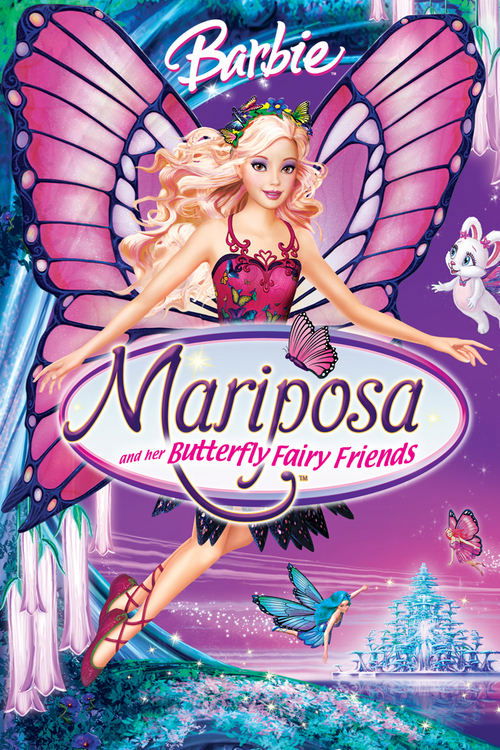
Barbie Mariposa (2008)
Directed by Conrad Helten
No — Barbie Mariposa is not woke, scoring 11 out of 100 on our wokeness meter.
Barbie Mariposa arrives from 2008 as the twelfth entry in the Mattel filmography and a spin-off of the Fairytopia trilogy.
Consciousness Markers
A female protagonist saves the kingdom and the cast is female-dominated, but this is a natural consequence of the Barbie brand rather than an articulated feminist thesis.
The tagline 'the most beautiful thing you can be is yourself' and the tiny-star lesson gesture at self-acceptance, but this is generic self-esteem messaging rather than a body-image or body-positivity agenda.
The film delivers a mild 'be yourself' moral, but it is woven into a children's adventure rather than delivered as a preachy lecture.
The voice cast is predominantly female and the protagonist is a female fairy, but there is no racial or ethnic diversity casting agenda at play in this animated Mattel production.
No LGBTQ+ characters, relationships, or themes appear anywhere in the film.
No engagement with race, racism, or racial identity; the fairies are fantasy creatures with no racial commentary.
No environmental or climate themes are present in the story.
No critique of capitalism, wealth, or class structures; the upper-class fairy sisters are comic foils, not targets of economic commentary.
Mariposa is introverted and prefers reading to socializing, but introversion is a personality trait, not a depiction of neurodivergence.
The film is a straightforward fantasy adventure with no historical revisionism or reframing of real events.
Why it received this score
Barbie Mariposa arrives from 2008 as the twelfth entry in the Mattel filmography and a spin-off of the Fairytopia trilogy. It conducts itself with the modest ambition of a direct-to-video product built to move a Magic Wings doll off the shelf. The heroine is a butterfly fairy who prefers reading and stargazing to the royal ball, a trait the film finds endearing and harmless. When the queen is poisoned, Mariposa is handed a map and a two-day deadline. The quest supplies mermaids, a cave of taunting reflections, a flying rabbit with a fondness for fluttercorn, and a villain named Henna who feeds fairies to nocturnal predators. The animation is functional. The stakes are low. The merchandising was extensive.
The cast is overwhelmingly female and the kingdom is saved without a male rescuer, though Prince Carlos exists mainly to share Mariposa's taste in books and to be locked in a cage for his own protection. This is the Barbie house style, not an articulated argument, and the film never pauses to make one. Its stated moral, printed on the cover and repeated by a tiny star that declines to align with its brighter neighbors, is that the most beautiful thing you can be is yourself. That is generic self-esteem boilerplate, administered softly enough that no child will register the instruction. Introversion gets similar treatment: a temperament, not a condition.
The omissions are just as legible. Nobody engages with race, since the fairies are fantasy creatures and the subject never surfaces. Nobody is gay. Nobody worries about money, even though two upper-class sisters named Rayna and Rayla serve as vain comic foils whose wealth goes unexamined. The environment is stable and unremarked upon. History is untouched. The residue is a harmless, professionally assembled bauble, pleasant enough for its intended audience, and eager above all to sell wings that open when you press a button.
Analysis generated by our Consciousness Algorithm


Synopsis
Elina, heroine of the Fairytopia films tells her friend Bibble the story of Flutterfield, a faraway kingdom populated by fairies with butterfly wings. Henna, the evil butterfly fairy has poisoned the queen of Flutterfield in an attempt to take over the kingdom.
Questions about Barbie Mariposa
Is Barbie Mariposa woke?
No — Barbie Mariposa is not woke, scoring 11 out of 100 on our wokeness meter. That earns it a verdict of Ultra Based.
Does Barbie Mariposa have any woke elements?
Very few. None of the 10 markers reaches 30, the level where a marker counts as present; the highest is Feminist Agenda at 25.
How does Barbie Mariposa compare to other 2008 movies?
It ranks #83 of the 212 films from 2008 we've scored; their average is 12. The wokest is Milk (68).
How is the Woke Score calculated?
An AI-assisted process researches the film and its reception, scores it 0–100 on ten markers, then combines those into one 0–100 Woke Score. It measures a specific set of 2020s cultural themes, not film quality.