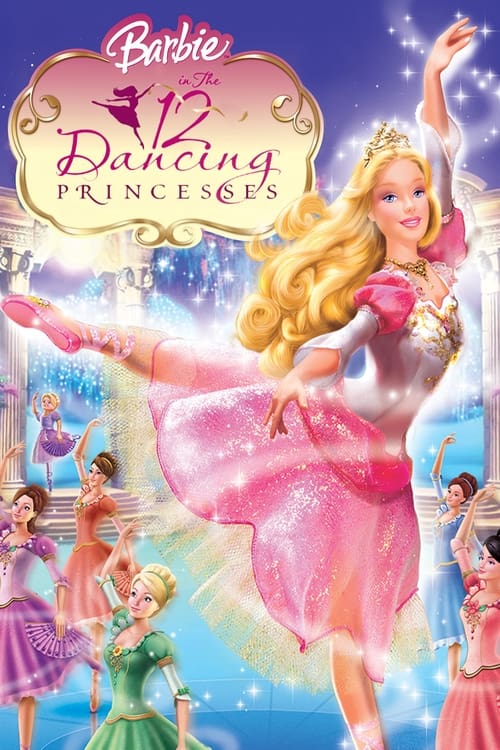
Barbie in the 12 Dancing Princesses (2006)
Directed by Greg Richardson
No — Barbie in the 12 Dancing Princesses is not woke, scoring 16 out of 100 on our wokeness meter.
A widowed king, twelve daughters, a scheming duchess, and a great deal of dancing.
Consciousness Markers
The film centers on twelve sisters resisting a woman who wants to force them into 'proper' ladylike roles, and it champions their right to pursue their own passion for dancing, though it resolves into a traditional wedding ending.
The film carries a mild, gentle moral about family love and staying true to oneself, but reviewers noted the lesson is vague and it is delivered through story rather than explicit preaching.
The twelve princesses and the entire principal cast are depicted as white European royalty with no meaningful racial or ethnic diversity in casting.
There are no LGBTQ+ characters, relationships, or themes; the romance is a conventional heterosexual pairing of Genevieve and Derek.
The film engages no racial themes, commentary, or consciousness whatsoever.
There is no environmental or climate-related messaging in the story.
The film contains no critique of wealth, capitalism, or class structures; it is itself a Mattel toy-driven commercial product.
No body positivity themes are present; the characters are uniformly slender fairy-tale princesses.
No neurodivergent characters or themes are depicted or referenced.
The film is a fantasy fairy-tale adaptation with no historical subject matter to revise.
Why it received this score
A widowed king, twelve daughters, a scheming duchess, and a great deal of dancing. Barbie in the 12 Dancing Princesses arrived in 2006 as the ninth entry in a franchise built to move dolls off shelves, and it does not pretend otherwise. Each sister is assigned a gemstone, a flower, and a name beginning with a successive letter of the alphabet, a system of categorization so tidy that it functions as its own merchandising spreadsheet. The studio's tie-in line included dolls of all twelve princesses and the cobbler, plus a carriage engineered to seat the entire set. The film is a commercial object and has the good sense not to apologize for it.
There is a modest current of social awareness running beneath the ballet. Duchess Rowena arrives to strip the palace of color, music, and joy, and her stated grievance is that the girls have unladylike hobbies and interests. Their defiance, their secret portal, their insistence on dancing, reads as a gentle argument for daughters pursuing their own passions against an authority figure who wants them decorative and compliant. It is a real theme, stated plainly. It also dissolves into a conventional wedding for Genevieve and Derek, which tends to undercut the rebellion it spent eighty minutes assembling.
The moral about family love and staying true to oneself is present but hazy, delivered through events instead of speeches, which spares us a sermon and also spares us a point. Reviewers at the time found the lesson vague, and they were correct. The villain dances out of the castle, the healing water revives the king, the sisters prevail. What stays with the viewer is the motion-captured ballet and the porcelain sheen of the animation, not a thesis. A harmless film. A tidy one. The classification, on this occasion, is brief.
Analysis generated by our Consciousness Algorithm


Synopsis
King Randolph sends for his cousin, Duchess Rowena, to help turn his daughters, Princess Genevieve and her eleven sisters, into royal material. But the Duchess strips the sisters of their fun, including their favorite pastime: dancing. When all hope may be lost, the sisters discover a secret passageway to a magical land where they can dance the night away.
Questions about Barbie in the 12 Dancing Princesses
Is Barbie in the 12 Dancing Princesses woke?
No — Barbie in the 12 Dancing Princesses is not woke, scoring 16 out of 100 on our wokeness meter. That earns it a verdict of Ultra Based.
Does Barbie in the 12 Dancing Princesses have any woke elements?
Very few. None of the 10 markers reaches 30, the level where a marker counts as present; the highest is Feminist Agenda at 25.
How does Barbie in the 12 Dancing Princesses compare to other 2006 movies?
It ranks #46 of the 211 films from 2006 we've scored; their average is 11. The wokest is An Inconvenient Truth (92).
How is the Woke Score calculated?
An AI-assisted process researches the film and its reception, scores it 0–100 on ten markers, then combines those into one 0–100 Woke Score. It measures a specific set of 2020s cultural themes, not film quality.