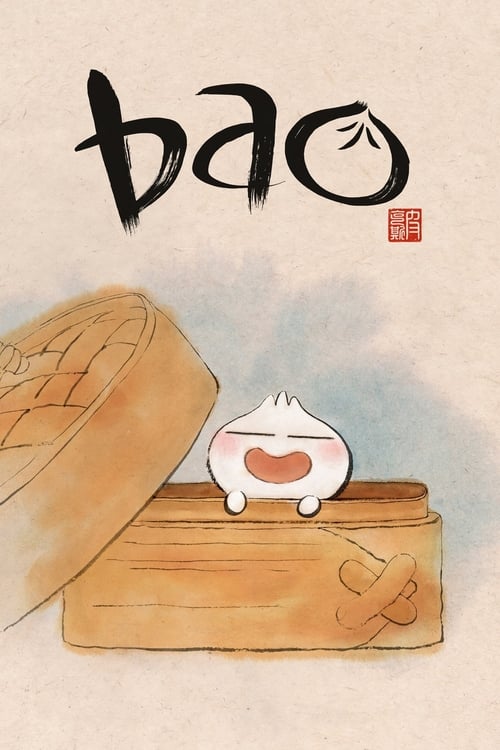
Bao (2018)
Directed by Domee Shi
No — Bao is not especially woke, scoring 32 out of 100 on our wokeness meter.
Bao arrives wordless, eight minutes long, and determined to make grown adults weep over a dumpling.
Consciousness Markers
Features an authentically rendered Chinese-Canadian family, and Shi explicitly cited the lack of Asian-American media as a motivation for the story's cultural specificity, though the cast is a natural fit rather than a diversity mandate on existing characters.
Deeply engaged with the Chinese-immigrant experience and cultural authenticity, with the crew consulting on Chinatown detail and production design; this is cultural specificity rather than racial-justice messaging, but it is deliberate and central.
Notable as the first Pixar short directed by a woman, and Shi deliberately centers the mother's interior emotional life as the protagonist; the female-authored perspective is real but the film's narrative agenda is maternal attachment, not gender politics.
The short is wordless and emotionally driven rather than preachy; any cultural significance is conveyed through imagery and detail rather than explicit sermonizing.
No LGBTQ+ characters, themes, or subtext appear anywhere in the short.
No environmental or climate themes are present.
An intimate family allegory with no economic or class critique whatsoever.
No body-positivity themes or messaging.
No neurodivergence themes or characters.
Not a historical narrative and makes no revisionist claims.
Why it received this score
Bao arrives wordless, eight minutes long, and determined to make grown adults weep over a dumpling. Domee Shi's short follows a Chinese-Canadian mother in Toronto whose steamed bun springs to life, grows into a boy, and is devoured in a single desperate gulp when he tries to leave. The film won an Academy Award, which is the industry's way of confirming that a mother eating her own child is acceptable so long as the child is dough. The cultural specificity is deliberate and sustained. Shi drew on her own upbringing, her mother consulted on bun-folding technique, and the production design fills the frame with rice cookers, foil-lined burners, and soy sauce bottles that read as observation instead of set dressing. The crew toured Chinatown kitchens for reference. The immigrant experience is the film's emotional engine, and it is rendered without a single line of dialogue. A viewer who has never seen a kitchen like this one may be confused. That is not the film's problem.
On the question of gender, the milestone is genuine: the first Pixar short directed by a woman. Shi also hands the interior life to the mother, who is granted grief, possessiveness, and a reconciliation that arrives through food. This is a maternal portrait, not a thesis on patriarchy, and it never stops to explain itself. The short has no interest in economic critique, climate anxiety, body politics, or neurological taxonomy. It wants to tell a story about a woman who cannot let go, and it does so in images, which spares us the sermon.
The restraint is the achievement. A lesser production would have added narration. The ending is dark, and the film calls it love. The distinction is the whole point, and Shi commits to it without flinching.
Analysis generated by our Consciousness Algorithm
Part of

Synopsis
An aging Chinese mother suffering from empty nest syndrome gets another chance at motherhood when one of her dumplings springs to life as a lively, giggly dumpling boy.
Questions about Bao
Is Bao woke?
No — Bao is not especially woke, scoring 32 out of 100 on our wokeness meter. That earns it a verdict of Based.
Does Bao have any woke elements?
3 of the 10 markers register at 30 or above, led by Racial Consciousness (60), Representation Casting (60) and Feminist Agenda (30). On Racial Consciousness: Deeply engaged with the Chinese-immigrant experience and cultural authenticity, with the crew consulting on Chinatown detail and production design; this is cultural specificity rather than racial-justice messaging, but it is deliberate and central.
How does Bao compare to other 2018 movies?
It ranks #66 of the 325 films from 2018 we've scored; their average is 20. The wokest is Return (92).
How is the Woke Score calculated?
An AI-assisted process researches the film and its reception, scores it 0–100 on ten markers, then combines those into one 0–100 Woke Score. It measures a specific set of 2020s cultural themes, not film quality.