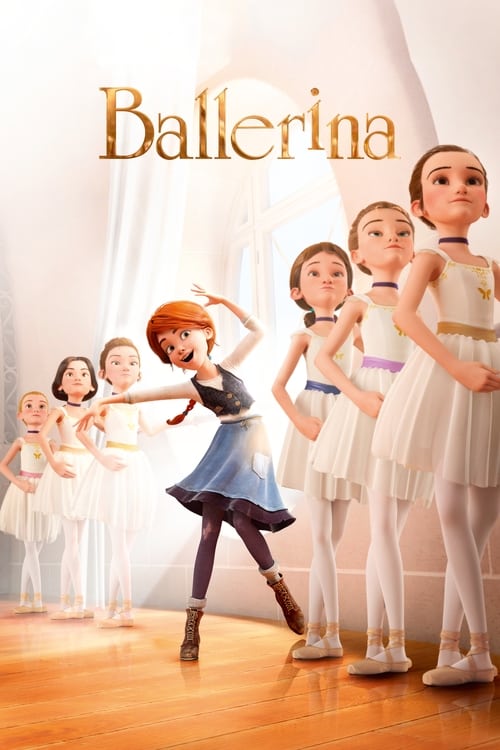
Ballerina (2016)
Directed by Eric Summer
No — Ballerina is not woke, scoring 11 out of 100 on our wokeness meter.
Ballerina opens in 1879 Brittany and moves briskly to Paris, where an eleven-year-old orphan named Félicie lies her way into the ballet school of the Paris Opera by intercepting another girl's acceptance letter.
Consciousness Markers
The story centers on a determined orphan girl and a female mentor, but its girl-empowerment arc is conventional and lacks explicit feminist critique.
Inspirational speeches about following one's passion are present, but they are generic children's-film uplift rather than social lecturing.
The cast and characters are overwhelmingly white in a period French setting; no meaningful diverse or inclusive casting choices are present.
No LGBTQ+ characters, relationships, or themes appear.
The film does not engage with race, racial identity, or racial justice themes.
There is no environmental or climate-related content.
A wealthy antagonist exists, but the film offers no systemic critique of capitalism or class economics.
Despite its ballet setting, the film does not address body image, body acceptance, or body positivity.
No neurodivergent characters or themes are present.
The 1880s Paris setting is fictionalized but not a revisionist historical narrative.
Why it received this score
Ballerina opens in 1879 Brittany and moves briskly to Paris, where an eleven-year-old orphan named Félicie lies her way into the ballet school of the Paris Opera by intercepting another girl's acceptance letter. The film is a Canadian and French co-production, competently animated, and entirely uninterested in the cultural questions that occupy the current decade. Its engine is pluck. Its fuel is a music box.
The empowerment arc is present, and tame. A determined girl and a limping former prima ballerina mentor her, and the choreographer eventually asks the two rivals why they dance. That scene is the closest the film comes to a thesis, and the thesis is that passion beats privilege. It is charming, and it is also the standard children's-film uplift, delivered without a word about the institution that handed the wealthy girl her place to begin with. The wealthy villainess is punished for being rude, not for being rich. Ballet, a discipline with a long and documented relationship to body image, is depicted here as a meritocracy of the heart; the film never once considers a body that does not conform. There is no racial consciousness, no queer presence, no climate anxiety, no neurodivergent character, and no revisionist reading of the 1880s. The cast is white, the story is white, and the Eiffel Tower and the Statue of Liberty appear as scenery, not as symbols awaiting interrogation.
Strip away the absent markers and a pleasant, well-executed confection remains, the sort children enjoy and adults forgive. A sequel and a television series are planned. The culture will have moved on by then. The ballet shoes will not.
Analysis generated by our Consciousness Algorithm


Synopsis
In 1879 Paris, a young orphan dreams of becoming a ballerina and flees her rural Brittany for Paris, where she passes for someone else and accedes to the position of pupil at the Grand Opera house.
Questions about Ballerina
Is Ballerina woke?
No — Ballerina is not woke, scoring 11 out of 100 on our wokeness meter. That earns it a verdict of Ultra Based.
Does Ballerina have any woke elements?
Very few. None of the 10 markers reaches 30, the level where a marker counts as present; the highest is Feminist Agenda at 15.
How does Ballerina compare to other 2016 movies?
It ranks #144 of the 285 films from 2016 we've scored; their average is 16. The wokest is 13th (92).
How is the Woke Score calculated?
An AI-assisted process researches the film and its reception, scores it 0–100 on ten markers, then combines those into one 0–100 Woke Score. It measures a specific set of 2020s cultural themes, not film quality.