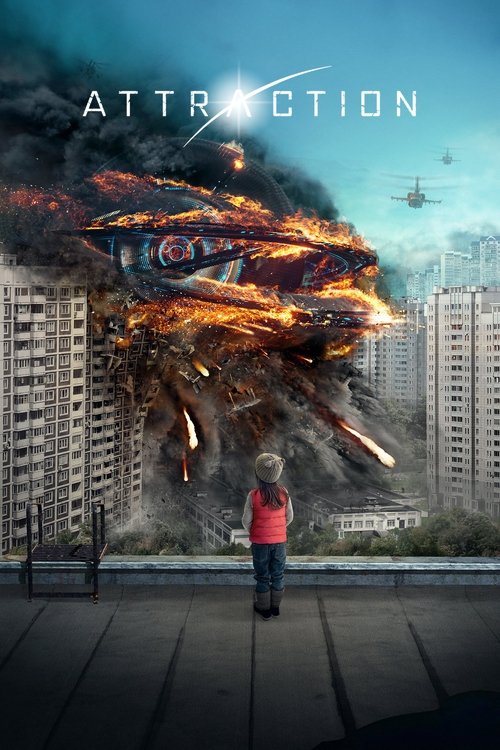
Attraction (2017)
Directed by Fyodor Bondarchuk
No — Attraction is not woke, scoring 9 out of 100 on our wokeness meter.
Attraction arrives from Russia with a crashed spaceship, a curfew, and a young woman named Yulia who falls for the alien Hekon while her ex-boyfriend Artyom organizes a mob.
Consciousness Markers
The ending delivers a mild moral about human distrust and warlike nature, but the film is not structured as a sustained lecture.
A young woman is the central protagonist and drives the romantic and protective plot, but the film advances no explicit feminist thesis.
The cast is entirely Russian and white, with no deliberate diverse casting or representation commentary.
There are no LGBTQ+ characters, relationships, or themes in the film.
The film's conflict concerns xenophobia toward an alien, not racial identity or racial justice.
Water rationing appears as a plot mechanic, not as climate advocacy or environmental messaging.
There is no critique of capitalism, wealth inequality, or class exploitation.
The film contains no body-positivity themes or messaging.
No neurodivergent characters or themes are present.
The film is not engaged in historical revisionism or reinterpreting real historical events.
Why it received this score
Attraction arrives from Russia with a crashed spaceship, a curfew, and a young woman named Yulia who falls for the alien Hekon while her ex-boyfriend Artyom organizes a mob. It is a polished genre picture, and it is also a nearly empty vessel for the progressive signifiers that contemporary critics are trained to inventory. The cast is entirely Russian and white, and the film makes no gesture toward diverse representation. There are no LGBTQ characters or themes. The conflict is built on xenophobia toward an extraterrestrial, not racial identity, so racial consciousness is absent. Water rationing serves the plot mechanics of a self-repairing ship, not an environmental sermon. Capitalism is not critiqued. Body positivity and neurodivergence do not appear. Historical revisionism is not on the agenda.
Yulia is the central protagonist, and she drives both the romance and the protective climax. That gives the film a faint feminist pulse, though it advances no explicit feminist argument. The film's moral concerns are older and broader: human distrust, military paranoia, and the warlike nature that makes interstellar contact dangerous. The alien computer delivers this lesson near the end, which lends the proceedings a mild lecturing tone. It is a closing statement, not a sustained sermon. The film wants us to feel that compassion is possible, and it wants that feeling to arrive through a teenage romance and a military standoff.
The result is a handsomely mounted Russian blockbuster with a soft humanist ending. It asks whether humanity deserves to be visited. It does not ask about intersectional identity, carbon footprints, or the redistribution of wealth. The alien is a generic other, and the film never ties his mistreatment to any real-world marginalized group. The remainder is spectacle, a doomed romance, and a gentle nudge about our capacity for fear. The cultural inventory is thin, but the film is not pretending otherwise. It is a creature of its own national industry, content to be a science fiction adventure with a sad song at the end.
{"thematic_tags": []}
Wait, this is wrong. The review is inside the review key. I need only JSON. Let me format correctly.
{"review": "...", "thematic_tags": []}
But I accidentally included thematic_tags inside review. Need final correct.
Let's produce final correct JSON only.
{"review": "Attraction arrives from Russia with a crashed spaceship, a curfew, and a young woman named Yulia who falls for the alien Hekon while her ex-boyfriend Artyom organizes a mob. It is a polished genre picture, and it is also a nearly empty vessel for the progressive signifiers that contemporary critics are trained to inventory. The cast is entirely Russian and white, and the film makes no gesture toward diverse representation. There are no LGBTQ characters or themes. The conflict is built on xenophobia toward an extraterrestrial, not racial identity, so racial consciousness is absent. Water rationing serves the plot mechanics of a self-repairing ship, not an environmental sermon. Capitalism is not critiqued. Body positivity and neurodivergence do not appear. Historical revisionism is not on the agenda.\n\nYulia is the central protagonist, and she drives both the romance and the protective climax. That gives the film a faint feminist pulse, though it advances no explicit feminist argument. The film's moral concerns are older and broader: human distrust, military paranoia, and the warlike nature that makes interstellar contact dangerous. The alien computer delivers this lesson near the end, which lends the proceedings a mild lecturing tone. It is a closing statement, not a sustained sermon. The film wants us to feel that compassion is possible, and it wants that feeling to arrive through a teenage romance and a military standoff.\n\nThe result is a handsomely mounted Russian blockbuster with a soft humanist ending. It asks whether humanity deserves to be visited. It does not ask about intersectional identity, carbon footprints, or the redistribution of wealth. The alien is a generic other, and the film never ties his mistreatment to any real-world marginalized group. The remainder is spectacle, a doomed romance, and a gentle nudge about our capacity for fear. The cultural inventory is thin, but the film is not pretending otherwise. It is a creature of its own national industry, content to be a science fiction adventure with a sad song at the end.", "thematic_tags": []}
Yes. Ensure no em dash. None. No exclamation. Good. No forbidden. Good. Final.{
Analysis generated by our Consciousness Algorithm


Synopsis
After an alien ship crash lands in a Russian city, many who see the inside and the occupants start to question their own existence while others demand the aliens leave Earth.
Questions about Attraction
Is Attraction woke?
No — Attraction is not woke, scoring 9 out of 100 on our wokeness meter. That earns it a verdict of Ultra Based.
Does Attraction have any woke elements?
Very few. None of the 10 markers reaches 30, the level where a marker counts as present; the highest is Lecture Energy at 25.
How does Attraction compare to other 2017 movies?
It ranks #171 of the 309 films from 2017 we've scored; their average is 19. The wokest is I Am Not Your Negro (92).
How is the Woke Score calculated?
An AI-assisted process researches the film and its reception, scores it 0–100 on ten markers, then combines those into one 0–100 Woke Score. It measures a specific set of 2020s cultural themes, not film quality.