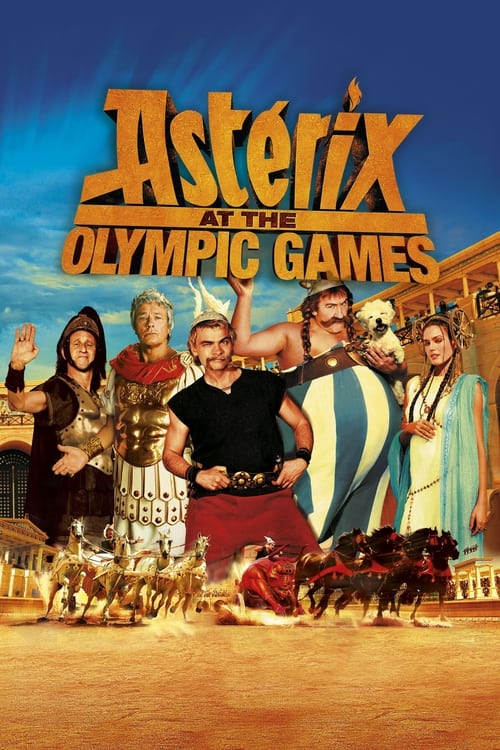
Asterix at the Olympic Games (2008)
Directed by Thomas Langmann
No — Asterix at the Olympic Games is not woke, scoring 0 out of 100 on our wokeness meter.
Asterix at the Olympic Games arrived in 2008 with the weight of a national treasury behind it, the most expensive French production of its moment, and the third entry in a live-action series that had already established Depardieu's Obelix as an institution.
Consciousness Markers
The cast is a uniformly white European ensemble of French, Italian, and Spanish actors; no diversity-conscious casting agenda is present.
No LGBTQ+ characters, themes, or subtext appear anywhere in the film.
Princess Irina functions purely as a romantic prize to be won; there is no feminist framing or commentary.
The film engages no racial themes or identity politics whatsoever.
No environmental or climate concerns are raised in this Olympic comedy.
The plot concerns athletic competition and palace intrigue, with no economic critique of wealth or capitalism.
Obelix's girth is played for slapstick laughs rather than any body-acceptance message.
No neurodivergent characters or themes are present.
The film is a fantasy farce set in a cartoon antiquity, not a revisionist account of real historical events.
This is broad slapstick comedy with no didactic or preachy messaging of any kind.
Why it received this score
Asterix at the Olympic Games arrived in 2008 with the weight of a national treasury behind it, the most expensive French production of its moment, and the third entry in a live-action series that had already established Depardieu's Obelix as an institution. The plot is a straightforward errand: two Gauls travel to Greece to win laurels so that a young friend may marry a princess. Brutus schemes against his father. Alain Delon, in his final screen performance, lends the proceedings a certain marble dignity that the script does not deserve.
The cultural inventory here is barren, and the barrenness is a matter of genre, not of failure. The casting is a uniformly European affair, French and Italian and Spanish names filling a roster that no one assembled with an eye toward anything but box office. Princess Irina exists as a prize, a wedding at the end of the race, and the film never pretends otherwise. Obelix's bulk is a punchline, hauled out whenever a scene needs a laugh, and no one involved appears to have considered that a message might be extracted from it. The parade of sports celebrities (Schumacher, Zidane, Parker, Mauresmo) is spectacle, not statement.
What the film offers instead is slapstick, wild boar, and a magic potion. It lectures no one. There is no thesis to deliver, no lesson appended to the final reel, no moral instruction smuggled into the closing ceremony. In an era that increasingly treats comedy as a delivery mechanism for instruction, this one simply wants to show a large man punching a Roman. There is something almost restful in that. The film was not good, and its critics said so at length. But it was, by the standards of its own ambitions, complete. A relic from an age when a French farce could cost a fortune and ask nothing of the viewer but laughter.
Analysis generated by our Consciousness Algorithm
Part of


Synopsis
Astérix and Obélix have to win the Olympic Games in order to help their friend Alafolix marry Princess Irina. Brutus uses every trick in the book to have his own team win the game, and get rid of his father Julius Caesar in the process.
Questions about Asterix at the Olympic Games
Is Asterix at the Olympic Games woke?
No — Asterix at the Olympic Games is not woke, scoring 0 out of 100 on our wokeness meter. That earns it a verdict of Ultra Based.
Does Asterix at the Olympic Games have any woke elements?
No. All 10 markers score zero.
How does Asterix at the Olympic Games compare to other 2008 movies?
It ranks #175 of the 212 films from 2008 we've scored; their average is 12. The wokest is Milk (68).
Is Asterix at the Olympic Games the most woke Asterix & Obelix (Live Action) movie?
No. It ranks #3 of the 5 Asterix & Obelix (Live Action) films we've scored; the wokest is Asterix & Obelix: The Middle Kingdom (28).