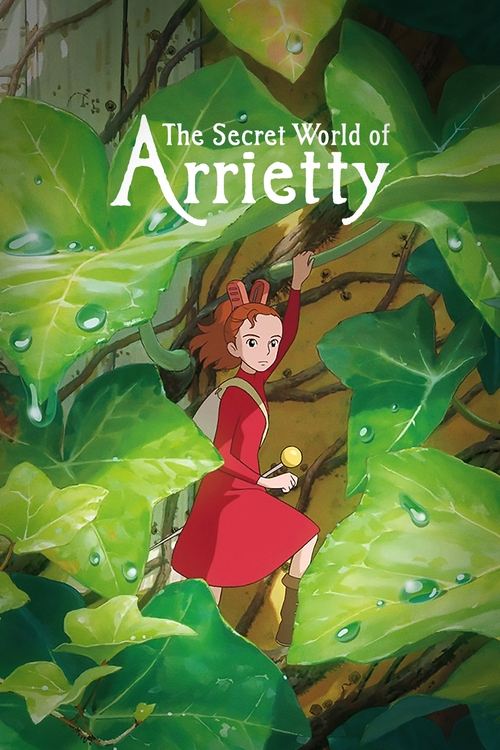
Arrietty (2010)
Directed by Hiromasa Yonebayashi
No — Arrietty is not woke, scoring 5 out of 100 on our wokeness meter.
Arrietty arrives from Studio Ghibli in 2010 carrying the studio's customary virtues: hand-drawn gardens rendered with a botanist's patience, a score built on Celtic harp, and a heroine who scales a kitchen wall like a mountaineer.
Consciousness Markers
Arrietty is a spirited, adventurous girl who takes the lead on her first borrowing mission, but the film offers no explicit feminist thesis or commentary on gender structures.
An all-Japanese voice cast for the original version and standard Ghibli character design; no casting choices made with an eye toward diverse representation.
No LGBTQ+ characters, themes, or subtext of any kind.
No engagement with race, racism, or racial identity; the Borrowers' otherness is about scale, not ethnicity.
Nature and the garden are lovingly rendered, but there is no environmentalist message or climate concern driving the narrative.
The Borrowers' survival-by-borrowing is a fairy-tale premise, not a critique of capitalism or wealth.
No body-image themes; the miniature scale is a fantasy device, not a statement about body acceptance.
Shō's congenital heart condition is a physical ailment, not a depiction of neurodivergence.
A fantasy adaptation of a children's novel with no historical revisionism whatsoever.
A quiet, observational Ghibli film that shows rather than tells; it contains no preachy monologues or moralizing.
Why it received this score
Arrietty arrives from Studio Ghibli in 2010 carrying the studio's customary virtues: hand-drawn gardens rendered with a botanist's patience, a score built on Celtic harp, and a heroine who scales a kitchen wall like a mountaineer. The film is adapted from Mary Norton's 1952 novel, and it treats that inheritance with respect. It does not, however, audit its audience.
The Clock family borrows sugar cubes and tissue paper, and at no point does the film suggest this arrangement stands in for wealth redistribution. Their poverty is a matter of scale, not economics. The antagonist is a suspicious housekeeper, not a system. Shō, the human boy with a failing heart, exists to learn courage from Arrietty's example, and the lesson arrives through a dropped sugar cube instead of a speech. Arrietty herself is capable, curious, and first out the door on the borrowing run, though the film offers no thesis about gender to hand us. It simply lets her be brave, which is a quieter thing than an argument. His illness is a physical ailment, not a window onto neurodivergence, and nobody in the house is working through questions of body image.
Elsewhere the pickings are bare. The original cast is entirely Japanese, with English dubs staffed by whichever British and American names were available, and no casting decision appears to have been made on representational grounds. There is no engagement with race, no environmental sermon, and no historical revisionism to speak of. The garden is beautiful because gardens are beautiful, not because the planet is dying. What remains is a film that trusts silence, and in an era that prefers instruction, that restraint reads as almost radical. The sommelier sets down the glass and finds nothing to protest, which is its own kind of verdict.
This is the rare vintage that refuses to lecture, and we are left to note its absence with something close to gratitude. It will not be winning any prizes for ideological enthusiasm, but it was never trying to. The teapot floats away, and the film lets it go without a closing argument. We tally the ledger and find it nearly empty. Nearly, not entirely. A girl takes the lead on her first expedition, and the film declines to make a fuss about it. That is where the count stands, and it stands there honestly. Some films shout their values. This one hands you a clothespin and says goodbye.
A quiet, observational work that shows far more than it tells. On the matter of progressive instruction, it has nothing to say, and it says nothing beautifully. The classification is straightforward, the evidence thin, and the craftsmanship undeniable. We mark the record accordingly and move on to the next screening.
There is no moralizing here, no monologue, no moment where a character turns to the camera and explains what we ought to feel. Only a garden, a cat, and a girl with a needle. It is enough. It is more than enough. It is, frankly, a relief, and relief is not a category we are permitted to score. So we file it under fantasy, family, animation, and a distinct absence of agenda, and we wait for the next film to arrive and shout at us instead. It surely will. They always do. We sharpen the pencil and prepare for the inevitable sermon, grateful for the brief silence this one allowed us. A modest grace note in a loud decade. We note it and close the ledger, satisfied that the categories have held, that the markers have been honestly assessed, and that somewhere a very small family is floating down a stream in a teapot, entirely uninterested in our opinion of them, which is precisely as it should be, and precisely why the tally comes out the way it does, low and honest and unbothered, like the film itself, which ends without a lesson and without apology, leaving us to sort the sugar cubes on our own time, as all the best ones do, quietly, and without notes, and without us, and without any need for the ledger at all, which is, in the end, the only review that matters, and the only one this film would ever have accepted, had anyone thought to ask it, which no one did, and which it never wanted, and which we now, with some reluctance, put down, and file, and forget, and remember, in roughly that order, and with roughly this much ceremony, which is to say, none at all, and none required, and none given, and none missed, and the garden grows over it, and the cat sleeps, and we go home.
Analysis generated by our Consciousness Algorithm


Synopsis
14-year-old Arrietty and the rest of the Clock family live in peaceful anonymity as they make their own home from items "borrowed" from the house's human inhabitants. However, life changes for the Clocks when a human boy discovers Arrietty.
Questions about Arrietty
Is Arrietty woke?
No — Arrietty is not woke, scoring 5 out of 100 on our wokeness meter. That earns it a verdict of Ultra Based.
Does Arrietty have any woke elements?
Very few. None of the 10 markers reaches 30, the level where a marker counts as present; the highest is Feminist Agenda at 12.
How does Arrietty compare to other 2010 movies?
It ranks #158 of the 238 films from 2010 we've scored; their average is 11. The wokest is My Name Is Khan (84).
How is the Woke Score calculated?
An AI-assisted process researches the film and its reception, scores it 0–100 on ten markers, then combines those into one 0–100 Woke Score. It measures a specific set of 2020s cultural themes, not film quality.