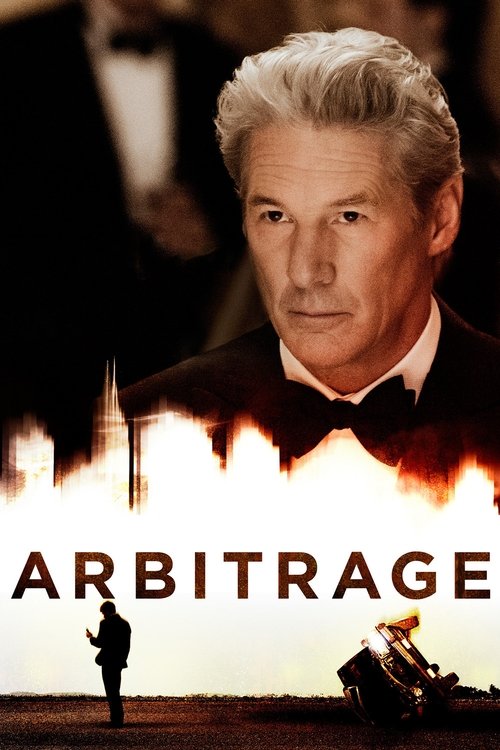
Arbitrage (2012)
Directed by Nicholas Jarecki
No — Arbitrage is not especially woke, scoring 22 out of 100 on our wokeness meter.
Nicholas Jarecki's Arbitrage opens on Richard Gere's Robert Miller, a hedge fund magnate with the polished, hollowed-out calm of a man who has never once been told no by anyone who mattered.
Consciousness Markers
The film is a sustained indictment of Wall Street fraud, hedge-fund greed, and the wealthy elite escaping consequences, with the magnate's corruption driving the entire plot.
The cast includes Nate Parker in a substantial role and a generally diverse ensemble, but the film casts them naturally without any commentary on representation.
Nate Parker's Jimmy Grant, a Black chauffeur's son, is exploited by a wealthy white financier to cover up a crime, lending a racial subtext of privilege and loyalty, though the film never explicitly frames it as such.
Susan Sarandon's Ellen and Brit Marling's Brooke are given agency and drive the plot's final turn, but the film is a character study of a male antihero rather than a feminist statement.
The film operates as a tense thriller and character study, showing moral rot rather than preaching about it, keeping didacticism low.
No LGBTQ+ characters or themes appear anywhere in the film.
No environmental or climate themes are present.
No body-positivity themes or messaging appear.
No neurodivergence themes or characters are present.
The film is a fictional story with no historical revisionism.
Why it received this score
Nicholas Jarecki's Arbitrage opens on Richard Gere's Robert Miller, a hedge fund magnate with the polished, hollowed-out calm of a man who has never once been told no by anyone who mattered. He is selling his empire, cooking the books to hide a four-hundred-million-dollar hole, and conducting an affair with a younger gallery owner whose phone calls he ignores at exactly the wrong moment. When a car crash kills her and leaves him bleeding in the dark, he does what men of his class have always done: he calls someone poorer, in this case Jimmy Grant, the son of his late chauffeur, and lets loyalty do the rest. The film tracks the cover-up with the patience of a man filing paperwork. It never raises its voice. That restraint is its chief virtue and, for our purposes, its chief limitation.
The class critique here is real and sustained. Miller's fraud, his lender's impatience, the buyer who reviews a damning second audit and decides the optics of scrutiny are worse than the crime, all of it forms a tidy indictment of wealth protecting itself. Susan Sarandon's Ellen and Brit Marling's Brooke eventually seize leverage and reshape the ending, which earns the film some credit on that front. Nate Parker's Jimmy, exploited to shield a white financier from consequence, carries a racial subtext the screenplay declines to name. The ensemble is diverse in a manner that feels like casting rather than commentary. There is no romantic subplot for anyone but the protagonist, and no lecture. The film prefers to let corruption simply walk to a podium and smile.
What we have, then, is a well-made thriller about a bad man escaping justice, made in 2012, before such stories required a closing statement. It observes rot instead of explaining it. That keeps the sermonizing to a minimum and the moral accounting squarely in the viewer's lap. A sommelier might call this a restrained vintage. It pairs well with cynicism and goes down without a single speech about the system.
Analysis generated by our Consciousness Algorithm


Synopsis
A troubled hedge fund magnate, desperate to complete the sale of his trading empire, makes an error that forces him to turn to an unlikely person for help.
Questions about Arbitrage
Is Arbitrage woke?
No — Arbitrage is not especially woke, scoring 22 out of 100 on our wokeness meter. That earns it a verdict of Based.
Does Arbitrage have any woke elements?
1 of the 10 markers register at 30 or above, led by Eat the Rich (55). On Eat the Rich: The film is a sustained indictment of Wall Street fraud, hedge-fund greed, and the wealthy elite escaping consequences, with the magnate's corruption driving the entire plot.
How does Arbitrage compare to other 2012 movies?
It ranks #37 of the 230 films from 2012 we've scored; their average is 12. The wokest is Killing Them Softly (92).
How is the Woke Score calculated?
An AI-assisted process researches the film and its reception, scores it 0–100 on ten markers, then combines those into one 0–100 Woke Score. It measures a specific set of 2020s cultural themes, not film quality.