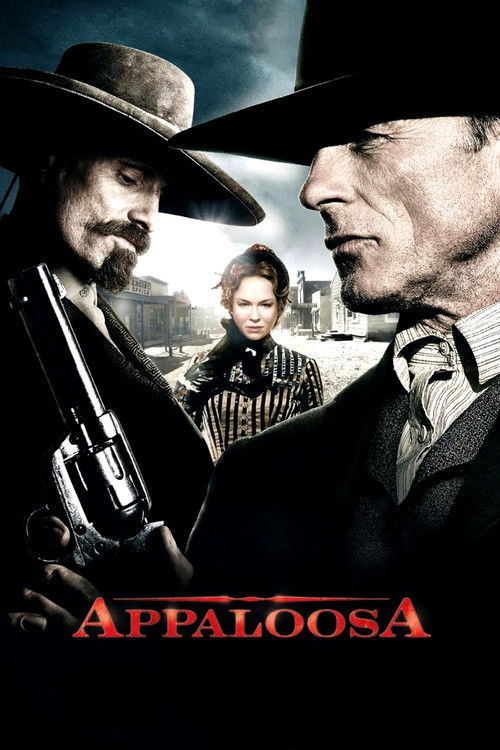
Appaloosa (2008)
Directed by Ed Harris
No — Appaloosa is not woke, scoring 2 out of 100 on our wokeness meter.
Ed Harris directs Appaloosa the way a man builds a linen cabinet: carefully, with visible affection for the grain, and with no interest whatsoever in what the neighbors think of it.
Consciousness Markers
The cast is overwhelmingly white, with Ariadna Gil as a prostitute and a brief appearance by Chiricahua raiders as antagonists; no meaningful diverse casting or commentary.
No LGBTQ+ characters or themes whatsoever; the central relationship is a guarded male friendship and a heterosexual love triangle.
Allie French is written as a promiscuous widow whose infidelity is framed as a survival trait to be tolerated by the men; this is a traditional Western treatment, not a feminist one.
The Chiricahua appear only as a momentary obstacle to be bought off with a horse; no engagement with race as a theme.
No environmental or climate content of any kind.
Bragg's rancher-turned-hotelier power is a plot device of frontier corruption, not a critique of capitalism; no eat-the-rich messaging.
No body positivity themes present.
No neurodivergent characters or themes.
Harris explicitly aimed to make a traditional, old-fashioned Western rather than a revisionist one, and the film follows classic genre conventions.
A quiet, character-driven genre piece with no didactic or preachy messaging.
Why it received this score
Ed Harris directs Appaloosa the way a man builds a linen cabinet: carefully, with visible affection for the grain, and with no interest whatsoever in what the neighbors think of it. He has said plainly that he wanted the old-fashioned article, citing My Darling Clementine and The Man Who Shot Liberty Valance, and he delivered it. Two lawmen ride into a New Mexico town, a rancher has gone bad, a widow complicates the arithmetic. The film runs on the unspoken comradeship between Virgil Cole and Everett Hitch, a friendship conducted almost entirely in glances and half-finished sentences. It is a quiet, well-made genre piece, and it knows exactly what it is.
The cast is white and the era is 1882, which the film treats as a matter of wardrobe and horseflesh. Ariadna Gil appears as Katie, a prostitute with a few lines and a sympathetic ear. A band of Chiricahua raiders arrives late, is bought off with a horse, and departs. No comment is offered on any of it, and none is asked for. Renee Zellweger's Allie French is a provocative widow whose infidelities the screenplay frames as survival instincts, a thing Cole must learn to tolerate. The movie regards this as wisdom about human nature. A modern production might have interrogated it. This one pats it on the shoulder and pours it a drink.
There is no sermon here, no cause, no lesson about the climate or the market or the body or the mind. Harris has made a Western that could have been released in 1962, and the only revision on offer is a slightly warmer regard for a woman's appetites. The result is pleasant, unhurried, and almost entirely free of contemporary conscience. We file it accordingly, with a small allowance for the presence of a Spanish actress in a frontier bordello. It is a vintage that tastes of leather and dust, and there is nothing in the glass that will trouble anyone's dinner party.
Analysis generated by our Consciousness Algorithm


Synopsis
Two friends hired to police a small town that is suffering under the rule of a rancher find their job complicated by the arrival of a young widow.
Questions about Appaloosa
Is Appaloosa woke?
No — Appaloosa is not woke, scoring 2 out of 100 on our wokeness meter. That earns it a verdict of Ultra Based.
Does Appaloosa have any woke elements?
Very few. None of the 10 markers reaches 30, the level where a marker counts as present; the highest is Representation Casting at 5.
How does Appaloosa compare to other 2008 movies?
It ranks #168 of the 212 films from 2008 we've scored; their average is 12. The wokest is Milk (68).
How is the Woke Score calculated?
An AI-assisted process researches the film and its reception, scores it 0–100 on ten markers, then combines those into one 0–100 Woke Score. It measures a specific set of 2020s cultural themes, not film quality.