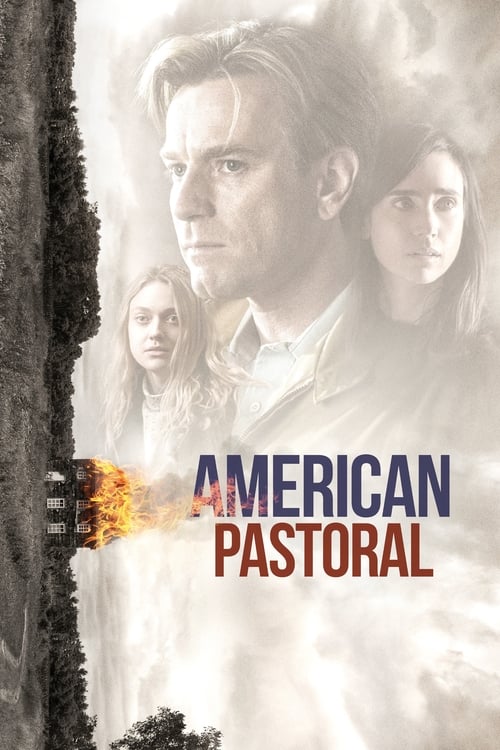
American Pastoral (2016)
Directed by Ewan McGregor
No — American Pastoral is not woke, scoring 11 out of 100 on our wokeness meter.
Ewan McGregor's American Pastoral arrives with the grave self-importance of a Philip Roth adaptation and the visual palette of a premium cable rerun.
Consciousness Markers
Merry's pronounced stutter is a central character trait and plot device, giving the film a genuine depiction of a communication disorder, though not framed in advocacy terms.
The cast includes Uzo Aduba as a glove-factory employee and a Jewish-American family at its center, but these are natural story elements rather than deliberate representational casting.
The 1967 Newark riots and Jewish identity figure in the backdrop, but the film treats race as setting rather than a consciousness-raising theme.
Merry's anarchist radicalism and the glove-factory setting touch on class and capital, but the film frames her politics as destructive rather than endorsing an anti-capitalist critique.
The political backdrop of Vietnam-era radicalism is present, but the film is a somber family drama rather than a preachy message piece.
Dawn and Merry have agency, but the film is fundamentally the father's tragedy; the women are largely defined by their roles as wife and radicalized daughter.
No LGBTQ+ characters or themes appear anywhere in the narrative.
No environmental or climate themes are present.
No body-positivity themes; Dawn's facelift is treated as a symptom of breakdown, not a body-acceptance statement.
The film is a fictional adaptation of a novel set against real events (Vietnam, Newark riots) but makes no revisionist historical claims.
Why it received this score
Ewan McGregor's American Pastoral arrives with the grave self-importance of a Philip Roth adaptation and the visual palette of a premium cable rerun. It follows Swede Levov, a Jewish glove manufacturer in postwar New Jersey, whose daughter Merry turns from stuttering child to antiwar anarchist to fugitive. The film treats this as a national tragedy filtered through one family's dining room. The social consciousness on display is mostly atmospheric: the Newark riots, Vietnam protests, and Jewish assimilation anxiety are present as weather, not argument. There is no LGBTQ thread, no climate sermon, no body-acceptance subplot. The camera does not lecture. It mourns.
Representation is incidental. Uzo Aduba appears as a factory employee with dignity and little screen time. The Levovs are Jewish, and that identity matters, though the film does not turn it into a thesis. Merry's stutter gives the story a genuine communication disorder, handled as character detail instead of advocacy. Her anarchist politics brush against class and capital, but the film frames her violence as domestic wreckage, not a call to dismantle the glove trade. Dawn gets a facelift and an affair, which the film treats as breakdown, not empowerment. The women have moments of agency, yet the emotional ledger belongs to the father. His suffering is the point.
The result is a film that wants to be about the shattered American century but settles for a sad man standing outside an abandoned house. It has progressive ingredients without progressive conviction. The politics are period decoration. The tragedy is personal. McGregor directs with a straight face and a heavy heart, which is admirable in a modest way. The film never becomes a sermon, never demands that we adjust our vocabulary, never suggests that the republic can be saved by a revised cast list. It simply watches a family come apart. As a cultural artifact, it is mild, melancholic, and mostly harmless. As a classification exercise, it is a low-yield vintage: some notes of social awareness, no lingering finish.
Analysis generated by our Consciousness Algorithm
Part of


Synopsis
Set in postwar America, a man watches his seemingly perfect life fall apart as his daughter's new political affiliation threatens to destroy their family.
Questions about American Pastoral
Is American Pastoral woke?
No — American Pastoral is not woke, scoring 11 out of 100 on our wokeness meter. That earns it a verdict of Ultra Based.
Does American Pastoral have any woke elements?
Very few. None of the 10 markers reaches 30, the level where a marker counts as present; the highest is Neurodivergence at 20.
How does American Pastoral compare to other 2016 movies?
It ranks #144 of the 285 films from 2016 we've scored; their average is 16. The wokest is 13th (92).
How is the Woke Score calculated?
An AI-assisted process researches the film and its reception, scores it 0–100 on ten markers, then combines those into one 0–100 Woke Score. It measures a specific set of 2020s cultural themes, not film quality.