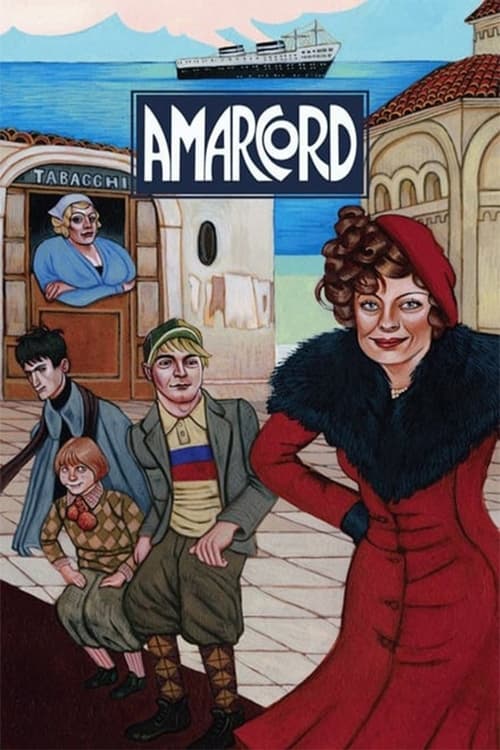
Amarcord (1973)
Directed by Federico Fellini
No — Amarcord is not woke, scoring 6 out of 100 on our wokeness meter.
Fellini's Amarcord arrives from 1973, which is to say from before the current vocabulary existed, and it wears that antiquity without apology.
Consciousness Markers
The film mocks Fascist pomposity and briefly features a gramophone playing 'The Internationale' and an anarchist father, but this is anti-Fascist satire, not a modern eat-the-rich economic critique.
Fellini skewers Fascist schooling and Church hypocrisy through comic vignettes rather than direct moralizing; the didacticism is diffuse and satirical.
A 1973 Italian production cast largely with non-professionals and locals of various shapes and sizes; there is no modern representation-casting agenda at work.
No LGBTQ+ characters or themes appear; the film's sexual content is entirely heterosexual adolescent fantasy.
Women are presented as objects of the adolescent male gaze (Gradisca, the tobacconist); the film is ribald and nostalgic rather than feminist.
No engagement with race or racial politics; the film concerns an insular Italian village.
No environmental or climate themes whatsoever.
The buxom tobacconist and varied bodies are played for bawdy comedy, not body-positivity advocacy.
Uncle Teo's confinement in an asylum is treated as tragicomic spectacle, not as neurodivergence advocacy.
A semi-autobiographical memory piece, not a revisionist reframing of historical record.
Why it received this score
Fellini's Amarcord arrives from 1973, which is to say from before the current vocabulary existed, and it wears that antiquity without apology. The film is a memory piece, a year in the life of a Rimini-adjacent village under Mussolini, structured by seasons and by the poplar seeds that announce spring. Titta chases Gradisca, the family endures, the town awaits the SS Rex. Fascism here is a target, mocked through the schoolmaster's recitations and the papier-mâché Duce, but the mockery is Italian and old, the satire of a man who grew up inside the thing he is ridiculing. There is a gramophone wired into the bell tower playing The Internationale, and an anarchist father forced to drink castor oil. This is the film's entire economic politics, and it amounts to a shrug.
The women are scenery for an adolescent gaze. Gradisca is a fantasy, the tobacconist is a punchline, and the segavecchia is burned in effigy each spring. Fellini casts non-professionals of every shape and size, and the effect is carnival, not advocacy. Uncle Teo's asylum, the buxom bodies, the bawdy confessions: all of it is spectacle, offered without a thesis. Nothing in the film concerns race, or the climate, or the varieties of desire that preoccupation with such matters would require. There is no sermon here, and no checklist.
Craft and melancholy are the residue. The schoolroom bores, the Church forgives nothing while fussing over flowers, and Miranda dies just as spring returns. Fellini makes his points sideways, in vignettes, and lets the audience assemble the indictment. The result is a film of enormous humane warmth that resists the categories we would now press upon it. A sommelier would call it a vintage from another cellar entirely.
Analysis generated by our Consciousness Algorithm


Synopsis
In an Italian seaside town, young Titta gets into trouble with his friends and watches various local eccentrics as they engage in often absurd behavior. Frequently clashing with his stern father and defended by his doting mother, Titta witnesses the actions of a wide range of characters, from his extended family to Fascist loyalists to sensual women, with certain moments shifting into fantastical scenarios.
Questions about Amarcord
Is Amarcord woke?
No — Amarcord is not woke, scoring 6 out of 100 on our wokeness meter. That earns it a verdict of Ultra Based.
Does Amarcord have any woke elements?
Very few. None of the 10 markers reaches 30, the level where a marker counts as present; the highest is Eat the Rich at 10.
How does Amarcord compare to other 1973 movies?
It ranks #13 of the 32 films from 1973 we've scored; their average is 11. The wokest is Soylent Green (39).
How is the Woke Score calculated?
An AI-assisted process researches the film and its reception, scores it 0–100 on ten markers, then combines those into one 0–100 Woke Score. It measures a specific set of 2020s cultural themes, not film quality.