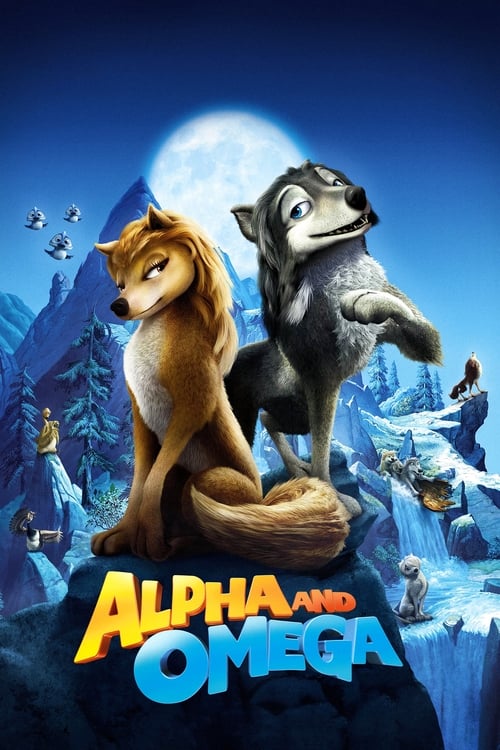
Alpha and Omega (2010)
Directed by Anthony Bell
No — Alpha and Omega is not woke, scoring 9 out of 100 on our wokeness meter.
Alpha and Omega arrives in the great tradition of animated road pictures in which two mismatched animals bicker across a continent and discover, somewhere around the third act, that they were made for each other.
Consciousness Markers
Kate is a capable Alpha hunter who ultimately defies an arranged marriage to choose her own mate, giving her some agency, but the story remains a traditional romance rather than a feminist statement.
The film's central conflict involves breaking down the pack's rigid Alpha/Omega class law, a mild anti-hierarchy theme, but it is framed as social tradition rather than an economic or anti-capitalist critique.
The film carries a gentle moral about love transcending social class and tradition, but it delivers this through plot resolution rather than preachy dialogue or direct address.
The voice cast is a conventional lineup of white Hollywood actors (Justin Long, Hayden Panettiere, Dennis Hopper, Danny Glover); no deliberate diverse or inclusive casting effort is evident.
The film is a heterosexual wolf romance with no LGBTQ+ characters, themes, or subtext of any kind.
The Alpha/Omega divide is a social-class hierarchy among wolves, not a racial or ethnic commentary; no racial consciousness is present.
There is no environmental or climate-themed messaging; the relocation of the wolves is a plot device, not an ecological parable.
No body-positivity themes or messaging appear in the film.
No neurodivergent characters or themes are present.
The film is a fictional animal adventure with no historical subject matter to revise.
Why it received this score
Alpha and Omega arrives in the great tradition of animated road pictures in which two mismatched animals bicker across a continent and discover, somewhere around the third act, that they were made for each other. This one pairs Kate, an Alpha wolf with a promising future in the hunt, with Humphrey, an Omega whose chief qualifications are enthusiasm and a willingness to be tranquilized. Pack law forbids their union. The packs, being wolves, require a merger to survive the winter. There is an arranged marriage, a golfing goose, a duck with a caddie's instincts, and a stampede. The machinery is familiar and it runs on schedule.
Where the film gestures toward social consciousness, it does so politely and then retreats. Kate refuses the match her father arranged, which grants her a measure of self-determination, though the story cannot imagine her wanting anything beyond the right boy. The Alpha and Omega divide is a caste system, and the wolves dismantle it in the final reel. We are meant to understand that love outranks tradition. The lesson arrives through plot instead of sermon, which is to its credit. Nobody turns to the camera to explain the moral. The caribou do the arguing.
The voice cast is a standard Hollywood roster, the romance is strictly boy-meets-girl, and the environmental angle amounts to park rangers with tranquilizer darts. What remains is a modest, harmless confection with eight direct-to-video sequels trailing behind it like ducklings. The animation has not aged gracefully. Neither, frankly, has the howling.
Analysis generated by our Consciousness Algorithm
Part of


Synopsis
Two young wolves at opposite ends of their pack's social order are thrown together into a foreign land and need each other to return home, but love complicates everything.
Questions about Alpha and Omega
Is Alpha and Omega woke?
No — Alpha and Omega is not woke, scoring 9 out of 100 on our wokeness meter. That earns it a verdict of Ultra Based.
Does Alpha and Omega have any woke elements?
Very few. None of the 10 markers reaches 30, the level where a marker counts as present; the highest is Feminist Agenda at 15.
How does Alpha and Omega compare to other 2010 movies?
It ranks #88 of the 238 films from 2010 we've scored; their average is 11. The wokest is My Name Is Khan (84).
How is the Woke Score calculated?
An AI-assisted process researches the film and its reception, scores it 0–100 on ten markers, then combines those into one 0–100 Woke Score. It measures a specific set of 2020s cultural themes, not film quality.