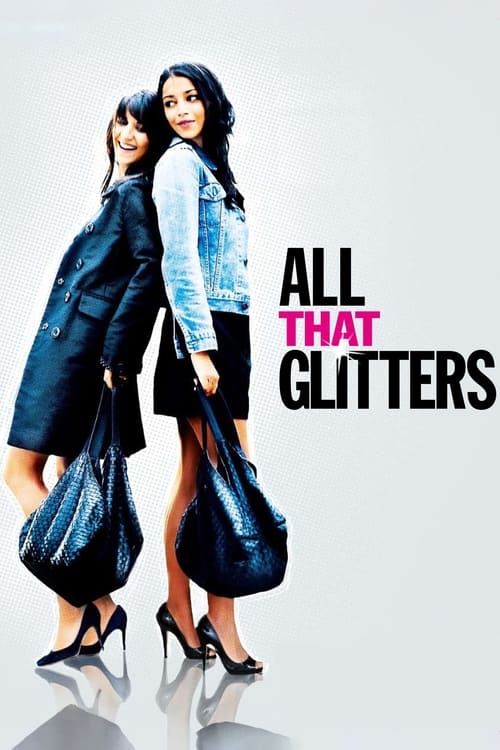
All That Glitters (2010)
Directed by Géraldine Nakache
No — All That Glitters is not especially woke, scoring 20 out of 100 on our wokeness meter.
Géraldine Nakache and Hervé Mimran's 2010 debut follows two suburban friends, Ely and Lila, who lie their way into a wealthy Parisian social circle and learn, at length, that money does not buy friendship.
Consciousness Markers
The cast features several actors of North African and Vietnamese descent, reflecting the diverse demographics of the Paris suburbs, but their backgrounds are not the focus of the story.
The film is co-written and directed by a woman and centers on a female friendship, but it does not advance an explicit feminist agenda.
A wealthy lesbian couple, Agathe and Joan, appear as supporting characters, but their relationship is incidental and not explored as a central theme.
The film mildly critiques the superficiality of the wealthy social circle, but ultimately endorses hard work and consumer success rather than anti-capitalist politics.
The moral about authenticity and friendship is delivered through light comedy rather than preachy lecturing.
Race and racial identity are not addressed or commented upon in the film.
There is no environmental or climate-related content.
There is no body positivity theme or messaging.
No neurodivergent characters or themes are present.
The film is a contemporary fictional story and does not engage with historical revisionism.
Why it received this score
Géraldine Nakache and Hervé Mimran's 2010 debut follows two suburban friends, Ely and Lila, who lie their way into a wealthy Parisian social circle and learn, at length, that money does not buy friendship. The premise is familiar and the film knows it. The comedy stays light, the class friction stays gentle, and the resolution arrives exactly where you expect: a job at an upscale shoe shop and a repaired friendship. It is a pleasant film. It is not a confrontational one.
The cast reflects the demographics of the Paris suburbs, with performers of North African and Vietnamese descent in prominent roles, though the film never pauses to comment on the fact. A wealthy lesbian couple, Agathe and Joan, drift through as supporting figures whose relationship registers as a plot detail and nothing more. A woman co-wrote and co-directed the film, and its central bond is between two young women, which earns a measure of credit without any accompanying argument. Race goes unmentioned. So do the climate, the body, and the neurodivergent mind. The rich are mildly mocked for their superficiality, and then the film quietly endorses hard work and consumer success as the truer path, a critique of capital that folds its tent the moment it might cost something.
Instead of a message, the film offers a moral about authenticity and friendship, delivered through comic embarrassment instead of sermonizing, and that restraint is to its credit. It would score poorly on any ideological scorecard and seems entirely at peace with the prospect. We classify it as a mild specimen: socially conscious in its casting, incurious about the categories such consciousness implies. The result is charming, weightless, and nearly free of agenda. There are worse things to be.
Taxonomy note: the picture is a feature expansion of the directors' own 2007 short, which places it outside our remake category, and its César recognition carries no weight in the Oscar column. It files neatly under no tags at all, which is its own kind of distinction.
Analysis generated by our Consciousness Algorithm


Synopsis
Best friends Ely and Lila share everything together, including their dream of a life beyond the Paris suburb they've lived in since childhood. One night they venture into the capital and meet a pair of wealthy young friends at a night club. Ashamed of their working-class background, and seeing an opportunity to escape, Ely and Lila begin to lie their way into this glamorous new world. Falling deeper into their web of lies, the young women begin to lose sight of themselves as their friendship is pushed to the limit.
Questions about All That Glitters
Is All That Glitters woke?
No — All That Glitters is not especially woke, scoring 20 out of 100 on our wokeness meter. That earns it a verdict of Based.
Does All That Glitters have any woke elements?
2 of the 10 markers register at 30 or above, led by Representation Casting (35) and Feminist Agenda (30). On Representation Casting: The cast features several actors of North African and Vietnamese descent, reflecting the diverse demographics of the Paris suburbs, but their backgrounds are not the focus of the story.
How does All That Glitters compare to other 2010 movies?
It ranks #34 of the 238 films from 2010 we've scored; their average is 11. The wokest is My Name Is Khan (84).
How is the Woke Score calculated?
An AI-assisted process researches the film and its reception, scores it 0–100 on ten markers, then combines those into one 0–100 Woke Score. It measures a specific set of 2020s cultural themes, not film quality.