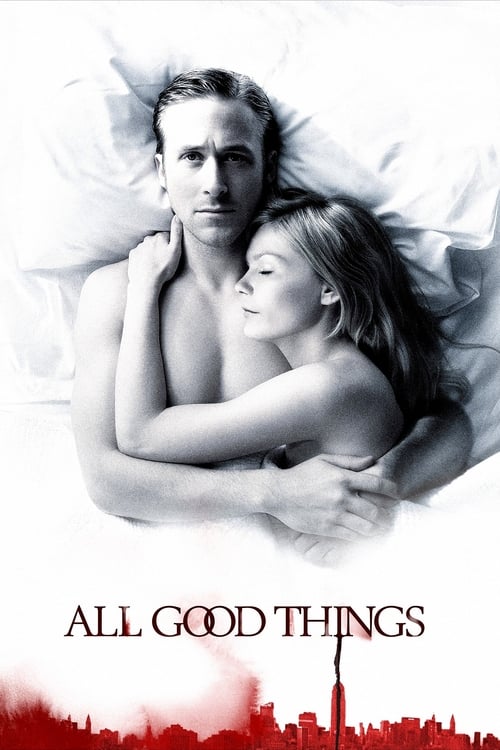
All Good Things (2010)
Directed by Andrew Jarecki
No — All Good Things is not woke, scoring 14 out of 100 on our wokeness meter.
Andrew Jarecki's All Good Things arrives dressed as a mystery and leaves as something closer to a cold case file with a romantic bruise.
Consciousness Markers
The film critiques the corrupting influence of extreme wealth and the power of a real estate dynasty, but it does not advance a systemic anti-capitalist argument.
The film sympathetically portrays a wife trapped by a controlling, abusive husband and patriarchal wealth, but it is a true-crime drama rather than a feminist polemic.
The film is a moody mystery-thriller that shows rather than tells, with no overt preaching or moralizing.
The cast is entirely white, reflecting the real-life subjects, with no deliberate racial or ethnic diversity in casting.
There are no LGBTQ+ characters, themes, or subtext in the film.
Race is not a theme; the story focuses on a wealthy white New York family and their social circle.
There is no environmental or climate-related content.
No body positivity themes or messaging are present.
The protagonist's psychological issues are portrayed as sociopathy or trauma, not as neurodivergence in the modern sense.
The film is a fictionalized account of real events, but it does not reinterpret history through a modern ideological lens.
Why it received this score
Andrew Jarecki's All Good Things arrives dressed as a mystery and leaves as something closer to a cold case file with a romantic bruise. Ryan Gosling plays David Marks, heir to a New York real estate fortune, who marries a working-class woman named Katie and then methodically dismantles her life. The film is based on Robert Durst, and it knows it. The cast is white to the last extra, which happens to match the subjects here, so the absence of any multicultural embroidery reads as fidelity instead of oversight. The 1970s production design does the heavy lifting, all wood paneling and unearned confidence.
Katie's arc gives the film a sliver of social consciousness. She is trapped by a controlling husband and by family money that functions as a leash, and the camera regards her predicament with genuine sympathy. That is the extent of it. This is a true-crime drama, not a manifesto, and it never reaches for a larger argument about women or power. The same holds for the wealth critique. The Marks dynasty is rotten, and the film savors watching it rot, but it stops short of indicting the system that produced it. There is no environmental sermon, no body politics, no examination of neurodivergence, and no reconsideration of the historical record through a contemporary lens. Race is simply not on the agenda. Neither is much of anything else.
A moody thriller that shows instead of tells, the film preaches almost nothing, which in this era is nearly quaint. It is a well-acted, ambiguous, frequently frustrating exercise in restraint. Classify it under wealth, dread, and the quiet cruelty of a family that owns too much.
Analysis generated by our Consciousness Algorithm


Synopsis
Newly-discovered facts, court records and speculation are used to elaborate the true love story and murder mystery of the most notorious unsolved murder case in New York history.
Questions about All Good Things
Is All Good Things woke?
No — All Good Things is not woke, scoring 14 out of 100 on our wokeness meter. That earns it a verdict of Ultra Based.
Does All Good Things have any woke elements?
Very few. None of the 10 markers reaches 30, the level where a marker counts as present; the highest is Eat the Rich at 25.
How does All Good Things compare to other 2010 movies?
It ranks #57 of the 238 films from 2010 we've scored; their average is 11. The wokest is My Name Is Khan (84).
How is the Woke Score calculated?
An AI-assisted process researches the film and its reception, scores it 0–100 on ten markers, then combines those into one 0–100 Woke Score. It measures a specific set of 2020s cultural themes, not film quality.