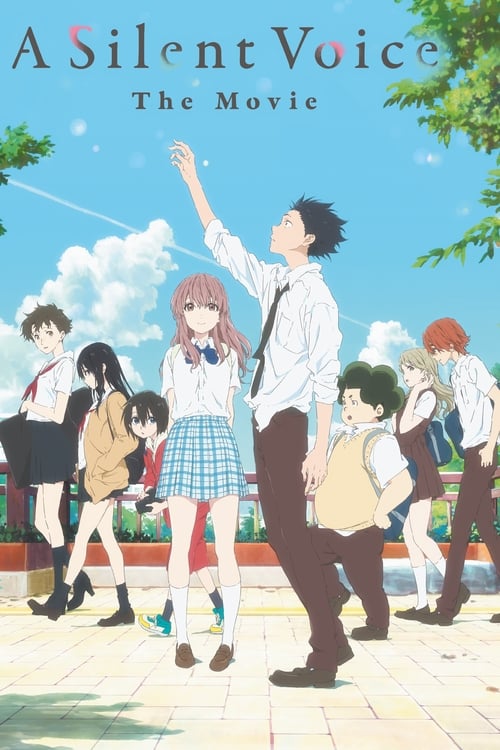
A Silent Voice: The Movie (2016)
Directed by Naoko Yamada
No — A Silent Voice: The Movie is not especially woke, scoring 26 out of 100 on our wokeness meter.
A Silent Voice arrives with a deaf protagonist and, in the English dub, a deaf actress in the role.
Consciousness Markers
The story centers on Shōko Nishimiya, a deaf protagonist, and the English dub deliberately cast deaf actress Lexi Cowden in the role. This is genuine, story-integral disability representation rather than a token gesture.
Director Naoko Yamada is a woman and the film features several complex female characters (Shōko, Yuzuru, Naoka, Miyoko), but there is no articulated feminist agenda driving the narrative.
The film sensitively portrays social anxiety, depression, and suicidal ideation in Shōya, but these are treated as mental-health struggles rather than framed through a neurodivergence-lens of autism/ADHD-style advocacy.
The film engages themes of bullying, disability, and suicide with moral seriousness, but director Yamada deliberately shows rather than preaches, keeping didacticism low.
Shōya's loyal friend Tomohiro Nagatsuka is a plus-size character treated with warmth and dignity, but the film never frames his body as a subject of positive-body commentary or messaging.
There are no LGBTQ+ characters, relationships, or themes anywhere in the film.
The film contains no engagement with race, racism, or racial identity as a theme.
No environmental or climate-related themes appear in the film.
There is no economic critique or anti-capitalist messaging; the drama is entirely interpersonal and psychological.
The film is a contemporary coming-of-age story with no historical subject matter to revise.
Why it received this score
A Silent Voice arrives with a deaf protagonist and, in the English dub, a deaf actress in the role. That is representation doing actual narrative work, since Shoko's deafness drives the plot, the bullying, the guilt, and the eventual reconciliation. Kyoto Animation did not cast a hearing performer and call it a day. The choice registers. It also stays within its lane. This is a story about a specific girl, not a platform.
Elsewhere the ledger is largely blank. There are no LGBTQ characters, no engagement with race, no environmental concern, no economic critique. The suffering here is entirely interpersonal. Shoya's torment is psychological, his redemption is private, and nobody is organizing a march. Tomohiro, the loyal plus-size friend, is treated with warmth and dignity, yet the film never once invites us to contemplate his body as a statement. Shoya's depression, social anxiety, and suicidal ideation are handled with care, but they are handled as mental health, not as an advocacy framework. The camera simply watches him struggle.
Naoko Yamada directed, and the film is populated by complicated women and girls: Shoko, her sister Yuzuru, the abrasive Naoka, the kind Miyoko. None of them exist to deliver a thesis. The film offers a method, not a message. Yamada shows the bullying in quick, intuitive bursts, then lets the silence do the arguing. A lesser production would have lectured. This one lets a boy fall into a river and asks us to sit with it. For a work so heavy with moral weight, the preaching is remarkably scarce. The classification is therefore modest, and the film is better for it.
Analysis generated by our Consciousness Algorithm


Synopsis
Shouya Ishida starts bullying the new girl in class, Shouko Nishimiya, because she is deaf. But as the teasing continues, the rest of the class starts to turn on Shouya for his lack of compassion. When they leave elementary school, Shouko and Shouya do not speak to each other again... until an older, wiser Shouya, tormented by his past behaviour, decides he must see Shouko once more. He wants to atone for his sins, but is it already too late...?
Questions about A Silent Voice: The Movie
Is A Silent Voice: The Movie woke?
No — A Silent Voice: The Movie is not especially woke, scoring 26 out of 100 on our wokeness meter. That earns it a verdict of Based.
Does A Silent Voice: The Movie have any woke elements?
1 of the 10 markers register at 30 or above, led by Representation Casting (45). On Representation Casting: The story centers on Shōko Nishimiya, a deaf protagonist, and the English dub deliberately cast deaf actress Lexi Cowden in the role.
How does A Silent Voice: The Movie compare to other 2016 movies?
It ranks #53 of the 285 films from 2016 we've scored; their average is 16. The wokest is 13th (92).
How is the Woke Score calculated?
An AI-assisted process researches the film and its reception, scores it 0–100 on ten markers, then combines those into one 0–100 Woke Score. It measures a specific set of 2020s cultural themes, not film quality.