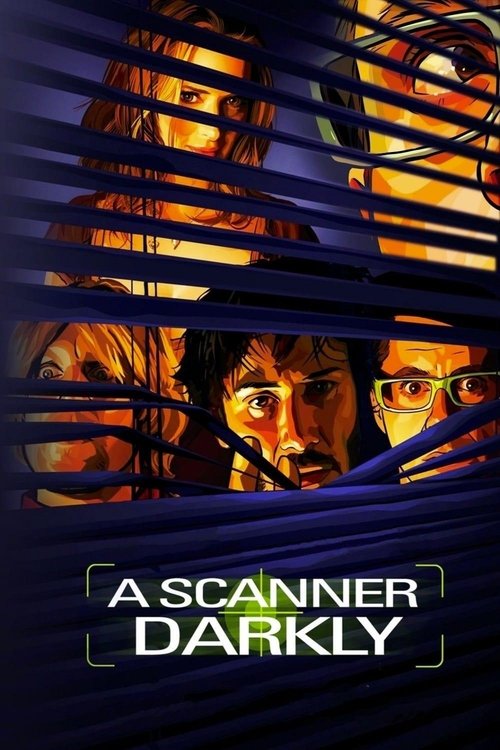
A Scanner Darkly (2006)
Directed by Richard Linklater
No — A Scanner Darkly is not especially woke, scoring 25 out of 100 on our wokeness meter.
A Scanner Darkly arrives from 2006, a rotoscoped adaptation of Philip K. Dick's most personal novel, and it concerns itself with a police state, a drug called Substance D, and the slow dissolution of a man who is both the watcher and the watched.
Consciousness Markers
The plot centers on New-Path, a corporation secretly manufacturing and distributing Substance D while running rehabilitation clinics, and on a police state sacrificing an agent to expose it. This is a critique of corporate power and institutional exploitation, though not a modern 'eat the rich' manifesto.
The film carries a dystopian cautionary message about the drug war, surveillance, and corporate malfeasance, but it remains narrative-driven and not preachy in modern social-justice terms. The lecture energy is mild and thematic rather than explicit.
The cast is predominantly white and the film makes no deliberate effort toward inclusive or representative casting. There is no commentary on representation.
The film contains no LGBTQ+ characters, relationships, or themes. The story focuses on drug addiction, surveillance, and identity loss.
Winona Ryder's Donna has some agency as an undercover officer, but the film does not advance a feminist agenda or critique patriarchal structures. No concrete feminist marker is present.
The film does not engage with racial identity, systemic racism, or racial consciousness. Its dystopian concerns are drug policy, surveillance, and corporate power.
There is no climate-change theme, environmental crusade, or ecological allegory in the film. The blue flowers are tied to drug production, not climate activism.
The film does not address body image, body acceptance, or body-positivity themes. Physical decline is depicted through drug damage rather than as a positive identity marker.
Drug-induced cognitive decline, paranoia, and hallucinations are portrayed as tragic damage, not as neurodivergent identity or advocacy. No neurodivergence marker is present.
The film is a near-future dystopian fiction, not a historical narrative, and it does not revise or reinterpret historical events. No revisionist-history marker applies.
Why it received this score
A Scanner Darkly arrives from 2006, a rotoscoped adaptation of Philip K. Dick's most personal novel, and it concerns itself with a police state, a drug called Substance D, and the slow dissolution of a man who is both the watcher and the watched. The film is animated with an interpolated rotoscope process that gives every face a quivering, unsettled quality, as if the characters were being rendered a frame behind their own intentions. Keanu Reeves plays Bob Arctor, an undercover agent who becomes addicted to the substance he is meant to be tracing, and the film follows him into a fog of scrambled identity and bureaucratic sacrifice. It is a sad, funny, paranoid piece of work, and it has almost no interest in the social questions that occupy the present decade.
The villain here is a corporation. New-Path runs the rehabilitation clinics and manufactures the drug that fills them, and the police knowingly ruin an agent's mind to expose the arrangement. That is a critique of institutional and corporate power, delivered through plot instead of sermon. It stops short of any modern manifesto about wealth and class, and it never pauses to address representation, identity, or the body as a site of affirmation. The cast is white, the concerns are existential, and the women in the story function as operatives within the same compromised machinery as the men.
The film's cautionary instinct is real but restrained. It warns about surveillance, the drug war, and the willingness of institutions to spend human beings as currency, and it does so through narrative and dread. Nowhere does it stop to explain itself to the audience. For a story this bleak, that restraint is the point, and it remains a more honest artifact than most of what the ensuing years produced.
Analysis generated by our Consciousness Algorithm


Synopsis
An undercover cop in a not-too-distant future becomes involved with a dangerous new drug and begins to lose his own identity as a result.
Questions about A Scanner Darkly
Is A Scanner Darkly woke?
No — A Scanner Darkly is not especially woke, scoring 25 out of 100 on our wokeness meter. That earns it a verdict of Based.
Does A Scanner Darkly have any woke elements?
1 of the 10 markers register at 30 or above, led by Eat the Rich (35). On Eat the Rich: The plot centers on New-Path, a corporation secretly manufacturing and distributing Substance D while running rehabilitation clinics, and on a police state sacrificing an agent to expose it.
How does A Scanner Darkly compare to other 2006 movies?
It ranks #21 of the 211 films from 2006 we've scored; their average is 11. The wokest is An Inconvenient Truth (92).
How is the Woke Score calculated?
An AI-assisted process researches the film and its reception, scores it 0–100 on ten markers, then combines those into one 0–100 Woke Score. It measures a specific set of 2020s cultural themes, not film quality.