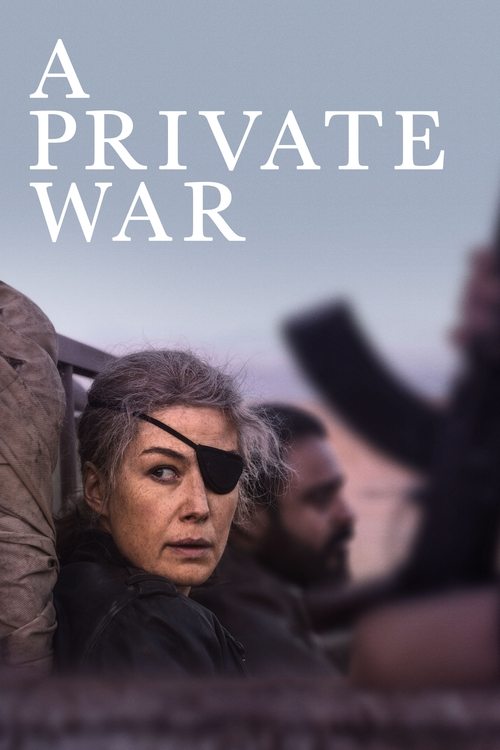
A Private War (2018)
Directed by Matthew Heineman
No — A Private War is not especially woke, scoring 25 out of 100 on our wokeness meter.
Matthew Heineman's A Private War arrives with the grim, unhurried patience of a film that knows its subject died for the story and intends to make us sit with that.
Consciousness Markers
Marie Colvin is a defiant woman thriving in the male-dominated war-correspondent boys' club, and the film foregrounds her rebellion against gendered expectations, though it plays as character portraiture rather than explicit ideological argument.
A female lead and a supporting cast that includes Black and Middle Eastern actors, but the diversity is largely organic to a globe-trotting war-correspondent story rather than a deliberate representational program.
The film humanizes civilian victims of conflicts in Palestine, Iraq, Libya, and Syria and frames Colvin's mission as giving voice to the voiceless, but it treats these as humanitarian war-reporting subjects rather than a racial-justice thesis.
The film carries a sincere message about the moral necessity of bearing witness and the cost of journalism, delivered through drama rather than direct sermonizing.
The film depicts Colvin's PTSD, nightmares, and psychiatric hospitalization, but frames it as trauma and mental-health struggle rather than the modern neurodivergence-identity framework.
No LGBTQ+ characters, relationships, or themes appear anywhere in the narrative.
No environmental or climate themes are present.
There is no critique of capitalism or wealth; a businessman love interest appears without any economic indictment.
No body-positivity themes or messaging are present.
The film is a straightforward biographical account of real events and real people, not a reinterpretation of history through a contemporary ideological lens.
Why it received this score
Matthew Heineman's A Private War arrives with the grim, unhurried patience of a film that knows its subject died for the story and intends to make us sit with that. Rosamund Pike plays Marie Colvin, the Sunday Times correspondent who lost an eye in Sri Lanka and kept dictating copy from her hospital bed. The film moves from Palestine to Iraq to Libya to Syria with a documentarian's refusal to decorate. It is a portrait of compulsion, not a celebration of it, and Heineman keeps the camera close enough that the eyepatch feels less like a badge than a wound that never closed.
The social consciousness here is present but modest. Colvin operates inside a boys' club of foreign correspondents and shoves her way through it, and the film treats her defiance as temperament, not thesis. Her supporting cast includes Black and Middle Eastern performers, though the story's globe-trotting premise supplies them naturally. When she insists on giving voice to the voiceless in Fallujah, Homs, and the bombarded streets of Syria, the film honors the dead civilians without converting them into an argument about race or empire. The sympathy is humanitarian. The framing is journalistic.
Where the film declines to go is as telling as where it goes. There is no romantic pairing beyond a businessman love interest, no environmental lament, no indictment of wealth, no meditation on body image. Colvin's nightmares and her psychiatric hospitalization are rendered as trauma and exhaustion, the price of the job, not as an identity to be claimed. The film's sermon, such as it is, concerns the moral necessity of bearing witness, and it delivers that sermon through the sound of shelling and the sight of a woman who will not leave. Sober. Unsentimental. A film about a journalist, made with the discipline of one.
Analysis generated by our Consciousness Algorithm

Synopsis
One of the most celebrated war correspondents of our time, Marie Colvin is an utterly fearless and rebellious spirit, driven to the frontlines of conflicts across the globe to give voice to the voiceless.
Questions about A Private War
Is A Private War woke?
No — A Private War is not especially woke, scoring 25 out of 100 on our wokeness meter. That earns it a verdict of Based.
Does A Private War have any woke elements?
2 of the 10 markers register at 30 or above, led by Feminist Agenda (40) and Representation Casting (35). On Feminist Agenda: Marie Colvin is a defiant woman thriving in the male-dominated war-correspondent boys' club, and the film foregrounds her rebellion against gendered expectations, though it plays as character portraiture rather than explicit ideological argument.
How does A Private War compare to other 2018 movies?
It ranks #83 of the 325 films from 2018 we've scored; their average is 20. The wokest is Return (92).
How is the Woke Score calculated?
An AI-assisted process researches the film and its reception, scores it 0–100 on ten markers, then combines those into one 0–100 Woke Score. It measures a specific set of 2020s cultural themes, not film quality.