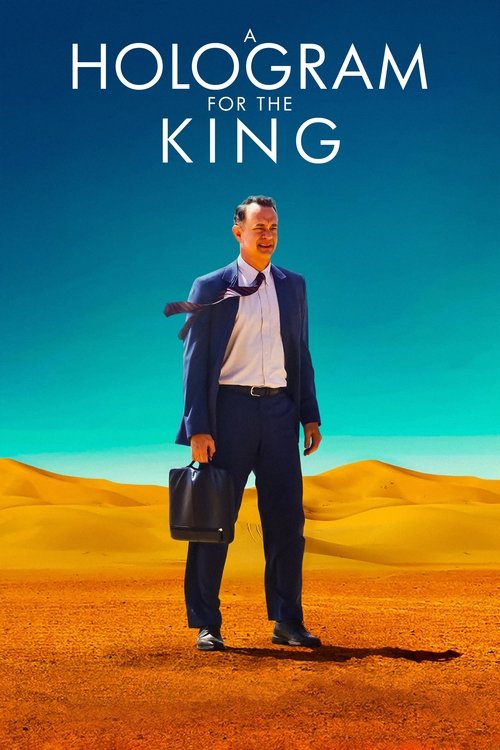
A Hologram for the King (2016)
Directed by Tom Tykwer
No — A Hologram for the King is not especially woke, scoring 22 out of 100 on our wokeness meter.
A Hologram for the King arrives as a 2016 international co-production in which Tom Hanks, playing a washed-up salesman named Alan Clay, travels to a planned city in the Saudi desert to sell a holographic teleconferencing system to a monarch who never appears.
Consciousness Markers
Alan Clay is haunted by having outsourced Schwinn's manufacturing to China and destroying American jobs, and the deal ultimately collapses to a cheaper Chinese competitor, offering a pointed critique of globalized corporate capitalism and the hollow planned city it builds.
The Saudi setting is populated with Middle Eastern actors (Omar Elba, Amira El Sayed) and a non-white female lead in Sarita Choudhury, though the casting reads as natural to the story rather than a deliberate representational statement.
Zahra is a professional Saudi doctor with a career, children, and an independent divorce in progress, granting her agency, but the film frames her primarily as a romantic reward for the protagonist rather than advancing a feminist thesis.
The film gestures at cultural friction between the American salesman and Saudi bureaucracy, but treats it as comic bewilderment rather than a sustained examination of race or systemic power.
The critique of outsourcing and corporate emptiness is present but delivered through melancholy character beats rather than direct sermonizing.
No LGBTQ+ characters, themes, or subtext appear anywhere in the film.
No environmental or climate themes are present; the desert setting is backdrop, not argument.
The mysterious lump on Clay's back is a medical anxiety plot device, not a body-positivity statement.
No neurodivergent characters or themes are depicted.
The film is a fictional adaptation with no historical revisionism.
Why it received this score
A Hologram for the King arrives as a 2016 international co-production in which Tom Hanks, playing a washed-up salesman named Alan Clay, travels to a planned city in the Saudi desert to sell a holographic teleconferencing system to a monarch who never appears. The film is adapted from a Dave Eggers novel, which is to say it carries the faint whiff of literary seriousness without ever committing to an argument. Tom Tykwer directs with the patience of a man watching sand settle. The result is a mild, sunstruck comedy of frustration, and our classification duties here are correspondingly mild.
Where the film registers on the cultural instruments, it does so softly. The Saudi setting is populated with Middle Eastern actors and a non-white female lead, cast as a matter of narrative convenience instead of representational declaration. Zahra, the doctor who treats the protagonist's back lump, is granted a career, children, and a divorce in progress, which is more agency than the genre typically extends. She is also, in the end, the romantic reward for a man who has accomplished nothing, a tension the film does not notice. The racial friction between American salesman and Saudi bureaucracy is played for comic bewilderment, a shrug instead of an examination. The sharpest edge belongs to the corporate critique: Clay is haunted by outsourcing Schwinn's manufacturing to China, and the deal collapses to a cheaper Chinese competitor, a tidy indictment of global capital and the empty condominiums it erects.
The remaining instruments read flat. No environmental argument attaches to the desert, which is backdrop and not thesis. The lump is medical anxiety, not a statement about bodies. No LGBTQ characters appear, no neurodivergent ones either, and the film revises no history because it invents its own. The critique of outsourcing arrives through melancholy glances, not sermons. The tally, then, is a pleasant film about a man failing upward in a country the screenplay never quite understands, asking nothing of us beyond endurance of its amiable drift.
Analysis generated by our Consciousness Algorithm


Synopsis
Alan Clay, a struggling American businessman, travels to Saudi Arabia to sell a new technology to the King, only to be challenged by endless Middle Eastern bureaucracy, a perpetually absent monarch, and a suspicious growth on his back.
Questions about A Hologram for the King
Is A Hologram for the King woke?
No — A Hologram for the King is not especially woke, scoring 22 out of 100 on our wokeness meter. That earns it a verdict of Based.
Does A Hologram for the King have any woke elements?
2 of the 10 markers register at 30 or above, led by Eat the Rich (45) and Representation Casting (35). On Eat the Rich: Alan Clay is haunted by having outsourced Schwinn's manufacturing to China and destroying American jobs, and the deal ultimately collapses to a cheaper Chinese competitor, offering a pointed critique of globalized corporate capitalism and the hollow planned city it builds.
How does A Hologram for the King compare to other 2016 movies?
It ranks #61 of the 285 films from 2016 we've scored; their average is 16. The wokest is 13th (92).
How is the Woke Score calculated?
An AI-assisted process researches the film and its reception, scores it 0–100 on ten markers, then combines those into one 0–100 Woke Score. It measures a specific set of 2020s cultural themes, not film quality.