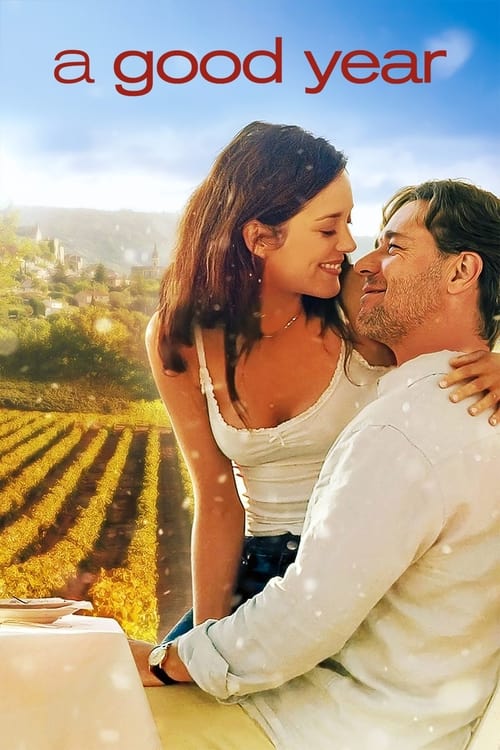
A Good Year (2006)
Directed by Ridley Scott
No — A Good Year is not woke, scoring 9 out of 100 on our wokeness meter.
Ridley Scott's A Good Year arrives in Provence with a suitcase of soft pastoral fantasy and a return ticket to London.
Consciousness Markers
Casting is comfortably international (a French-American co-production with a continental supporting ensemble), but the film casts no aspersions on representation and treats its players as charming scenery rather than statements.
There is a soft pastoral rebuke of City finance — the workaholic trader abandoning London for the vineyard, the van Gogh kept in a vault as an investment — but the critique is lifestyle-oriented rather than class-conscious.
Marion Cotillard's Fanny is spunky, sharp-tongued and famously rumored to have sworn off men, but she exists to be won over; this is rom-com gender furniture, not a feminist agenda.
A gentle, sun-dappled romance that prefers to let its moral (slow down, smell the lavender) drift by unspoken rather than preached.
No LGBTQ+ characters, subtext, or themes appear anywhere in this Provençal idyll.
A multiracial supporting cast is present (Archie Panjabi among them), but race is never mentioned, thematized, or examined.
Vines, soil, and sunshine abound, but as terroir and tourism rather than ecology or climate anxiety.
No engagement, positive or otherwise, with body image or size diversity.
No neurodivergent characters or themes are present.
The film makes no historical claims and revises none.
Why it received this score
Ridley Scott's A Good Year arrives in Provence with a suitcase of soft pastoral fantasy and a return ticket to London. Russell Crowe plays Max Skinner, a finance man who inherits his uncle's vineyard and plans to flip it before the lavender has time to settle. The film is a romantic comedy-drama about slowing down, smelling the wine, and discovering that a childhood crush has grown into Marion Cotillard. Critics found it pleasant, pretty and predictable. That verdict still holds. The sunshine is abundant. The moral is optional.
The casting has a continental ease: French and American players, a supporting ensemble that treats Provence as a postcard. It is representation as scenery, not statement. Race is never discussed. Queer life is absent. Climate exists only as sunshine and soil. Body image and neurodivergence do not enter the frame. History is not revised because history is barely invoked. This is not a moral failing; it is a narrowness. The film wants us to relax, and it asks little of our social attention in return.
There is a mild rebuke of City finance: the workaholic trader, the van Gogh kept in a vault, the partnership offered as a gilded cage. The critique is lifestyle-deep. It prefers the vineyard to the trading floor, but it does not indict the arrangement so much as request a sabbatical. The moral drifts by unspoken: slow down, smell the lavender, maybe fall for the café owner. The sermon is so gentle it barely clears its throat. As a specimen of 2006 romantic comedy, A Good Year is a low-yield vintage for cultural analysis: smooth, sun-dappled, and almost entirely without ideological aftertaste.
Analysis generated by our Consciousness Algorithm


Synopsis
Failed London banker Max Skinner inherits his uncle's vineyard in Provence, where he spent many childhood holidays. Upon his arrival, he meets a woman from California who tells Max she is his long-lost cousin and that the property is hers.
Questions about A Good Year
Is A Good Year woke?
No — A Good Year is not woke, scoring 9 out of 100 on our wokeness meter. That earns it a verdict of Ultra Based.
Does A Good Year have any woke elements?
Very few. None of the 10 markers reaches 30, the level where a marker counts as present; the highest is Eat the Rich at 20.
How does A Good Year compare to other 2006 movies?
It ranks #75 of the 211 films from 2006 we've scored; their average is 11. The wokest is An Inconvenient Truth (92).
How is the Woke Score calculated?
An AI-assisted process researches the film and its reception, scores it 0–100 on ten markers, then combines those into one 0–100 Woke Score. It measures a specific set of 2020s cultural themes, not film quality.