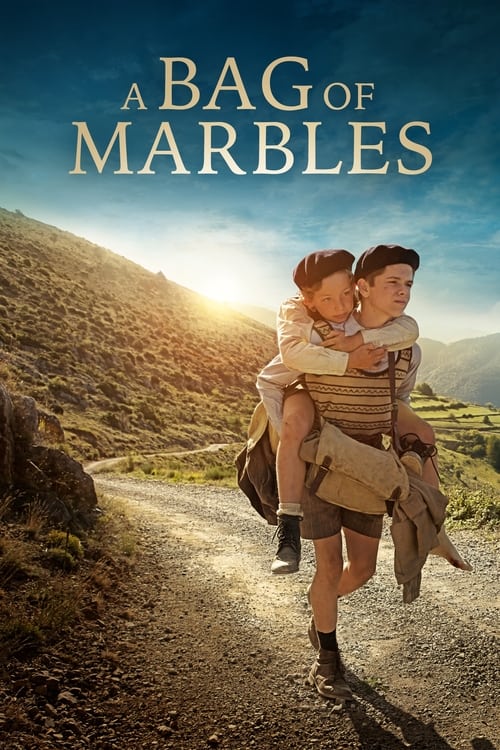
A Bag of Marbles (2017)
Directed by Christian Duguay
No — A Bag of Marbles is not woke, scoring 2 out of 100 on our wokeness meter.
There is a temptation, when a film arrives bearing yellow stars and boxcars, to reach for the heaviest adjectives available and let them do the work.
Consciousness Markers
The cast is entirely white European, with no notable inclusive or diverse casting choices.
No LGBTQ+ characters, themes, or subtext are present.
The story focuses on two Jewish boys and their survival; no feminist agenda or gender-justice commentary is present.
The film depicts Nazi persecution of Jews, but this is historical atrocity, not modern racial-justice consciousness or systemic-racism commentary.
No environmental or climate-related themes appear.
There is no critique of capitalism or wealth inequality as a thematic element.
No body-positivity themes or body-diversity messaging are present.
No neurodivergent characters or themes are depicted.
The film is a straightforward adaptation of a Holocaust memoir, not a revisionist or counter-narrative historical retelling.
The film is a dramatic survival story rather than a preachy or didactic modern social lecture.
Why it received this score
There is a temptation, when a film arrives bearing yellow stars and boxcars, to reach for the heaviest adjectives available and let them do the work. A Bag of Marbles declines the invitation. Christian Duguay's adaptation of Joseph Joffo's memoir follows two Jewish brothers, Maurice and Joseph, through occupied France as they flee toward the free zone, and it tells this story with a plainness that borders on the austere. The camera stays close to the boys. The danger is ordinary. The cruelty arrives without commentary, which is its own kind of argument.
What the film does not do is instructive. It never pauses to explain its own importance to the audience. There are no anthems, no speeches about the better angels of our nature, no contemporary vocabulary retrofitted onto 1942. The brothers survive through wit, luck, and the occasional kindness of strangers, and the film trusts that arithmetic to carry the emotional weight. The cast is uniformly European and uniformly good. Nobody is present to represent a category. Nobody is present to be corrected. The historical record is treated as a record, not as a mirror for present-day grievances.
This is a somber, well-made picture that understands the difference between depicting atrocity and sermonizing about it. It won audience prizes at Jewish film festivals, which tells you where its natural audience lives, and it earned respectable notices without becoming a cultural event. In an era when every period piece seems contractually obliged to wink at the modern viewer, there is something almost archaic about a film this content to simply watch two children walk. It is a survival story. It stays a survival story. That restraint is rarer than it ought to be, and it is the film's quiet achievement. The final scene, set in a present-day Paris cafe, lands softly, as it should, without a lesson attached to it.
We are left with a competent, moving, unremarkable-in-its-politics film about a subject that requires no embellishment. The sommelier sets down the glass and writes nothing in the ledger. Some vintages are simply what they say they are.
This film contains no markers of modern social consciousness. All ten categories score zero. It is a Holocaust drama about two boys, and it knows it.
Analysis generated by our Consciousness Algorithm


Synopsis
At the beginning of the 1940s, in a France occupied by Nazi forces, lived the Jewish Joffo family. Happy and tight-knit, she sees her future darken when all members of the family are forced to wear the yellow star. Fearing the worst, the parents organized their family to flee to the free zone in the south of the country. Maurice, twelve years old, and Joseph, ten years old, will therefore leave alone in order to maximize their chances of finding their older brothers already settled in Nice. The brothers left to their own devices demonstrate an incredible amount of cleverness, courage, and ingenuity to escape the enemy invasion and to try to reunite their family once again.
Questions about A Bag of Marbles
Is A Bag of Marbles woke?
No — A Bag of Marbles is not woke, scoring 2 out of 100 on our wokeness meter. That earns it a verdict of Ultra Based.
Does A Bag of Marbles have any woke elements?
No. All 10 markers score zero.
How does A Bag of Marbles compare to other 2017 movies?
It ranks #276 of the 309 films from 2017 we've scored; their average is 19. The wokest is I Am Not Your Negro (92).
How is the Woke Score calculated?
An AI-assisted process researches the film and its reception, scores it 0–100 on ten markers, then combines those into one 0–100 Woke Score. It measures a specific set of 2020s cultural themes, not film quality.