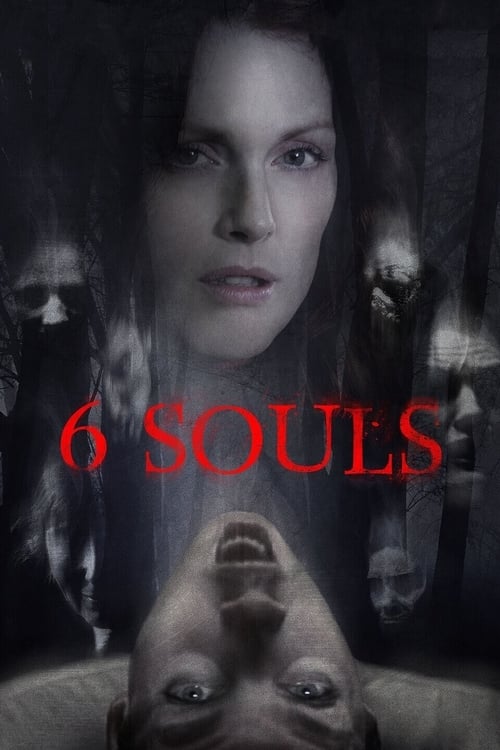
6 Souls (2010)
Directed by Måns Mårlind
No — 6 Souls is not woke, scoring 0 out of 100 on our wokeness meter.
6 Souls, known in its earlier life as Shelter, arrives as a supernatural thriller in which Julianne Moore plays a forensic psychiatrist whose patient, played by Jonathan Rhys Meyers, turns out to be a vessel for the souls of the faithless.
Consciousness Markers
The cast is overwhelmingly white, with only a minor Black supporting role. There is no evident modern representation-casting agenda.
The film contains no LGBTQ+ characters, themes, or subtext.
A female psychiatrist is the protagonist, but the film does not advance or engage with feminist themes or gender politics.
Race is not a thematic concern, and the film does not explore racial identity, injustice, or consciousness.
There is no environmental or climate-related content in the film.
The film does not critique capitalism, wealth inequality, or class structures.
There is no body-positivity theme or messaging present.
Multiple personality disorder appears as a supernatural horror device, not as a neurodivergence-awareness or advocacy element.
The historical flashback involving a faithless priest and witchcraft is fictional backstory, not a revisionist historical narrative.
The film has religious and faith-versus-science themes, but it does not deliver a modern progressive lecture to the audience.
Why it received this score
6 Souls, known in its earlier life as Shelter, arrives as a supernatural thriller in which Julianne Moore plays a forensic psychiatrist whose patient, played by Jonathan Rhys Meyers, turns out to be a vessel for the souls of the faithless. The film was shot around Pittsburgh, sat on a shelf for three years, and was renamed for its American video-on-demand debut. That is a fitting biography for a movie whose interests lie entirely in the older, darker furniture of the genre: priests, plagues, witch doctors in the holler, and a curse delivered by mud stuffed into the orifices of a corpse.
The picture is a horror mystery, and it behaves like one. It asks questions about belief and science, gives Julianne Moore a dead husband and a daughter in peril, and resolves everything with a root through the neck. There is no cultural project underneath it. The cast is white, the themes are theological, and the villain is a faithless clergyman punished by a folk healer. No modern social argument is advanced, and none is attempted. The multiple personalities are a plot device, not a statement, and the film has no interest in diagnosing anyone for the audience's edification.
What remains is a moody, muddled thriller that received a seven percent approval rating and a limited release, which is roughly the reception such things earn. Faith-based outlets found it more intelligent than the genre usually manages, which tells us something about the genre. We are left with a film that engages religion, death, and the supernatural without ever reaching for a contemporary lesson. Every marker on our ledger sits at zero. The film wants only to frighten us, and it does not even do that with much conviction. A clean sheet, then, and a weary nod.
Analysis generated by our Consciousness Algorithm


Synopsis
A female forensic psychiatrist discovers that all of one of her patient's multiple personalities are murder victims. She will have to find out what's happening before her time is finished.
Questions about 6 Souls
Is 6 Souls woke?
No — 6 Souls is not woke, scoring 0 out of 100 on our wokeness meter. That earns it a verdict of Ultra Based.
Does 6 Souls have any woke elements?
No. All 10 markers score zero.
How does 6 Souls compare to other 2010 movies?
It ranks #204 of the 238 films from 2010 we've scored; their average is 11. The wokest is My Name Is Khan (84).
How is the Woke Score calculated?
An AI-assisted process researches the film and its reception, scores it 0–100 on ten markers, then combines those into one 0–100 Woke Score. It measures a specific set of 2020s cultural themes, not film quality.