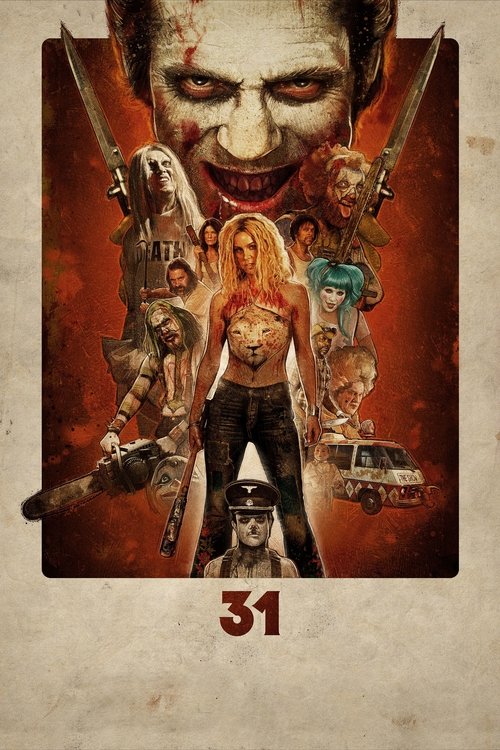
31 (2016)
Directed by Rob Zombie
No — 31 is not woke, scoring 9 out of 100 on our wokeness meter.
Rob Zombie's 31 arrives with the confidence of a man who has read a statistic about Halloween and decided that was enough.
Consciousness Markers
Wealthy aristocrats bet on the survival of captive carnival workers for sport, offering a mild class-exploitation critique, though not a coherent anti-capitalist message.
Cast includes a Black actor and women, but they exist naturally in the exploitation-horror ensemble without any deliberate representation framing or commentary.
A cross-dressing killer clown appears, but it is used as grotesque horror imagery, not as LGBTQ+ representation or theme.
Features a female survivor, but this is standard final-girl horror convention, not a feminist agenda or commentary.
A neo-Nazi clown is a villain, but the film does not engage with racial justice, systemic racism, or racial consciousness.
No environmental or climate themes.
No body-positivity themes or messaging.
No neurodivergence themes or representation.
Set in 1976 but uses the period setting for exploitation atmosphere, not historical revisionism.
No didactic or preachy messaging; it is an exploitation horror film.
Why it received this score
Rob Zombie's 31 arrives with the confidence of a man who has read a statistic about Halloween and decided that was enough. Five carnival workers are abducted on the night of October 31, 1976, deposited in a maze of grimy rooms, and informed by three powdered-wig aristocrats that they have twelve hours to survive against a gang of homicidal clowns. The premise is The Running Man with grease paint, and the film knows it. There is a neo-Nazi clown, a cross-dressing clown, a clown named Sex-Head, and a chainsaw. The camera lingers on the screaming with the patience of a sommelier decanting a difficult vintage.
The class politics here are, if anything, the most legible element. Wealthy grotesques in aristocratic dress wager on the survival odds of captive working-class carnies, which amounts to a glancing critique of the rich treating human life as sport. It is a real thread, and it is thin. Nobody in the film pauses to explain the arrangement, which is to the picture's credit. Elsewhere the cultural ledger stays blank. The Black carnies and the women exist as exploitation-horror furniture, dispatched or menaced according to the genre's oldest customs. The cross-dressing killer is deployed as grotesquerie, not as any statement about identity. A neo-Nazi villain provides texture and nothing more. The 1976 setting is atmosphere, a fog machine of period detail, not a thesis about the past.
What remains is a nasty, gaudy, deliberately ugly piece of work that has no interest in instructing anyone about anything. Critics found it forced and unoriginal, and they were not wrong. Yet there is a certain integrity in a film that refuses to smuggle a lesson into the carnage. It simply wants to hurt its characters and show you the wound. As cultural documents go, this one is mostly a document about Rob Zombie.
Analysis generated by our Consciousness Algorithm
Part of


Synopsis
Five carnival workers are kidnapped and held hostage in an abandoned, Hell-like compound where they are forced to participate in a violent game, the goal of which is to survive twelve hours against a gang of sadistic clowns.
Questions about 31
Is 31 woke?
No — 31 is not woke, scoring 9 out of 100 on our wokeness meter. That earns it a verdict of Ultra Based.
Does 31 have any woke elements?
Very few. None of the 10 markers reaches 30, the level where a marker counts as present; the highest is Eat the Rich at 15.
How does 31 compare to other 2016 movies?
It ranks #158 of the 285 films from 2016 we've scored; their average is 16. The wokest is 13th (92).
How is the Woke Score calculated?
An AI-assisted process researches the film and its reception, scores it 0–100 on ten markers, then combines those into one 0–100 Woke Score. It measures a specific set of 2020s cultural themes, not film quality.