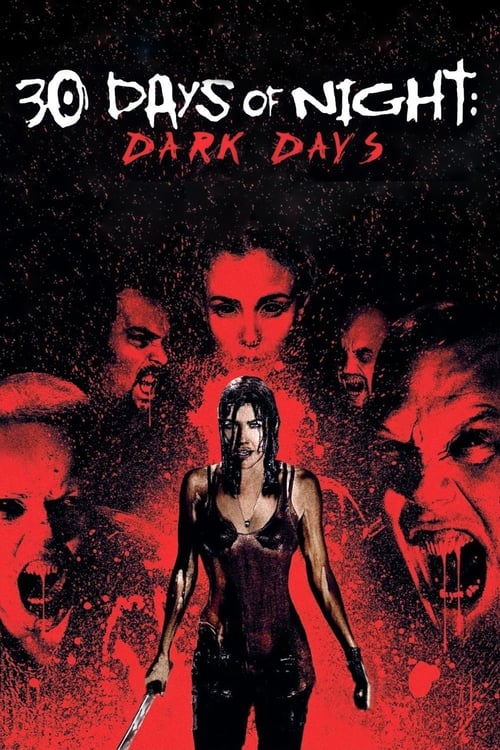
30 Days of Night: Dark Days (2010)
Directed by Ben Ketai
No — 30 Days of Night: Dark Days is not woke, scoring 7 out of 100 on our wokeness meter.
30 Days of Night: Dark Days arrives direct to video with the weary inevitability of a sequel nobody requested, following Stella Oleson as she relocates to Los Angeles to hunt vampires, avenge her husband, and endure a generally miserable time.
Consciousness Markers
The cast includes Harold Perrineau and Mia Kirshner in supporting roles, but this is unremarkable ensemble casting for a direct-to-DVD horror sequel with no commentary on representation.
Stella is a vengeance-driven female lead who ultimately decapitates the vampire queen, but this is standard horror-final-girl mechanics rather than any articulated feminist agenda.
A Black actor appears in a supporting role with no engagement of race, racism, or racial identity as a theme.
Stella delivers an in-universe lecture about the existence of vampires, but this is plot exposition, not social or moral instruction aimed at the audience.
No LGBTQ+ characters, themes, or subtext appear anywhere in the film.
No environmental or climate themes are present; the polar-night setting is purely atmospheric.
No economic critique or class commentary of any kind.
No body-positivity themes; the film's treatment of bodies is strictly visceral horror.
No neurodivergent characters or themes.
No historical revisionism; the film is a fictional vampire narrative.
Why it received this score
30 Days of Night: Dark Days arrives direct to video with the weary inevitability of a sequel nobody requested, following Stella Oleson as she relocates to Los Angeles to hunt vampires, avenge her husband, and endure a generally miserable time. The polar-night menace of the original is traded for dimly lit corridors and a ship in the bay. Ben Ketai directs with efficiency and little else, and the whole enterprise carries the faint odor of a franchise coasting on fumes.
On the matter of social consciousness, the film offers almost nothing to classify. Harold Perrineau and Mia Kirshner turn up in supporting roles, competent ensemble casting that passes without comment on representation. Stella functions as a vengeance-driven lead who eventually decapitates the vampire queen, which reads as standard horror final-girl mechanics, not an articulated statement about anything. She does deliver a lecture on the existence of vampires, but the address lands on a room of skeptical humans inside the story, not on us. A Black actor stands among the hunters and race never enters the frame. There is no economic critique, no environmental note, no body-positivity gesture, no neurodivergent thread.
The result is a brisk, nihilistic B-movie with an ending that bites its heroine in more ways than one. Its cultural footprint is a smudge. A viewer seeking progressive instruction will find the cupboard bare, and a viewer seeking a good vampire film will likely do the same. This is a minor entry in a minor franchise, conducting itself with no agenda beyond the next jump scare. We classify it accordingly.
Analysis generated by our Consciousness Algorithm


Synopsis
After surviving the incidents in Barrow, Alaska, Stella Olemaun relocates to Los Angeles, where she intentionally attracts the attention of the local vampire population in order to avenge the death of her husband, Eben.
Questions about 30 Days of Night: Dark Days
Is 30 Days of Night: Dark Days woke?
No — 30 Days of Night: Dark Days is not woke, scoring 7 out of 100 on our wokeness meter. That earns it a verdict of Ultra Based.
Does 30 Days of Night: Dark Days have any woke elements?
Very few. None of the 10 markers reaches 30, the level where a marker counts as present; the highest is Representation Casting at 20.
How does 30 Days of Night: Dark Days compare to other 2010 movies?
It ranks #125 of the 238 films from 2010 we've scored; their average is 11. The wokest is My Name Is Khan (84).
How is the Woke Score calculated?
An AI-assisted process researches the film and its reception, scores it 0–100 on ten markers, then combines those into one 0–100 Woke Score. It measures a specific set of 2020s cultural themes, not film quality.