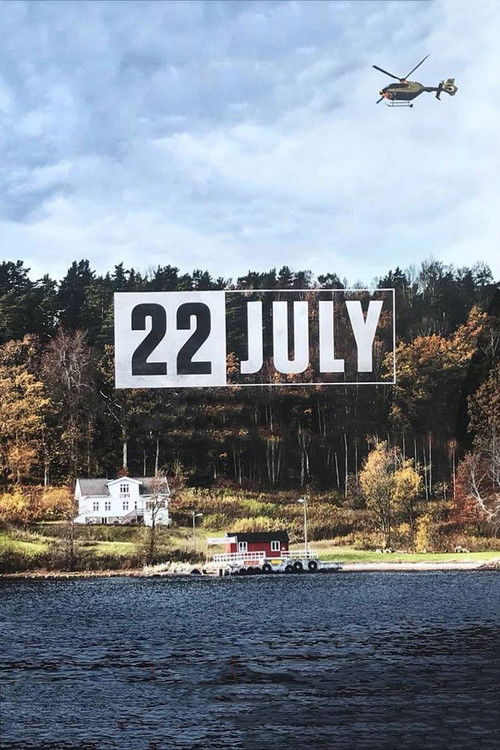
22 July (2018)
Directed by Paul Greengrass
No — 22 July is not woke, scoring 2 out of 100 on our wokeness meter.
Paul Greengrass has spent a career turning recent history into handheld, jittery docudrama, and 22 July applies that method to the 2011 Norway attacks with the grim patience of a coroner's report.
Consciousness Markers
The film uses a Norwegian cast and crew for authenticity, not as a deliberate diversity or representation statement.
No LGBTQ+ characters, themes, or subtext are present.
The narrative focuses on male survivors, lawyers, and the terrorist; no feminist agenda or gender-conscious critique is evident.
While the attacker is a white nationalist, the film examines terrorism, grief, and legal process rather than racial justice or systemic racism as a theme.
No environmental or climate-related themes appear.
No critique of capitalism or wealth inequality is present.
No body positivity themes or messaging are included.
The film depicts brain injury and trauma, but not neurodivergence as a social or identity category.
The film is a factual dramatization of the 2011 Norway attacks, not a revisionist or counter-narrative history.
The film is a somber procedural drama that avoids preachy or didactic lecturing.
Why it received this score
Paul Greengrass has spent a career turning recent history into handheld, jittery docudrama, and 22 July applies that method to the 2011 Norway attacks with the grim patience of a coroner's report. The film opens with the Oslo bombing, moves to the island of Utøya, then spends its long second half on hospitals, courtrooms, and the slow reassembly of a shattered body and a shattered nation. Greengrass cast Norwegian performers and shot in Norway, then had them speak English, a compromise that drains some texture from the proceedings while keeping the thing exportable. The result is sober, well-made, and almost entirely free of the cultural signaling that defines its era.
That absence is the notable thing. The killer is a white nationalist who murders children at a Labour Party camp, and the film refuses to convert him into a lecture. He is a defendant. The lawyers argue about sanity. The survivors testify. Viljar Hanssen, shot five times and left with lasting brain injury, learns to walk again and takes the stand, and the camera watches him do it without underlining the lesson. There is no speech about the rise of the far right, no montage of grief set to a pop song, no moment where a character turns to the audience to explain what we should feel. Greengrass trusts the material. The material is heavy enough to bear it.
So we arrive at a film that scores nothing on every index we keep. No identity casting, no environmental sermon, no critique of capital, no revision of the historical record. It is a tragedy reconstructed with care by a competent craftsman who had no interest in telling anyone how to vote. In 2018 that read as restraint. In the current climate it reads almost as a relic. We note it, file it under procedural, and move on to the next screener.
Analysis generated by our Consciousness Algorithm


Synopsis
On 22 July 2011, neo-Nazi terrorist Anders Behring Breivik murdered 77 young people attending a Labour Party Youth Camp on Utøya Island outside of Oslo. This three-part story focuses on the survivors, the political leadership of Norway, and the lawyers involved.
Questions about 22 July
Is 22 July woke?
No — 22 July is not woke, scoring 2 out of 100 on our wokeness meter. That earns it a verdict of Ultra Based.
Does 22 July have any woke elements?
No. All 10 markers score zero.
How does 22 July compare to other 2018 movies?
It ranks #287 of the 325 films from 2018 we've scored; their average is 20. The wokest is Return (92).
How is the Woke Score calculated?
An AI-assisted process researches the film and its reception, scores it 0–100 on ten markers, then combines those into one 0–100 Woke Score. It measures a specific set of 2020s cultural themes, not film quality.