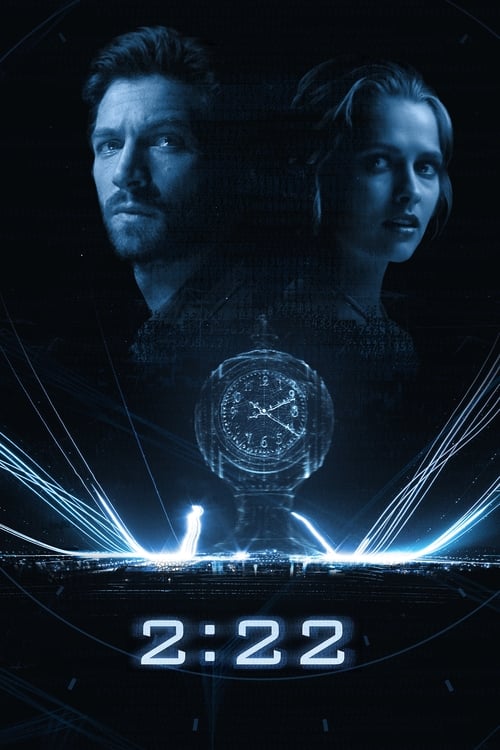
2:22 (2017)
Directed by Paul Currie
No — 2:22 is not woke, scoring 7 out of 100 on our wokeness meter.
2:22 arrives with the hushed confidence of a film that believes numerology is a personality.
Consciousness Markers
The cast is overwhelmingly white, with Remy Hii as the only notable non-white performer in a minor role; diversity is incidental rather than a stated aim.
Sarah exists primarily as the object of Dylan's destiny and Jonas's obsession; she has little agency beyond the final act's realization, and no feminist framework is present.
No LGBTQ+ characters, relationships, or themes appear anywhere in the film.
The film engages no racial themes whatsoever; its concerns are entirely cosmic fate and reincarnation.
A supernova is invoked as a mystical plot device, not as any environmental or climate commentary.
No economic critique or class commentary exists; the villain is a jealous artist, not a system.
No body-positivity themes or messaging are present.
Dylan's pattern-visualization and fugue states are framed as supernatural/cosmic phenomena, not as neurodivergence or a coded condition.
The 30-year-old murder backstory is fictional invention within the plot, not a revisionist reframing of real historical events.
This is a pulpy fate-and-destiny thriller with no preachy messaging or moral instruction directed at the audience.
Why it received this score
2:22 arrives with the hushed confidence of a film that believes numerology is a personality. An air traffic controller named Dylan blacks out at the same minute each afternoon, prevents a midair collision, and then spends the rest of the running time noticing that Grand Central Terminal repeats its commuters like a faulty carousel. There is a supernova, a pair of star-crossed birthdays, and an artist who paints the future because the plot requires someone to. The machinery of fate grinds along, pleasant enough, and entirely indifferent to the world outside its own head.
For a film so preoccupied with repetition, it is revealing what never repeats here: any recognizable progressive impulse. The cast is a wall of pale faces, with a single non-white performer tucked into the margins and given nothing to do. Sarah, our heroine, exists chiefly as the target of one man's destiny and another man's obsession, her agency arriving only in the final reel when the script remembers she has lines. The villain is a jealous painter, not an economy. The cosmic threat is a supernova, not a climate. Dylan's visions are supernatural, not neurodivergent, so the film declines even the accidental credit it might have earned.
We are left with a pulpy thriller that wants to be hypnotic and settles for tidy. Nobody lectures us. Nobody asks us to examine our complicity in anything. The film is too busy explaining its own clockwork to bother with moral instruction, and there is a strange integrity in that. As vintages go, this one is thin, faintly sweet, and best served cold to an audience that has already stopped asking questions. The cellar is largely empty. We log it accordingly.
Analysis generated by our Consciousness Algorithm


Synopsis
Two planes almost collide after a blinding flash of light paralyzes air traffic controller Dylan Branson for a few seconds. Suspended from his job, Dylan starts to notice an ominous pattern of sounds and events that repeats itself in exactly the same manner every day, ending precisely at 2:22 p.m. Also drawn into a complex relationship with a woman, Dylan must figure out a way to break the power of the past and take control of time itself.
Questions about 2:22
Is 2:22 woke?
No — 2:22 is not woke, scoring 7 out of 100 on our wokeness meter. That earns it a verdict of Ultra Based.
Does 2:22 have any woke elements?
Very few. None of the 10 markers reaches 30, the level where a marker counts as present; the highest is Representation Casting at 15.
How does 2:22 compare to other 2017 movies?
It ranks #208 of the 309 films from 2017 we've scored; their average is 19. The wokest is I Am Not Your Negro (92).
How is the Woke Score calculated?
An AI-assisted process researches the film and its reception, scores it 0–100 on ten markers, then combines those into one 0–100 Woke Score. It measures a specific set of 2020s cultural themes, not film quality.