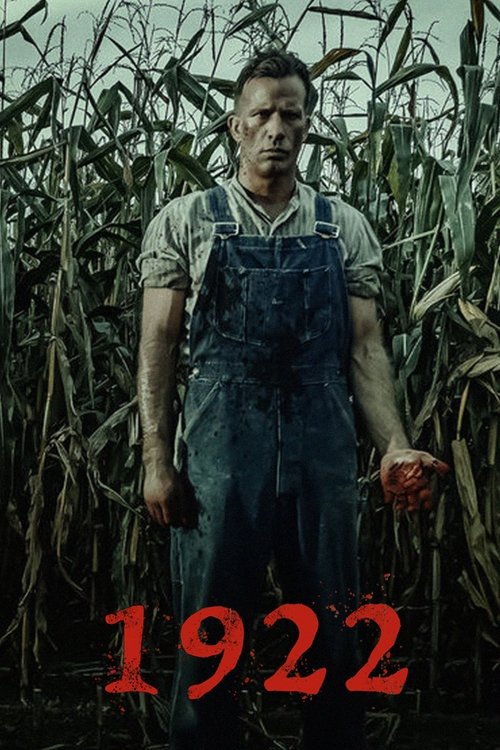
1922 (2017)
Directed by Zak Hilditch
No — 1922 is not woke, scoring 0 out of 100 on our wokeness meter.
Here is a film that commits the unfashionable act of being about something old: a man, his land, his wife, and a butcher knife.
Consciousness Markers
The cast is entirely white and the film makes no effort toward diverse or inclusive representation.
There are no LGBTQ+ characters, themes, or subtext in the film.
Arlette desires independence and threatens divorce, but the narrative treats her as a victim of murder rather than advancing a feminist agenda.
The film is set in an all-white rural Nebraska community and engages no racial themes or consciousness.
There is no environmental or climate-related messaging in the story.
The murder is motivated by personal greed and land disputes, not by a systemic anti-capitalist critique.
The film contains no body-positive themes or messaging.
Wilf's hallucinations and guilt-driven madness are portrayed as supernatural horror, not as neurodivergence.
The 1922 setting is used for atmospheric period horror, not to revise or reinterpret historical narratives.
The film tells its story through atmosphere and character guilt rather than preachy or lecturing dialogue.
Why it received this score
Here is a film that commits the unfashionable act of being about something old: a man, his land, his wife, and a butcher knife. 1922 arrives with Stephen King's name attached and Thomas Jane's face caked in prairie grime, and it asks nothing of its audience except a tolerance for rat imagery and slow spiritual collapse. Wilfred James wants to keep his eighty acres. His wife wants to sell and move to Omaha. He cuts her throat, drops her in a well, and spends the next eight years being devoured from the inside. The film has no interest in instructing us. It simply watches.
The performances are sturdy. Jane, working in a register somewhere between confession and rot, carries the weight of a man who has confused property with identity. Molly Parker's Arlette is dispatched early and returns as a vision, which spares the film the trouble of giving her a life beyond the one she threatens. The son, played by Dylan Schmid, is a boy ruined by complicity, and the film lets that ruin happen without commentary. What we get instead of messaging is weather, corn, rats, and the sound of a well filling up.
Some will find the restraint admirable. Others will find it airless. The film is grim in the way that period horror often is, using 1922 as a texture instead of a thesis, and never once stopping to explain itself to a modern audience. There is no lesson here, no diagnosis of the culture, no invitation to feel virtuous for having watched. Just a farmer, a ghost, and a rodent problem that will not resolve. It is a modest achievement, and an increasingly rare one. The credits roll. The rats stay.
Analysis generated by our Consciousness Algorithm


Synopsis
A simple yet proud rancher conspires to murder his wife for financial gain, convincing his teenage son to participate.
Questions about 1922
Is 1922 woke?
No — 1922 is not woke, scoring 0 out of 100 on our wokeness meter. That earns it a verdict of Ultra Based.
Does 1922 have any woke elements?
No. All 10 markers score zero.
How does 1922 compare to other 2017 movies?
It ranks #281 of the 309 films from 2017 we've scored; their average is 19. The wokest is I Am Not Your Negro (92).
How is the Woke Score calculated?
An AI-assisted process researches the film and its reception, scores it 0–100 on ten markers, then combines those into one 0–100 Woke Score. It measures a specific set of 2020s cultural themes, not film quality.