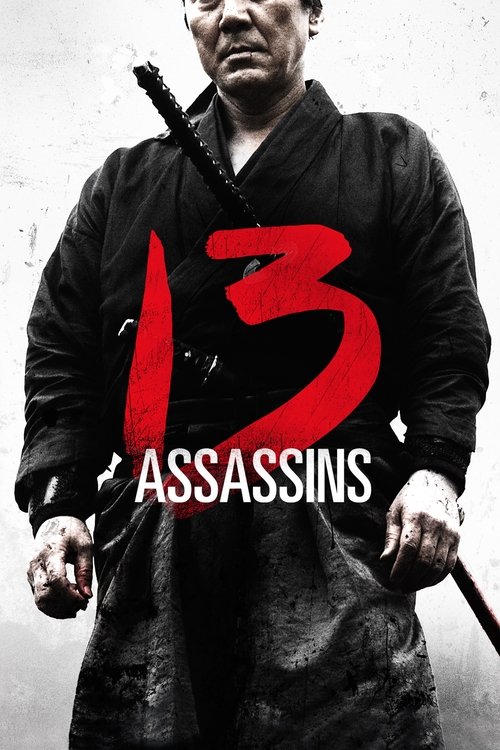
13 Assassins (2010)
Directed by Takashi Miike
No — 13 Assassins is not woke, scoring 14 out of 100 on our wokeness meter.
Takashi Miike's 13 Assassins is a remake of Eiichi Kudo's 1963 chanbara, and it carries itself like a man who read the assignment and decided the assignment was a sword.
Consciousness Markers
Critique of corrupt feudal lords and abuse of power, with a speech that rulers depend on the people, but not a modern anti-capitalist economic critique.
Some moralizing dialogue about lords and people in the climax, but mostly action-driven.
All-Japanese cast in a Japanese period film; no modern diversity casting or race/gender swapping.
No LGBTQ+ characters or themes.
Women are largely victims or absent; no feminist agenda or female agency.
No racial themes; conflict is feudal and political, not racial.
No environmental or climate themes.
No body positivity themes.
No neurodivergence themes.
Fictional jidaigeki set in the Edo period; no ideological rewriting of historical events.
Why it received this score
Takashi Miike's 13 Assassins is a remake of Eiichi Kudo's 1963 chanbara, and it carries itself like a man who read the assignment and decided the assignment was a sword. Thirteen men, twelve samurai and a hunter, plot to kill a sadistic lord before he ascends to the shogunate council. The setting is 1844, which spares the production any obligation to comment on a living society. Every face on screen is Japanese, because the story is Japanese and unfolds in Japan. We note this for the record, since the record is the only thing we keep.
Lord Naritsugu, the target, tortures and murders with the cheer of a man who has never been refused. The film's politics are feudal, not economic. Shinzaemon's closing argument, that a lord cannot survive without the people beneath him, lands as a mild rebuke to tyrants and to no economic system in particular. It is a sentiment old enough to vote. The last act is a 45-minute battle of arrows, explosives, and mud, and whatever sermonizing exists gets buried under the noise of men dying in a booby-trapped village. We are not being lectured at length. We are being entertained, with a brief pause to feel something.
The women are victims or absences, and the film does not stop to interrogate this. There is no romance, no identity politics, no environmental parable, no casting engineered to flatter a modern viewer. A hunter who may or may not be immortal wanders out of the woods and shrugs off a spear through the neck. This is a period piece about power, honor, and the logistics of ambush. It asks nothing of us but attention, and it earns that attention the old way, through craft. The ledger stays clean. The swords do not.
---
Thematic classification: this is a remake of a 1963 film, and nothing else on the list applies. It won no Academy Award, spawned no sequel, adapts no book, depicts no real events, involves no superheroes, and never reached number one at the domestic box office. The swords, once again, do not care.
{"thematic_tags": ["remake"]}
Analysis generated by our Consciousness Algorithm


Synopsis
A bravado period action film set at the end of Japan's feudal era in which a group of unemployed samurai are enlisted to bring down a sadistic lord and prevent him from ascending to the throne and plunging the country into a war-torn future.
Questions about 13 Assassins
Is 13 Assassins woke?
No — 13 Assassins is not woke, scoring 14 out of 100 on our wokeness meter. That earns it a verdict of Ultra Based.
Does 13 Assassins have any woke elements?
Very few. None of the 10 markers reaches 30, the level where a marker counts as present; the highest is Eat the Rich at 20.
How does 13 Assassins compare to other 2010 movies?
It ranks #57 of the 238 films from 2010 we've scored; their average is 11. The wokest is My Name Is Khan (84).
How is the Woke Score calculated?
An AI-assisted process researches the film and its reception, scores it 0–100 on ten markers, then combines those into one 0–100 Woke Score. It measures a specific set of 2020s cultural themes, not film quality.