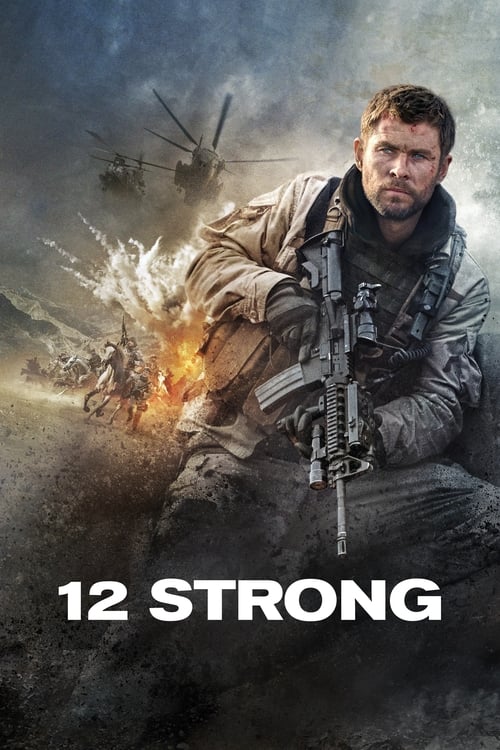
12 Strong (2018)
Directed by Nicolai Fuglsig
No — 12 Strong is not woke, scoring 12 out of 100 on our wokeness meter.
12 Strong arrives with a title that promises a headcount and delivers exactly that.
Consciousness Markers
The Special Forces ensemble is notably multiethnic (Michael Peña, Trevante Rhodes, Navid Negahban, and Afghan actors), but this diversity is presented as a natural feature of a military unit rather than a self-conscious statement.
The film depicts Afghan allies, particularly Dostum, with a measure of respect and cross-cultural brotherhood, but it does so through a conventional American-military lens rather than any racial-consciousness critique.
The film carries a patriotic postscript and some warrior-ethos moralizing, but its messaging is traditional military heroism rather than modern social-justice lecturing.
No LGBTQ+ characters or themes appear anywhere in the film.
Elsa Pataky's wife character is a brief domestic presence; the film offers no feminist framing or commentary on gender.
No environmental or climate themes are present.
The film is a patriotic military procedural with no economic critique of capitalism or the wealthy.
No body-positivity themes or messaging.
No neurodivergence themes or characters.
The film is a straightforward, celebratory account of a real mission, not a revisionist reframing of history.
Why it received this score
12 Strong arrives with a title that promises a headcount and delivers exactly that. Twelve men, one horse-borne cavalry charge, and a mission that planners gave two years and the soldiers finished in twenty-three days. The film is based on Doug Stanton's nonfiction account of Operational Detachment Alpha 595, and it carries the flat, procedural confidence of a briefing document. The ensemble is notably mixed in its casting, with Michael Peña, Trevante Rhodes and Navid Negahban filling out the ranks and the Afghan side of the alliance. None of this is framed as an announcement. The unit simply looks like a unit, and the film moves on. That restraint earns a nod, though it is restraint born of indifference, not of principle.
Where the film does extend itself, it is toward General Dostum, played with gravity by Negahban. The relationship between Mitch Nelson and the warlord gets the only real character work on offer, a study in mutual suspicion softening into brotherhood. It is a generous portrait, and it is also an American one, filtered through the needs of the visiting captain. The Afghan perspective exists to validate the visitor's growth. Elsewhere the film is a desert of concerns. No economic critique, no environmental conscience, no interest in bodies, minds, or genders beyond the standard-issue kind. Elsa Pataky appears as a wife, briefly, to be left behind.
The closing postscript delivers the warrior ethos with a straight face, honoring the dead and the decorated in the customary register. This is old-fashioned patriotic sermonizing, not the newer variety, and it lands with the weight of a monument plaque. A competent, honorable, slightly plodding film about men on horses. The classification is straightforward, and the film seems content with that.
Analysis generated by our Consciousness Algorithm


Synopsis
A team of special forces head into Afghanistan in the aftermath of the September 11th attacks in an attempt to dismantle the Taliban.
Questions about 12 Strong
Is 12 Strong woke?
No — 12 Strong is not woke, scoring 12 out of 100 on our wokeness meter. That earns it a verdict of Ultra Based.
Does 12 Strong have any woke elements?
1 of the 10 markers register at 30 or above, led by Representation Casting (35). On Representation Casting: The Special Forces ensemble is notably multiethnic (Michael Peña, Trevante Rhodes, Navid Negahban, and Afghan actors), but this diversity is presented as a natural feature of a military unit rather than a self-conscious statement.
How does 12 Strong compare to other 2018 movies?
It ranks #169 of the 325 films from 2018 we've scored; their average is 20. The wokest is Return (92).
How is the Woke Score calculated?
An AI-assisted process researches the film and its reception, scores it 0–100 on ten markers, then combines those into one 0–100 Woke Score. It measures a specific set of 2020s cultural themes, not film quality.