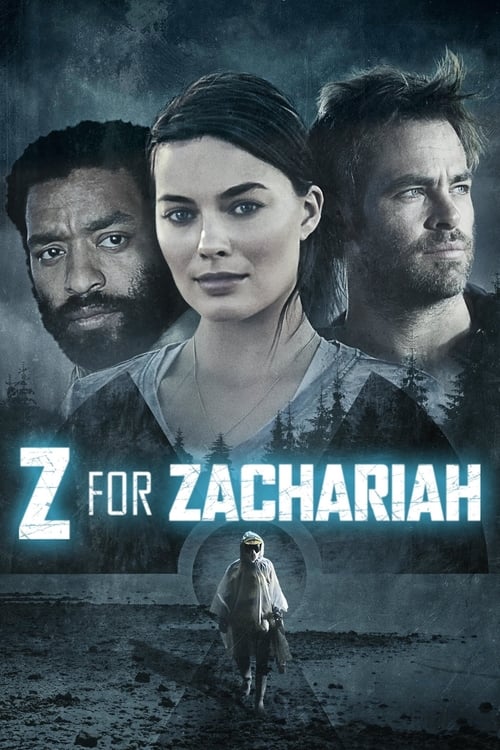
Z for Zachariah (2015)
Directed by Craig Zobel
No — Z for Zachariah is not especially woke, scoring 27 out of 100 on our wokeness meter.
Z for Zachariah is a post-nuclear chamber drama in which three survivors negotiate a valley, a farm, and each other.
Consciousness Markers
Race is an explicit, textual element: John's 'You all be white people together' and Caleb's shared-faith bonding with Ann render the love triangle a racialized one absent from the source novel.
The novel's John Loomis was white; the film race-swaps the role to Chiwetel Ejiofor, placing a Black man as co-lead opposite a white woman and white man, deliberately echoing The World, the Flesh and the Devil.
Ann is the farm-holding protagonist and survivor-narrator by inheritance, giving a woman narrative primacy, but the film frames her as a romantic/religious participant rather than advancing a feminist thesis.
Craig Zobel's film is a slow, restrained character drama that dramatizes its tensions rather than preaching them; any message arrives through implication.
No LGBTQ+ characters or themes appear in this three-hander.
The apocalypse is nuclear, with radiation and fallout as threats; environmental collapse is not the subject.
No economic or class critique; the film is concerned with survival, faith, and jealousy.
No body-image or body-acceptance themes.
No neurodivergence or mental-health-identity framing; John's distress is trauma, not a neurodivergent trait.
The film adapts a 1974 novel but does not rewrite historical record or claim to correct history.
Why it received this score
Z for Zachariah is a post-nuclear chamber drama in which three survivors negotiate a valley, a farm, and each other. Craig Zobel directs with patience and desaturated light, drawing on Tarkovsky for a mood of quiet ruin. The film adapts Robert C. O'Brien's 1974 novel but makes one significant alteration: John Loomis, white on the page, becomes Chiwetel Ejiofor. That choice turns the central love triangle into a racialized one, with a Black man, a white woman, and a white man circling one another in a ruined Eden. The film even echoes The World, the Flesh and the Devil, another last-people triangle. It does not shout about this. It simply lets the tension breathe.
Margot Robbie's Ann owns the farm by inheritance and narrates her own survival, which gives her narrative primacy. Yet the film treats her as a romantic and religious participant more than a vehicle for a feminist argument. Race, by contrast, is textual. John's line, 'You all be white people together,' lands with blunt force, and Caleb's shared faith with Ann sharpens the divide. The film has no LGBTQ characters or themes, no body-image concerns, no neurodivergence framing, no climate crusade (the apocalypse is nuclear), no economic critique, and no revisionist history. Its faith is personal, not corrective.
Lecture energy is low. Zobel dramatizes jealousy, grief, and trust instead of sermonizing, and the result is a slow, humid piece of acting and landscape. The film's cultural markers are present but restrained, like a sommelier detecting a few distinct notes in an otherwise austere vintage. It is not a tract. It is a mood, and the mood is mostly silence.
Analysis generated by our Consciousness Algorithm


Synopsis
In the wake of a nuclear war, a young woman survives on her own, fearing she may actually be the proverbial last woman on earth, until she discovers the most astonishing sight of her life: another human being. A distraught scientist, he’s nearly been driven mad by radiation exposure and his desperate search for others. A fragile, imperative strand of trust connects them. But when a stranger enters the valley, their precarious bond begins to unravel.
Questions about Z for Zachariah
Is Z for Zachariah woke?
No — Z for Zachariah is not especially woke, scoring 27 out of 100 on our wokeness meter. That earns it a verdict of Based.
Does Z for Zachariah have any woke elements?
2 of the 10 markers register at 30 or above, led by Racial Consciousness (60) and Representation Casting (52). On Racial Consciousness: Race is an explicit, textual element: John's 'You all be white people together' and Caleb's shared-faith bonding with Ann render the love triangle a racialized one absent from the source novel.
How does Z for Zachariah compare to other 2015 movies?
It ranks #46 of the 289 films from 2015 we've scored; their average is 15. The wokest is Chi-Raq (78).
How is the Woke Score calculated?
An AI-assisted process researches the film and its reception, scores it 0–100 on ten markers, then combines those into one 0–100 Woke Score. It measures a specific set of 2020s cultural themes, not film quality.