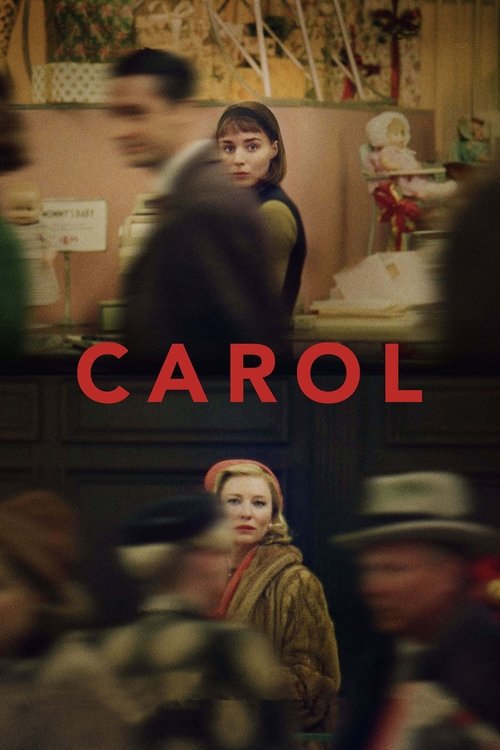
Carol (2015)
Directed by Todd Haynes
Yes — Carol is woke, scoring 60 out of 100 on our wokeness meter.
Todd Haynes has made a film of almost aggressive restraint, in which two women fall in love in 1952 New York and the camera refuses to editorialize.
Consciousness Markers
The film's central romance is between two women, exploring their forbidden love in the 1950s; it is a landmark LGBTQ+ film.
Focuses on women's desires, agency, and a woman's fight for custody while refusing to deny her sexuality, though it avoids explicit feminist rhetoric.
Centers two female leads and a lesbian romance, but the cast is predominantly white and the leads are straight actresses; representation is more about gender and sexuality than racial diversity.
Deliberately restrained and non-preachy, avoiding 'agenda film' tropes; social commentary is implicit.
No engagement with racial issues; the cast is entirely white and the narrative does not address race.
No environmental themes.
No critique of capitalism; the department store setting is incidental.
No body positivity themes.
No neurodivergence themes.
Set in the 1950s but based on a novel, not a revisionist take on historical events.
Why it received this score
Todd Haynes has made a film of almost aggressive restraint, in which two women fall in love in 1952 New York and the camera refuses to editorialize. The romance between Carol Aird and Therese Belivet sits at the center of every frame, handled with a delicacy that most contemporary dramas would find unbearable. There is no breakdown scene, no confession of shame, no speech explaining the historical stakes to a modern audience. The lovers simply love, and the world around them quietly conspires to make that love expensive. As an artifact of queer cinema it operates at the highest level, and the British Film Institute's decision to rank it the greatest LGBTQ film ever made is not difficult to understand.
The film also concerns itself with a woman's desire and her refusal to disown it. When Carol faces a morality clause and the threat of losing her daughter, she declines to lie about who she is, accepting the cost with a composure that borders on the stoic. This is a feminist argument delivered without a manifesto. Therese, meanwhile, builds a life and a career as a photographer, moving from objects to people, from a department store counter to the New York Times. These women want things, and the film lets them pay for wanting them.
Where the film declines to participate is in the broader catalog of contemporary concerns. The cast is uniformly white, and the narrative shows no interest in race, climate, or the failings of capitalism, despite the department store that opens the story. The screenplay was reportedly built to avoid the agenda picture, and it succeeds. Social weight arrives through implication, not instruction. What remains is a love story that trusts its audience to feel the injustice without being told where to look. The restraint is the point, and it is nearly extinct.
Analysis generated by our Consciousness Algorithm


Synopsis
In 1950s New York, a department-store clerk who dreams of a better life falls for an older, married woman.
Questions about Carol
Is Carol woke?
Yes — Carol is woke, scoring 60 out of 100 on our wokeness meter. That earns it a verdict of Woke.
What makes Carol woke?
3 of the 10 markers register at 30 or above, led by LGBTQ+ Themes (95), Feminist Agenda (60) and Representation Casting (45). On LGBTQ+ Themes: The film's central romance is between two women, exploring their forbidden love in the 1950s; it is a landmark LGBTQ+ film.
How does Carol compare to other 2015 movies?
It ranks #6 of the 289 films from 2015 we've scored; their average is 15. The wokest is Chi-Raq (78).
How is the Woke Score calculated?
An AI-assisted process researches the film and its reception, scores it 0–100 on ten markers, then combines those into one 0–100 Woke Score. It measures a specific set of 2020s cultural themes, not film quality.