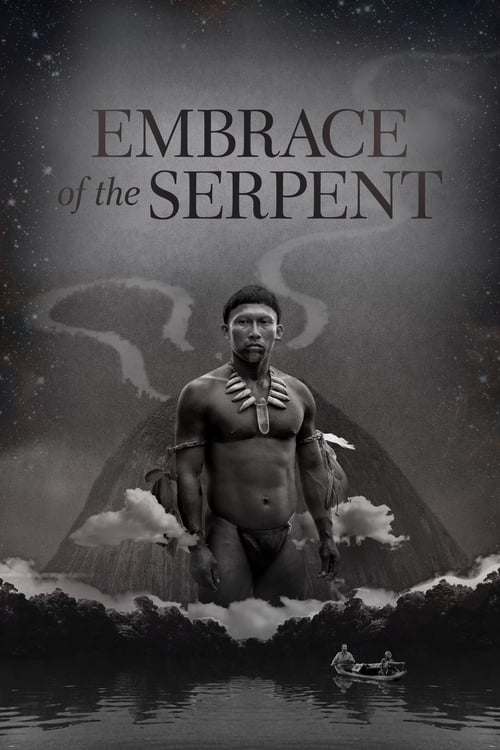
Embrace of the Serpent (2015)
Directed by Ciro Guerra
Yes — Embrace of the Serpent is woke, scoring 66 out of 100 on our wokeness meter.
Ciro Guerra's Embrace of the Serpent arrives in black and white, which is the correct decision for a film about the slow subtraction of a continent.
Consciousness Markers
Explicitly critiques white colonialism, enslavement, and cultural erasure of indigenous peoples.
Features indigenous actors from Amazonian communities and dialogue in multiple indigenous languages (Ocaina, Ticuna, Bora, etc.), centering their perspective.
Critiques the rubber boom, extraction, and enslavement for profit; portrays capitalism and colonialism as destructive.
Depicts the destruction of the Amazon rainforest by rubber barons and colonizers, with ecological devastation as a central theme.
Reimagines colonial history from an indigenous perspective, based on real explorers' journals but fictionalized to center indigenous experience.
Themes are conveyed through poetic imagery and narrative rather than direct preaching; some didactic elements in its colonial critique.
No LGBTQ+ themes or characters.
No feminist agenda; women are largely absent or in traditional roles.
No body positivity themes.
No neurodivergence themes.
Why it received this score
Ciro Guerra's Embrace of the Serpent arrives in black and white, which is the correct decision for a film about the slow subtraction of a continent. Two journeys, thirty years apart, share a shaman named Karamakate and a canoe. The dialogue is largely in Ocaina, Ticuna, Bora and other languages, spoken by people drawn from the communities in question. Antonio Bolívar, one of the last remaining Ocaina speakers, plays the older Karamakate, and the film is built around him with a care that most productions reserve for their catering. This is representation done properly: not a gesture, an architecture.
Guerra's target is the rubber boom, the missions, and the gentlemen scientists who arrive with notebooks and leave with everything. The Amazon is stripped on screen, its trees taken for profit, its people converted and enslaved, and the film regards each transaction with the flat patience of an accountant reviewing a ledger. The critique of extraction is total. Nobody in this film gets rich without something being ruined, usually something that cannot be replaced. The historical record is rearranged so that the indigenous perspective sits at the centre, which is a legitimate act of reclamation and also, plainly, a revision.
Where the film declines to lecture, it mostly trusts its images, and its sermons stay brief and poetic. Women are nearly absent. There is no romantic subplot of any kind. The film has no interest in the body, in diagnosis, or in the contemporary vocabulary of identity beyond the colonial wound itself. It is an old-fashioned kind of angry, the kind that trusts a river to make its argument. We have graded harder-working films more generously. We have also graded worse ones higher, which is the business we are in.
Analysis generated by our Consciousness Algorithm


Synopsis
The epic story of the first contact, encounter, approach, betrayal and, eventually, life-transcending friendship, between Karamakate, an Amazonian shaman, last survivor of his people, and two scientists that, over the course of 40 years, travel through the Amazon in search of a sacred plant that can heal them. Inspired by the journals of the first explorers of the Colombian Amazon, Theodor Koch-Grunberg and Richard Evans Schultes.
Questions about Embrace of the Serpent
Is Embrace of the Serpent woke?
Yes — Embrace of the Serpent is woke, scoring 66 out of 100 on our wokeness meter. That earns it a verdict of Woke.
What makes Embrace of the Serpent woke?
6 of the 10 markers register at 30 or above, led by Racial Consciousness (88), Representation Casting (85) and Eat the Rich (70). On Racial Consciousness: Explicitly critiques white colonialism, enslavement, and cultural erasure of indigenous peoples.
How does Embrace of the Serpent compare to other 2015 movies?
It ranks #3 of the 289 films from 2015 we've scored; their average is 15. The wokest is Chi-Raq (78).
How is the Woke Score calculated?
An AI-assisted process researches the film and its reception, scores it 0–100 on ten markers, then combines those into one 0–100 Woke Score. It measures a specific set of 2020s cultural themes, not film quality.