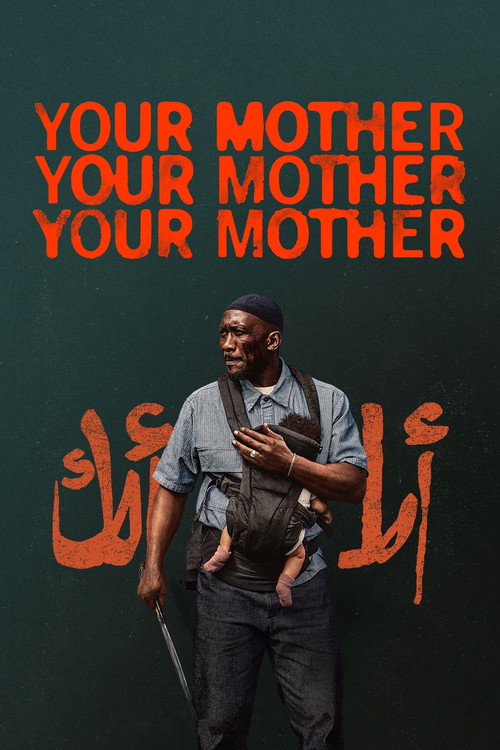
Your Mother Your Mother Your Mother (2026)
Directed by Bassam Tariq
Bassam Tariq's action-thriller arrives carrying the full weight of a representational mission statement, which it wears with more grace than most films that know they are making history.
Consciousness Markers
The film's casting is consciously engineered for representational impact: Mahershala Ali as a devout Muslim protagonist, John Cho deliberately cast against type as a cowboy-hat-wearing Christian nationalist villain, and a director who publicly addressed the burden of Muslim representation at TIFF. This is not incidental diversity; it is the architecture of the film.
The film positions a quietly devout Muslim man against an aggressively Christian nationalist pastor, and critics drew explicit parallels between this dynamic and broader commentary on minority identities under cultural siege. The director's TIFF remarks about correcting Hollywood's flattened Muslim representation confirm the racial and religious consciousness is deliberate.
The film's central narrative engine is a man searching Houston for breast milk for his infant daughter, a plot device critics explicitly framed as re-centering action cinema around maternal labor and domestic nurturing. The title derives from a hadith about the supreme primacy of mothers. The maternal is not background; it is the thesis.
The Christian nationalist villain functions as a fairly blunt ideological counterweight to the Muslim protagonist, and the director's public framing of the film as a corrective to decades of Hollywood misrepresentation gives the project a sermonizing intent. Critics praised the film for avoiding tidy resolution, which prevents the score from climbing higher.
The film undertakes deliberate genre revisionism, rewriting the conventions of the action thriller to center Islamic faith, grief, and maternal caregiving. This is not historical revisionism in the strict sense, but the ideological project of correcting a genre's cultural defaults is present and acknowledged by its creators.
The protagonist targets figures he deems morally corrupt, and the villain operates an illicit network, giving the film a faint anti-establishment undercurrent. This is too diffuse and genre-conventional to register as a genuine anti-capitalist argument.
No LGBTQ+ themes, characters, or subtext are present in the available research or plot summary.
No climate or environmental themes are present in the film's plot, reception, or production context.
No body positivity themes or messaging are present in the available material.
No neurodivergence themes or representation are present in the available material.
Why it received this score
Bassam Tariq's action-thriller arrives carrying the full weight of a representational mission statement, which it wears with more grace than most films that know they are making history. Mahershala Ali plays Latif, a Houston contract killer whose Islamic faith is not a character quirk but the load-bearing wall of his identity. When his wife dies, the film's central quest becomes something no action movie has previously dared to propose: finding human breast milk for an infant who cannot tolerate formula. Critics called this a radical subversion of genre conventions. It is also, in its quiet way, a film that has done a great deal of advance press for itself.
The casting decisions deserve to be taken seriously as cultural arguments, because that is clearly how they were intended. John Cho plays the villain, a fire-and-brimstone evangelical Texas pastor running an armed crusade in a cowboy hat. Cho has acknowledged in interviews that this casting deliberately dismantles expectations. He is correct. It also places Christian nationalism in the role that Hollywood has historically reserved for Islamic extremism, a swap the film makes with full awareness and no particular subtlety. The ideological architecture here is load-bearing in a different sense: remove the inversion and the whole structure loses its point.
What keeps the film from collapsing into a lecture is the genuine texture of Latif's doubt. The research suggests Tariq is interested in religious rage as a psychological condition, not a policy position, and the film's refusal to deliver spiritual resolution earns it some credit against its more schematic instincts. Director Tariq cited Ramy Youssef and Riz Ahmed at TIFF as touchstones for complex Muslim storytelling. The lineage is visible. So is the effort. This is a film that has thought very carefully about what it is doing and would like you to think carefully about it too.
Analysis generated by our Consciousness Algorithm
Synopsis
Latif, a devoutly religious hitman, struggles to balance work, faith and fatherhood. When his wife dies, he embarks on a desperate journey across Houston to protect his children, confronting the forces closing in around him – and the beliefs threatening to unravel within.