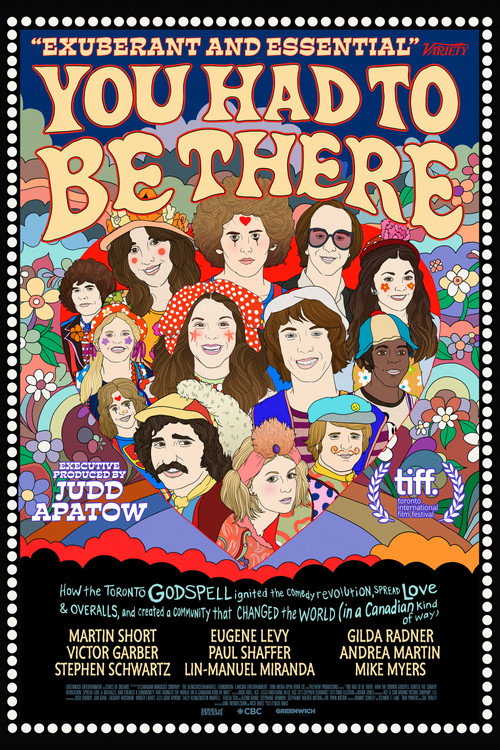
You Had to Be There: How the Toronto Godspell Ignited the Comedy Revolution... (2026)
Directed by Nick Davis
You Had to Be There arrives as a documentary so cheerfully free of contemporary social messaging that scoring it on this rubric feels faintly absurd, like running a wine through a breathalyzer.
Consciousness Markers
Avril Chown's on-camera disclosure of sexual assaults she experienced in the industry after Godspell is the film's one genuinely sober moment and carries an implicit feminist weight. The film does not editorialize around it, which is to its credit, but the disclosure is there.
Victor Garber, who is openly gay, appears as a central interview subject, and the film does not make his sexuality a theme or a talking point. His presence is noted here purely in the spirit of completeness.
The 1972 ensemble included Rudy Webb as its sole Black cast member, a fact the documentary registers without turning it into a programmatic statement about diversity. The film is not assembling a modern showcase cast; it is interviewing elderly Canadians about a show that happened fifty years ago.
The documentary touches, however lightly, on the cultural irony of a Jesus musical becoming the launchpad for a generation of Jewish comedians. This is framed as charming historical curiosity, not racial consciousness-raising, and the film declines to interrogate the whiteness of early Canadian comedy.
A documentary about 1972 Toronto theatre has no occasion to discuss the climate, and it does not.
The film is, if anything, a warm endorsement of the entertainment industry as a vehicle for artistic self-actualization. No rich people are eaten.
No evidence of this theme in any form.
No evidence of this theme in any form.
The film is engaged in straightforward historical preservation, not revisionism. It wants to tell you who was in this cast, not reframe what the 1970s meant.
Critics across every major outlet described the film as uncynical, warm, and nostalgic. There is no lecturing energy detectable here. The film is too busy being delighted with itself to scold anyone.
Why it received this score
You Had to Be There arrives as a documentary so cheerfully free of contemporary social messaging that scoring it on this rubric feels faintly absurd, like running a wine through a breathalyzer. Director Nick Davis has assembled the surviving members of the 1972 Toronto Godspell cast, pointed a camera at them, and allowed them to be charming for ninety-odd minutes. Martin Short is charming. Eugene Levy is charming. Victor Garber is charming. The film does not complicate this. It does not ask us to reckon with anything. It simply documents, with evident affection, the moment a low-budget Canadian musical accidentally became a petri dish for North American comedy, producing SCTV, Saturday Night Live, and several decades of cultural output that will outlast most things currently being argued about on the internet.
The film's one moment of genuine gravity belongs to cast member Avril Chown, who discloses on camera that she left the entertainment industry after experiencing repeated sexual assaults on a children's television production shortly after Godspell ended its run. The documentary handles this with restraint, which is the correct choice, and then returns to being warm and nostalgic, which is also the correct choice. There is a faint feminist register to this disclosure, and it has been noted accordingly in the scoring. The observation that a musical about Jesus became a cultural launchpad for Jewish comedians is also present, framed as the kind of irony the universe occasionally produces without anyone's help.
The overall profile here is of a film that is, in the technical vocabulary of this enterprise, essentially inert. It is a document of a thing that happened, made by people who are glad it happened, for audiences who will also be glad. Lin-Manuel Miranda appears to offer his endorsement, which is the contemporary equivalent of a historical plaque. The film earned second runner-up for the TIFF People's Choice Documentary Award, a distinction that suggests it succeeded at being liked. We have nothing further to add.
Analysis generated by our Consciousness Algorithm
Synopsis
Martin Short, Eugene Levy, Gilda Radner, Victor Garber, Paul Shaffer, and other entertainment icons got their start in a 1972 Toronto production of the musical Godspell. Featuring interviews with the surviving cast members, Lin-Manuel Miranda, Mike Myers, and more, the film recounts a pivotal moment in comedy history, in hilarious, moving, and inspiring detail.