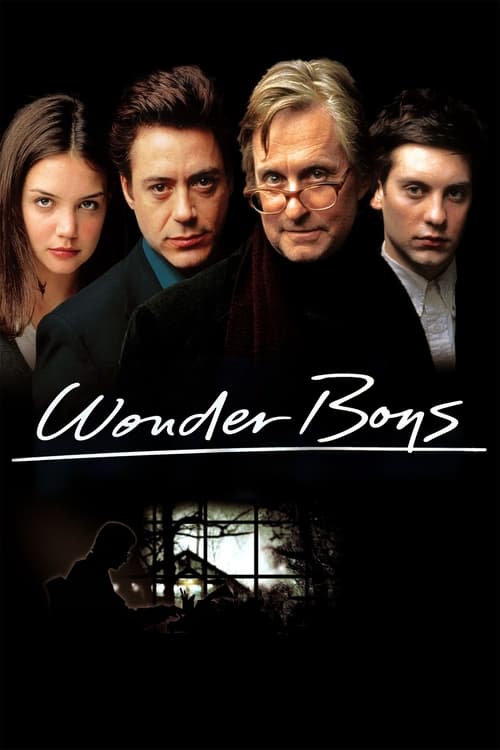
Wonder Boys (2000)
Directed by Curtis Hanson
No — Wonder Boys is not woke, scoring 12 out of 100 on our wokeness meter.
Wonder Boys presents itself as a deeply textured study of academic malaise, an adaptation of Michael Chabon’s novel that successfully navigates the ennui of a celebrated, yet stagnant, literary career.
Consciousness Markers
A significant subplot involves editor Terry Crabtree's bisexuality, his fling with a trans woman, and his later sexual encounter with student James Leer.
The cast is overwhelmingly white and male-centered, though it includes a trans woman character and a bisexual male character in supporting roles.
Frances McDormand's chancellor has professional authority, but the film is primarily a male midlife-crisis story and offers no feminist critique.
The film has no meaningful engagement with race or racial identity.
There is no climate or environmental theme in the film.
The publishing-industry backdrop is not used for any anti-capitalist or eat-the-rich argument.
The film does not engage with body-positivity themes.
James Leer's depression and compulsive lying are not framed through a neurodivergence lens.
The film is a contemporary character study with no historical revisionism.
Wonder Boys is a meandering character comedy-drama and does not lecture the audience on social issues.
Why it received this score
Wonder Boys presents itself as a deeply textured study of academic malaise, an adaptation of Michael Chabon’s novel that successfully navigates the ennui of a celebrated, yet stagnant, literary career. While the film possesses a certain gravitational pull, owing to its rich character work and atmospheric setting, its progressive sensibilities remain remarkably peripheral. The central narrative, a protracted exploration of a middle-aged man adrift in a professional crisis, functions primarily as a male drama. The infrequent appearances of varied perspectives, such as a trans woman in a supporting role or the Bisexual nature of one of the supporting characters, are modest, insufficient to suggest any significant shift in the film’s cultural orientation.
We find little in the way of challenging social commentary. The screenplay avoids any substantial engagement with race, climate change, or economic critique. The publishing industry, the backdrop for the film’s internal anxieties, is treated with a literary reverence rather than an anti-capitalist lens. The absence of a thematic focus on environmentalism or systemic inequality is perhaps the most striking feature. Similarly, the film does not attempt to frame James Leer’s struggles through a lens of neurodivergence; his actions are viewed purely as a result of general adolescent self-absorption.
Ultimately, this is a film concerned with the interior life of its characters, a meticulous rendering of a specific type of literary life. Its moments of social awareness are quiet, almost incidental, rather than intentional. The film’s emotional resonance is found in its melancholy rather than its ideological stance. It is a skillfully crafted piece of cinema that simply does not aspire to the level of cultural confrontation found in more explicitly modern, socially conscious works.
Analysis generated by our Consciousness Algorithm
Part of


Synopsis
Grady is a 50-ish English professor who hasn't had a thing published in years—not since he wrote his award winning 'Great American Novel' 7 years ago. This weekend proves even worse than he could imagine as he finds himself reeling from one misadventure to another in the company of a new wonder boy author.
Questions about Wonder Boys
Is Wonder Boys woke?
No — Wonder Boys is not woke, scoring 12 out of 100 on our wokeness meter. That earns it a verdict of Ultra Based.
Does Wonder Boys have any woke elements?
1 of the 10 markers register at 30 or above, led by LGBTQ+ Themes (40). On LGBTQ+ Themes: A significant subplot involves editor Terry Crabtree's bisexuality, his fling with a trans woman, and his later sexual encounter with student James Leer.
How does Wonder Boys compare to other 2000 movies?
It ranks #48 of the 125 films from 2000 we've scored; their average is 13. The wokest is But I'm a Cheerleader (72).
How is the Woke Score calculated?
An AI-assisted process researches the film and its reception, scores it 0–100 on ten markers, then combines those into one 0–100 Woke Score. It measures a specific set of 2020s cultural themes, not film quality.