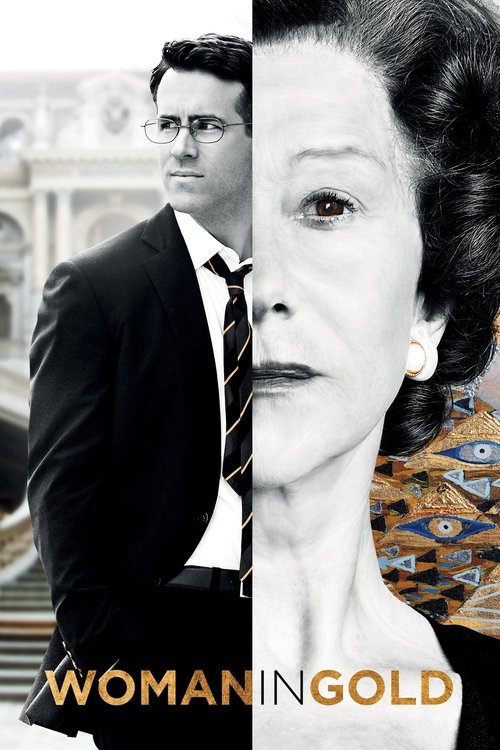
Woman in Gold (2015)
Directed by Simon Curtis
No — Woman in Gold is not woke, scoring 14 out of 100 on our wokeness meter.
Here is a film that arrives with its credentials in order: a true story of Nazi looting, an elderly survivor, a Supreme Court case, and Helen Mirren in sensible spectacles.
Consciousness Markers
The climactic arbitration scene has Schoenberg delivering an earnest moral lecture on the meaning of restitution and Nazi crimes, giving the film a moderate didactic streak.
The film centers on a determined elderly woman taking on a government, but her gender is incidental to a story about art restitution rather than a vehicle for feminist argument.
The film depicts Nazi persecution of a Jewish family, but treats it as historical tragedy rather than framing it through modern racial-justice consciousness.
The cast is overwhelmingly white and European, with no deliberate diverse or color-conscious casting choices; Jewish characters are played by non-Jewish actors without comment.
The film takes documented dramatic liberties with the historical record (e.g., Rehnquist's role, Altmann's departure), but these are conventional biopic embellishments rather than ideologically revisionist reframing.
The antagonist is a national gallery and government bureaucracy hoarding art, but the film frames this as a legal and moral wrong rather than a critique of capitalism or wealth.
There are no LGBTQ+ characters, relationships, or themes anywhere in the film.
There is no environmental or climate theme in the film.
There is no body-positivity theme or messaging in the film.
There is no depiction or discussion of neurodivergence in the film.
Why it received this score
Here is a film that arrives with its credentials in order: a true story of Nazi looting, an elderly survivor, a Supreme Court case, and Helen Mirren in sensible spectacles. It is the kind of prestige drama that British producers assemble the way a caterer assembles a cold buffet, with every item recognizable and nothing requiring a second look. The moral stakes are unimpeachable. The filmmaking is not. One sits through it the way one sits through a very long museum wall text.
On the matter of social consciousness, the picture is largely content to be a period piece about persecution suffered rather than a statement about persecution as a living theme. The Jewish family at its center is rendered as historical tragedy, not as a launching point for contemporary racial reckoning. The cast is white and European throughout, and the Jewish characters are played by performers who are not Jewish, a choice the film regards as unremarkable. Maria Altmann's stubbornness against a national bureaucracy is admirable but reads as a legal quest, not a gender argument. There is no romance outside heterosexuality, no environmental concern, no attention to body or mind. The antagonist is a gallery and a government, which the film treats as a moral wrong rather than a symptom of any economic order.
Where the picture does lean forward is in the arbitration chamber, where Ryan Reynolds delivers a closing speech about the meaning of restitution that is earnest, well-intentioned, and roughly four minutes longer than it needs to be. The screenplay also reshapes the historical record in the standard biopic manner, most notably in the invented courtroom sympathies of the Chief Justice, though these are conveniences of storytelling, not ideology. What remains is a respectable, muted, faintly wearying film that believes decency is sufficient and never asks whether decency is enough.
Analysis generated by our Consciousness Algorithm


Synopsis
Maria Altmann, an octogenarian Jewish refugee, takes on the government to recover artwork she believes rightfully belongs to her family.
Questions about Woman in Gold
Is Woman in Gold woke?
No — Woman in Gold is not woke, scoring 14 out of 100 on our wokeness meter. That earns it a verdict of Ultra Based.
Does Woman in Gold have any woke elements?
1 of the 10 markers register at 30 or above, led by Lecture Energy (35). On Lecture Energy: The climactic arbitration scene has Schoenberg delivering an earnest moral lecture on the meaning of restitution and Nazi crimes, giving the film a moderate didactic streak.
How does Woman in Gold compare to other 2015 movies?
It ranks #112 of the 289 films from 2015 we've scored; their average is 15. The wokest is Chi-Raq (78).
How is the Woke Score calculated?
An AI-assisted process researches the film and its reception, scores it 0–100 on ten markers, then combines those into one 0–100 Woke Score. It measures a specific set of 2020s cultural themes, not film quality.