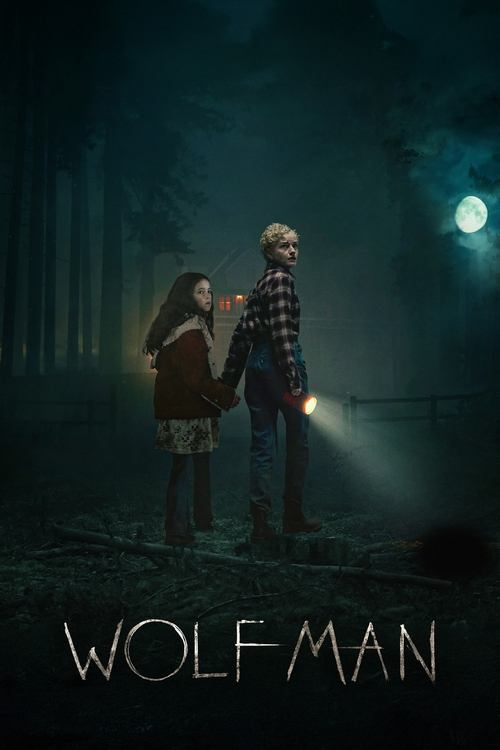
Wolf Man (2025)
Directed by Leigh Whannell
No — Wolf Man is not woke, scoring 6 out of 100 on our wokeness meter.
Leigh Whannell's Wolf Man arrives as a sober, rain-soaked reboot of a Universal property, and it conducts itself with the grim efficiency of a creature feature that has no interest in broader cultural argument.
Consciousness Markers
Julia Garner's Charlotte is a working journalist and mother who ultimately survives and kills the monster, and Garner researched societal pressures on working mothers, but this is standard survival-horror material rather than a feminist thesis.
A single line references Native American tribes naming the disease 'ma'iingan odengwaan' or 'Face of the Wolf,' a passing nod with no thematic development.
Whannell's film is an intimate, atmospheric horror piece with no preachy messaging or moralizing monologues.
The cast is overwhelmingly white, led by Christopher Abbott, Julia Garner, and Matilda Firth, with no notable diverse casting choices or commentary on representation.
There are no LGBTQ+ characters, relationships, or themes anywhere in the film.
The film contains no environmental or climate-related themes whatsoever.
There is no economic critique or anti-capitalist messaging in this creature feature.
Body image and body positivity are not themes; the physical transformation is horror spectacle, not a statement about body acceptance.
The infection is modeled on neurodegenerative disease like ALS, but this is used for tragic body-horror effect rather than as neurodivergence representation or advocacy.
The film is a straightforward reboot of the Universal Monster and makes no attempt to revise or reinterpret historical events.
Why it received this score
Leigh Whannell's Wolf Man arrives as a sober, rain-soaked reboot of a Universal property, and it conducts itself with the grim efficiency of a creature feature that has no interest in broader cultural argument. The cast is overwhelmingly white, led by Christopher Abbott, Julia Garner, and Matilda Firth, and nobody seems to have been cast to make a point. The concerns are marital strain, paternal inheritance, and the slow horror of losing his mind to infection. There is a single line about Native American tribes calling the disease ma'iingan odengwaan, or Face of the Wolf, and then the movie moves on. A nod is not a thesis. The gesture registers as local color, not as racial consciousness.
Julia Garner's Charlotte is a journalist and a mother, and Garner reportedly interviewed working mothers about societal pressure. In practice, Charlotte spends most of the runtime barricading doors, wielding a hammer, and eventually firing the fatal shot. This is competent survival-horror material, not a feminist reimagining. Mothers in horror have been surviving and killing monsters for decades. The film has no LGBTQ characters or themes. It has no environmental agenda, no critique of capital, no body-positive reading of its own transformation effects, and no advocacy around neurodivergence, even though the infection is modeled on neurodegenerative disease. The prosthetics are designed to disturb, not to celebrate. The werewolf's changing body is a tragedy, not a statement. Whannell has spoken about a friend who died of ALS, but the film turns that grief into spectacle, not into a platform.
Whannell keeps the camera close and the dialogue sparse. There are no sermons, no moralizing monologues, and no attempt to revise history. The result is a film that wants to be intimate and sad, and mostly succeeds on those terms. As a cultural document, it is nearly inert. It offers a few faint ripples of contemporary awareness, then retreats into the dark. We are left with a well-made monster movie that has nothing to teach us about the present moment, which may be the most honest thing about it.
Analysis generated by our Consciousness Algorithm
Part of


Synopsis
With his marriage fraying, Blake persuades his wife Charlotte to take a break from the city and visit his remote childhood home in rural Oregon. As they arrive at the farmhouse in the dead of night, they're attacked by an unseen animal and barricade themselves inside the home as the creature prowls the perimeter. But as the night stretches on, Blake begins to behave strangely, transforming into something unrecognizable.
Questions about Wolf Man
Is Wolf Man woke?
No — Wolf Man is not woke, scoring 6 out of 100 on our wokeness meter. That earns it a verdict of Ultra Based.
Does Wolf Man have any woke elements?
Very few. None of the 10 markers reaches 30, the level where a marker counts as present; the highest is Feminist Agenda at 15.
How does Wolf Man compare to other 2025 movies?
It ranks #187 of the 217 films from 2025 we've scored; their average is 26. The wokest is STRAW (92).
How is the Woke Score calculated?
An AI-assisted process researches the film and its reception, scores it 0–100 on ten markers, then combines those into one 0–100 Woke Score. It measures a specific set of 2020s cultural themes, not film quality.