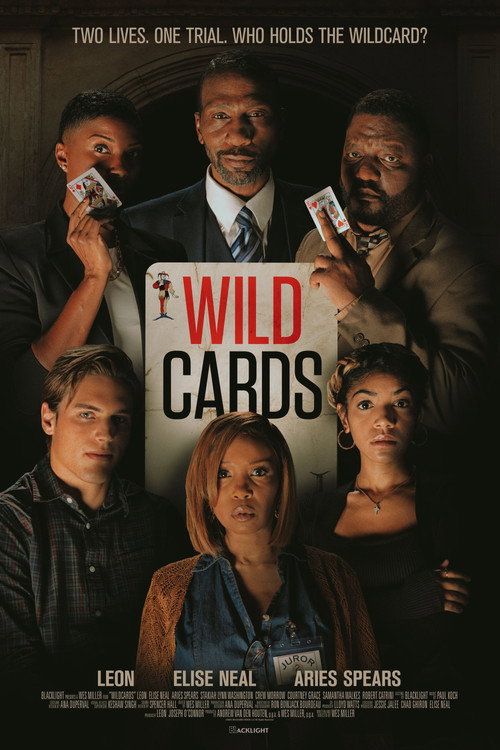
Wildcards (2026)
Directed by Wes Miller
Wildcards arrives in the tradition of the American courtroom thriller, a genre that has always understood that the law is an excellent container for social anxiety.
Consciousness Markers
Race is not a subtext here, it is the text. A privileged white defendant, a Black female victim, a racially diverse jury navigating systemic bias, and community screenings paired with discussions on racial accountability in the legal system form the film's entire skeleton.
The film is produced by a Black-led production entity, features a predominantly Black cast in positions of authority and moral complexity, and casts a white actor specifically as the privileged accused. The racial composition of the cast is not incidental but load-bearing.
The central crime is sexual assault of a young woman, and a key juror's arc involves the experience of being unseen and disbelieved in institutional settings. The film asks, with some urgency, whether women are believed in a courtroom.
The director's stated mission to examine 'the discourse in our country' and the film's touring theatrical model, explicitly paired with community leader Q&As on legal reform and racial accountability, signals a film that considers itself a conversation starter. The packaging is thriller; the intent is seminar.
The accused is explicitly described as 'privileged,' and wealth is framed as a structural advantage in the legal system. The critique is secondary to the racial framing and does not stand alone as a class-conscious argument.
No LGBTQ+ themes, characters, or narrative elements are present in the available material.
No climate or environmental themes are present in the film.
No body positivity themes or related narrative elements are present in the available material.
No neurodivergence themes or characters are present in the available material.
The film is a fictional contemporary legal thriller and does not engage in reframing historical events or figures.
Why it received this score
Wildcards arrives in the tradition of the American courtroom thriller, a genre that has always understood that the law is an excellent container for social anxiety. Wes Miller, a lawyer by training, has constructed a jury-room procedural in which almost every variable has been pre-assigned its symbolic weight: the defendant is young, white, and wealthy; the victim is a young Black woman; the jury is diverse in ways the film intends you to notice; and the lone Black female juror, played by Elise Neal, carries the additional burden of representing institutional invisibility. The film is not subtle about any of this. It does not aspire to subtlety. Subtlety, one senses, was discussed and voted down in the writers' room.
The racial consciousness on display is not incidental texture but the film's structural foundation. Where a film like 12 Angry Men used the jury room to examine individual conscience against mob pressure, Wildcards uses it to examine systemic bias, privilege, and the credibility gap afforded to Black women in American legal proceedings. These are legitimate and serious subjects. The film's distribution strategy, touring single-night screenings paired with live Q&As featuring community leaders and discussions on legal reform, confirms that Miller intends the film to function as civic education wrapped in a thriller's clothing. The director himself described the project as examining national discourse. We take him at his word. The film does examine national discourse. At length.
What keeps the needle from burying itself is the film's evident commercial ambition. Miller's stated goal of producing something "fast-paced and commercially viable" creates a productive friction with the sermonizing undertow, and the cast, anchored by Leon as a morally conflicted defense attorney, brings enough genuine complexity to prevent the whole enterprise from collapsing into a PowerPoint presentation with cinematography. The privilege critique is present but largely subordinate to the racial framework, functioning more as a supporting argument than a thesis. The result is a film that knows exactly what it wants to say and is committed to saying it, which is either a strength or a liability depending entirely on your appetite for films that arrive with a syllabus attached.
Analysis generated by our Consciousness Algorithm
Synopsis
A jury deliberating the case of Theodore Sterling, a privileged young man accused of sexual assault of a 20-something African-American woman. The prosecution is led by Assistant State Attorney James Jones, an overworked yet determined prosecutor, who faces off against Greg Sims, a veteran defense attorney with an unbroken 25-year winning streak.