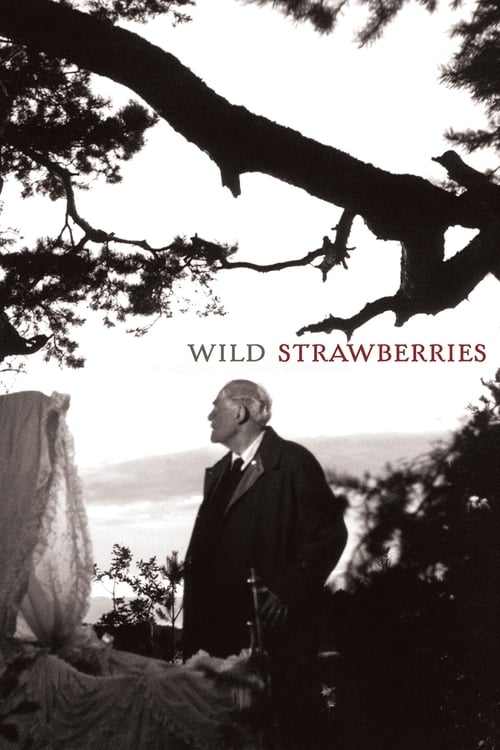
Wild Strawberries (1957)
Directed by Ingmar Bergman
No — Wild Strawberries is not woke, scoring 0 out of 100 on our wokeness meter.
Ingmar Bergman's Wild Strawberries (1957) concerns an elderly bacteriologist named Isak Borg who drives from Stockholm to Lund to collect an honorary degree, and who spends the journey being ambushed by his own memories.
Consciousness Markers
The cast is entirely white Swedish actors, with no evident effort toward inclusive or diverse representation.
There are no LGBTQ+ themes, characters, or subtext in the film.
The film includes female characters with inner lives, but it does not advance a feminist agenda or critique patriarchy in modern terms.
Race is not a subject or concern in the film's narrative or themes.
There is no environmental or climate-related messaging in the film.
The film critiques personal coldness and emotional failure, not capitalism or wealth inequality.
There is no body-positivity theme or challenge to conventional beauty standards.
The film explores memory, dreams, and existential regret, but not neurodivergence as a social or identity category.
The film is a fictional, semi-autobiographical meditation and does not revise historical narratives.
Its philosophical themes are introspective and artistic rather than delivered as modern social-justice lecturing.
Why it received this score
Ingmar Bergman's Wild Strawberries (1957) concerns an elderly bacteriologist named Isak Borg who drives from Stockholm to Lund to collect an honorary degree, and who spends the journey being ambushed by his own memories. There are dreams, a childhood sweetheart, a pair of feuding spouses ejected from the car, and a great deal of quiet Scandinavian regret. Victor Sjöström plays the old man with the weariness of someone who has genuinely earned it, and the picture remains a landmark of mid-century European art cinema. It also presents our current classification apparatus with almost nothing to work on, which is its own kind of respite.
We searched the film diligently for the signifiers of contemporary social consciousness and came away empty. The cast is uniformly Swedish and uniformly pale. Marianne and Sara are drawn with real interiority, yet the film has no interest in patriarchy as a system to be indicted. Race never surfaces as a subject, nor does the environment, nor the politics of wealth. Borg's failings are emotional and personal: coldness, vanity, an inability to love. Bergman locates the problem inside one man's soul, not inside an economic order, and he declines to lecture. The final dream of a lakeside picnic offers reconciliation, not instruction.
This leaves the ledger blank across every column we maintain. That is not a criticism of the film. A 1957 Swedish meditation on mortality was never going to traffic in the cultural vocabulary of the 2020s, and demanding that it do so would be an act of critical vandalism. We record the zeroes and move on, chastened, mildly bored, and quietly admiring the strawberries.
Analysis generated by our Consciousness Algorithm


Synopsis
Crotchety retired doctor Isak Borg travels from Stockholm to Lund, Sweden, with his unhappy daughter-in-law, Marianne, in order to receive an honorary degree from his alma mater. Along the way, they encounter a series of hitchhikers, each of whom causes the elderly doctor to muse upon the pleasures and failures of his own life. These include the vivacious young Sara, a dead ringer for the doctor's own first love.
Questions about Wild Strawberries
Is Wild Strawberries woke?
No — Wild Strawberries is not woke, scoring 0 out of 100 on our wokeness meter. That earns it a verdict of Ultra Based.
Does Wild Strawberries have any woke elements?
No. All 10 markers score zero.
How does Wild Strawberries compare to other 1957 movies?
It ranks #10 of the 13 films from 1957 we've scored; their average is 3. The wokest is 12 Angry Men (18).
How is the Woke Score calculated?
An AI-assisted process researches the film and its reception, scores it 0–100 on ten markers, then combines those into one 0–100 Woke Score. It measures a specific set of 2020s cultural themes, not film quality.