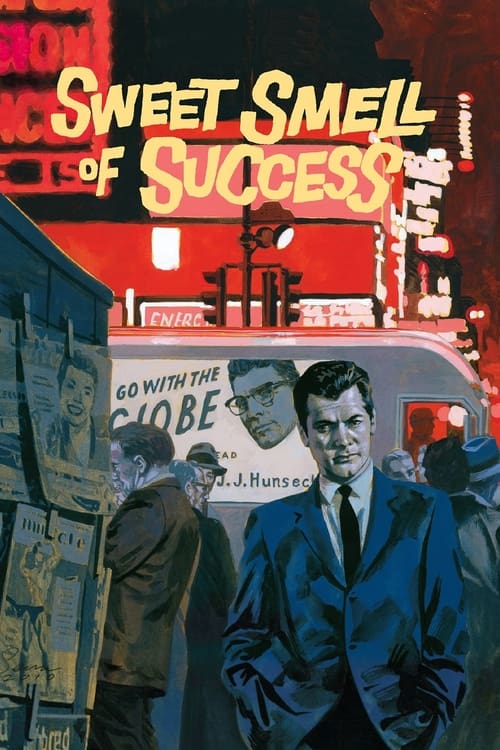
Sweet Smell of Success (1957)
Directed by Alexander Mackendrick
No — Sweet Smell of Success is not woke, scoring 5 out of 100 on our wokeness meter.
The 1957 vintage arrives in black and white, dialogue-dense, and unimpressed by anyone's feelings.
Consciousness Markers
The film is a venomous portrait of press corruption and the abuse of influence, but its target is personal ambition and moral rot rather than capitalism or class as such.
The film is dialogue-dense and morally acidic, and Steve delivers a short rebuke of J.J.'s malignant social influence, but it dramatizes rather than preaches.
Susan is largely a possession fought over by men, and Rita is coerced into a sexual favor to keep her job; the film offers no feminist critique of this dynamic, only Susan's final flight from her brother.
The cast is entirely white, consistent with 1957 Hollywood studio practice; no minority characters appear in the story at all.
No LGBTQ+ characters, themes, or subtext anywhere in the film.
Race is never a subject of the film; the jazz milieu and New York press world are depicted without any engagement with racial politics.
No environmental or climate content whatsoever.
No body-positivity themes; the film's attitude toward women's appearances is conventionally mid-century and at times leering.
No depiction or discussion of neurodivergence.
Set in its own present-day New York; no historical revisionism of any kind.
Why it received this score
The 1957 vintage arrives in black and white, dialogue-dense, and unimpressed by anyone's feelings. Alexander Mackendrick's camera stalks Times Square while Clifford Odets and Ernest Lehman supply a vernacular that no New Yorker ever spoke and every New Yorker wishes he had. Burt Lancaster, behind vaselined glasses, plays a columnist who ruins a jazz guitarist out of sibling jealousy; Tony Curtis plays the press agent who does the ruining for a shot at the byline. The film is a study in moral rot, and it is entirely comfortable being one. Its New York is uniformly white, its jazz milieu decorative, its gaze on women leering and mid-century. Nothing in the frame reaches for a social thesis about race, sexuality, the climate, or the mind. Instead it offers appetite, corruption, and wit.
The women fare as objects of exchange. Susan exists to be fought over by two men and then to walk into the dawn; Rita is traded to a columnist to keep her job, and the film records this without a flicker of objection. There is no critique of the arrangement, only the fact of it. The corruption on display is personal, not structural. J.J. Hunsecker is a monster of vanity and influence, and the script hates him for it. It does not hate the system that made him, or the money, or the class that reads him. Ambition is the villain here. Capital is merely the weather.
The film lectures no one. It dramatizes, acidly, and lets the audience do its own moral arithmetic. Steve gets one speech about malignant influence and then the scene moves on. This is a picture of enormous craft and almost no contemporary social consciousness. We classify it accordingly, with respect.
Analysis generated by our Consciousness Algorithm


Synopsis
New York City newspaper writer J.J. Hunsecker holds considerable sway over public opinion with his Broadway column, but one thing that he can't control is his younger sister, Susan, who is in a relationship with aspiring jazz guitarist Steve Dallas. Hunsecker strongly disapproves of the romance and recruits publicist Sidney Falco to find a way to split the couple, no matter how ruthless the method.
Questions about Sweet Smell of Success
Is Sweet Smell of Success woke?
No — Sweet Smell of Success is not woke, scoring 5 out of 100 on our wokeness meter. That earns it a verdict of Ultra Based.
Does Sweet Smell of Success have any woke elements?
Very few. None of the 10 markers reaches 30, the level where a marker counts as present; the highest is Eat the Rich at 12.
How does Sweet Smell of Success compare to other 1957 movies?
It ranks #2 of the 13 films from 1957 we've scored; their average is 3. The wokest is 12 Angry Men (18).
How is the Woke Score calculated?
An AI-assisted process researches the film and its reception, scores it 0–100 on ten markers, then combines those into one 0–100 Woke Score. It measures a specific set of 2020s cultural themes, not film quality.