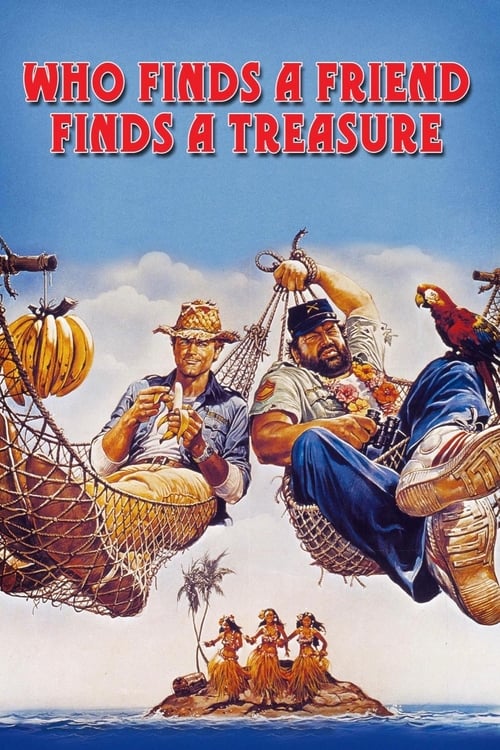
Who Finds a Friend Finds a Treasure (1981)
Directed by Sergio Corbucci
No — Who Finds a Friend Finds a Treasure is not woke, scoring 5 out of 100 on our wokeness meter.
By 1981 the partnership of Terence Hill and Bud Spencer had settled into a comfortable rhythm: two large men, one boat, an island, and a great many punches.
Consciousness Markers
Pacific islander characters are played by native-named performers (Kainowa Lauritzen, Mirna Seya, etc.), but this is 1981 stunt casting for a slapstick adventure, not a modern representation agenda.
The natives being captured as slaves by pirates is a plot device for the heroes to punch, not a modern racial-consciousness statement.
Gangsters and pirates serve as generic villains to be beaten up; there is no economic critique or eat-the-rich framing.
The comedic Japanese holdout who thinks WWII continues is a farcical gag, not a revisionist-historical argument.
No LGBTQ+ characters, subtext, or themes anywhere in the film.
Louise Bennett's 'Mama' is a background maternal figure; the film is a male buddy punch-up with no feminist framing whatsoever.
No environmental or climate themes exist in this Pacific-island treasure romp.
Bud Spencer's heft is used for comedic brawling, not as any body-positivity statement.
No neurodivergent characters or themes are present.
This is pure slapstick and fistfights with zero sermonizing or moral lecturing.
Why it received this score
By 1981 the partnership of Terence Hill and Bud Spencer had settled into a comfortable rhythm: two large men, one boat, an island, and a great many punches. Who Finds a Friend Finds a Treasure follows a gambler fleeing his creditors and an actor promoting a terrible brand of jam, both of whom wash up on a Pacific island that turns out to be inhabited, periodically raided by pirates, and guarded by a Japanese holdout who never received the news that the war ended. Sergio Corbucci directs with the efficient indifference of a man completing a contract.
The islanders are played by performers with native names, which lends the production a faint sheen of authenticity, though the film's interest in them extends only as far as their usefulness as people to be rescued. Pirates capture them for the slave trade, a device that exists so the heroes have someone to avenge with their fists. No argument is made about empire, extraction, or the price of the Pacific. The Japanese soldier is pure farce, a man in a bunker still fighting a concluded war, and the humor rests on his stubbornness, not on any reconsideration of history. Louise Bennett appears as Mama, a maternal figure with a handful of lines, and the film's emotional register begins and ends with male friendship and knuckles.
Bud Spencer's bulk functions as a comic weapon, a body built for throwing men through walls, and the screenplay has no thoughts about it beyond that. There is no romance, no sermon, no lesson, no closing plea to the audience. The heroes end up broke, working as museum janitors, having handed a priceless idol to an institution. If that reads as commentary on anything, it is accidental, and the movie is too busy throwing haymakers to notice. A cultural artifact of the lowest possible ambition, executed with genuine craft.
Analysis generated by our Consciousness Algorithm


Synopsis
Alan gets a map to some war treasure which the Japanese army left behind on a small Pacific island at the end of World War II. But some gangsters try to steal the map from him and so he hides on Charlie's boat which just leaves the harbor. He manipulates the ship's compass so that Charlie is not aware that he is sailing to the treasure island. But when they step on the island, they discover that it is not as abandoned as they believed: there are some natives - and a Japanese soldier still defending the treasure
Questions about Who Finds a Friend Finds a Treasure
Is Who Finds a Friend Finds a Treasure woke?
No — Who Finds a Friend Finds a Treasure is not woke, scoring 5 out of 100 on our wokeness meter. That earns it a verdict of Ultra Based.
Does Who Finds a Friend Finds a Treasure have any woke elements?
Very few. None of the 10 markers reaches 30, the level where a marker counts as present; the highest is Representation Casting at 12.
How does Who Finds a Friend Finds a Treasure compare to other 1981 movies?
It ranks #13 of the 43 films from 1981 we've scored; their average is 5. The wokest is The Fox and the Hound (18).
How is the Woke Score calculated?
An AI-assisted process researches the film and its reception, scores it 0–100 on ten markers, then combines those into one 0–100 Woke Score. It measures a specific set of 2020s cultural themes, not film quality.