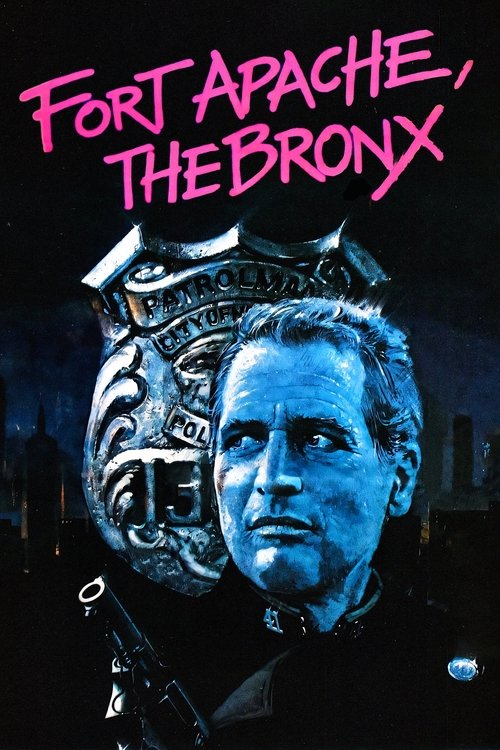
Fort Apache, the Bronx (1981)
Directed by Daniel Petrie
No · Ultra Based
How we score movies →Consciousness Markers
The film carries implicit moral lectures about individual character and duty, though it does not explicitly lecture the audience. The subtext suggests that virtue and moral fortitude are solutions to urban problems.
The film includes minority cast members, but they are predominantly portrayed as criminals, addicts, or supporting characters without agency. Pam Grier's role as a drug-addicted prostitute reinforces rather than complicates stereotypes.
The film depicts racial minorities but frames them as problems to be managed by white authority figures. There is no interrogation of systemic racism or structural inequality, only documentation of urban decay.
The film contains no feminist themes or female-centered narrative. Female characters exist peripherally, primarily as victims or complications in the male-centered police drama.
No LGBTQ+ themes, characters, or representation present in the film.
No climate themes or environmental consciousness present in this urban police drama.
The film contains no critique of capitalism or economic systems. Its concerns are purely individual and moral rather than structural.
No body positivity themes or body diversity consciousness present in the film.
No representation of neurodivergence or disability awareness in this film.
The film does not engage in historical revisionism. It operates within its contemporary moment without challenging historical narratives.
Synopsis
From the sight of a police officer this movie depicts the life in New York's infamous South Bronx. In the center is "Fort Apache", as the officers call their police station, which really seems like an outpost in enemy's country. The story follows officer Murphy, who seems to be a tuff cynic, but in truth he's a moralist with a sense for justice.
Why it received this score
Fort Apache, the Bronx presents itself as a morally serious examination of urban policing, yet its framework remains stubbornly centered on white virtue navigating hostile terrain. Paul Newman's Officer Murphy is the conscience of the story, the reasonable man trying to do right in an environment depicted as fundamentally chaotic and criminal. The South Bronx itself functions less as a community than as a backdrop for this particular moral struggle, a space populated by drug addicts, dealers, and criminals who exist primarily to validate the protagonist's ethical quandaries.
The film's racial representation is undeniably present but profoundly limited. Pam Grier appears as a drug-addicted sex worker, a role that reinforces rather than challenges the stereotypes the film ostensibly documents. The supporting cast includes Latino and Black officers and residents, yet their presence serves primarily to confirm the film's underlying assumption: that this is a place where chaos reigns and only the moral fortitude of men like Murphy prevents total collapse. There is no interrogation of systemic inequality, no suggestion that the conditions depicted might result from policy instead of inherent community pathology.
In terms of contemporary progressive sensibilities, the film registers as a period piece of the pre-consciousness era. It contains no feminist themes, no LGBTQ+ representation, no climate consciousness, no body positivity, no neurodivergence awareness, and no anti-capitalist sentiment. The film's lecture energy, such as it exists, derives entirely from its assertion that individual moral character matters more than structural analysis. By 2020s standards, it is a relic of a moment when films could center white redemption narratives without irony.
Analysis generated by our Consciousness Algorithm
Critic Reviews
“A tough-talking street melodrama, both shocking and sorrowful, acted by Paul Newman and a huge cast with the kind of conviction that can't be ignored.”
“While the movie has some good sequences, as a whole it never seems to come together - the pacing is all off.”
“The pace of the film is also on a low level, with episodic sequences rather than ones that build: more suitable to a television series than a feature film. But the accompanying low-keyed acting, mostly in the police parts of Newman, Ken Wahl and Edward Asner, lends the film a sustaining interest. [13 Feb 1981, p.17]”
“At best, the filmmakers are guilty of wholesale confusion. For lamentable example, the plot degenerates into a hopeless tangle of loose threads and discarded hooks, beginning with the initial vicious teaser, which identifies Pam Grier as a drug-crazed prostitute who guns down a pair of unwary young patrolmen in their squad car. [7 Feb 1981, p.C1]”