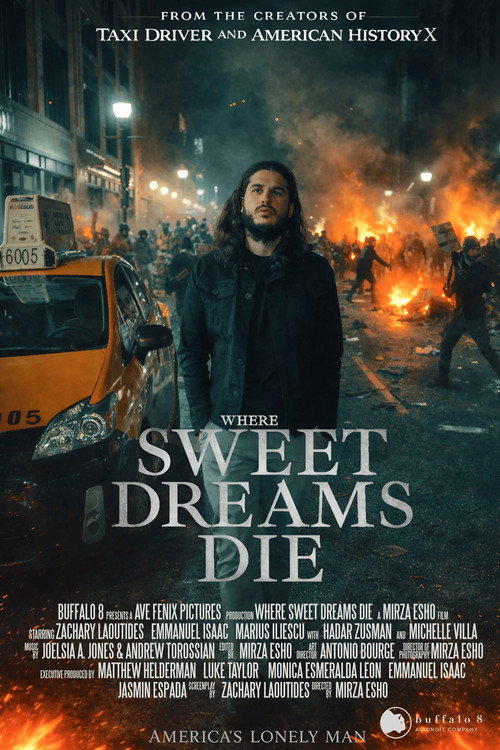
Where Sweet Dreams Die (2026)
Directed by Mirza Esho
Where Sweet Dreams Die arrives as an independent drama-thriller with a thesis stamped on its forehead: economic despair manufactures bigotry, and the immigrant is always the nearest available target.
Consciousness Markers
The film's engine is the contrast between a Syrian immigrant's dignified pursuit of the American Dream and an Italian American man's racialized scapegoating of that same immigrant. Anti-immigrant sentiment is not backdrop; it is the psychological thesis.
An Assyrian director, a Syrian immigrant co-lead, and a production company founded as the first Latino-owned studio in the Midwest constitute a deliberate and layered multicultural architecture. This is not accidental diversity; it is structural.
Festival commentary explicitly frames the film as a critique of xenophobia, conspiracy thinking, and the psychology of scapegoating. A film described by its own promotional ecosystem as a warning about radicalization is, by definition, making a point, and making it with some insistence.
The American Dream is treated not as aspiration but as a trap that, when it fails, produces radicalization and violence. Economic despair is the soil in which the story's ugliness grows, and the film does not suggest the system failed accidentally.
Addiction and paranoid radicalization are depicted in the protagonist, but the framing is cautionary and psychological rather than affirming or identity-based. It scores marginally only because these conditions receive narrative attention.
The wife exists primarily as a cancer diagnosis rather than a character, which is arguably the opposite of a feminist agenda. A minor score is awarded only because her suffering catalyzes the male protagonist's collapse, which some reviewers might charitably frame as centering female experience.
No LGBTQ+ characters, themes, or subtext are present in any available material. The film is occupied elsewhere.
No climate themes, environmental anxieties, or green consciousness detected. The characters are too busy destroying each other to address the planet.
No body positivity content identified. The film's relationship to the human body is largely one of deterioration, which is a different genre entirely.
The film is an original contemporary story with no historical revisionism present. History is not consulted.
Why it received this score
Where Sweet Dreams Die arrives as an independent drama-thriller with a thesis stamped on its forehead: economic despair manufactures bigotry, and the immigrant is always the nearest available target. Director Mirza Esho, himself an Assyrian filmmaker working through a Latino-founded Chicago studio, has constructed a film whose very production credits are an argument. The story of Luca Brunello, an Italian American restaurant owner watching his life dissolve into debt, his wife's cancer, and addiction, is presented as the origin story of a radicalized man. His collision with Ashton Nassar, a Syrian immigrant building something from nothing, is not a coincidence of plot. It is a controlled experiment.
The film's social consciousness is worn openly, though not without craft. Esho frames the Syrian immigrant's arc with a dignity that is clearly intentional, a counter-portrait to the paranoid spiral consuming the protagonist. The American Dream is treated here as a promissory note the economy has no intention of honoring, and the film is not subtle about who suffers when that note comes due. The anti-immigrant scapegoating depicted is presented with the clinical interest of a pathologist: here is the mechanism, here are the conditions, observe the progression. Whether the film trusts its audience to draw conclusions or prefers to draw them itself is the central tension, and the festival circuit's enthusiasm for its social messaging suggests the balance tips toward the latter.
What keeps the film from settling into pure sermon is its genre bones. The psychological thriller machinery creates genuine pressure, and the two lead performances carry the weight of a story that could easily collapse into allegory. Luca Brunello is not a symbol; he is a specific failing man, and that specificity is the film's most honest quality. The cultural apparatus surrounding the production, the diaspora coverage, the festival awards, the identity of the filmmakers, is as much a part of the text as anything on screen. This is, in the end, a film about who gets to fail and who gets blamed for it. The answer, as with most films of this persuasion, is predetermined. The journey there is at least earnest.
Analysis generated by our Consciousness Algorithm

Synopsis
As his restaurant crumbles and his wife battles cancer, an Italian American owner's fate collides with a driven Middle Eastern immigrant chasing the American Dream and his legacy.