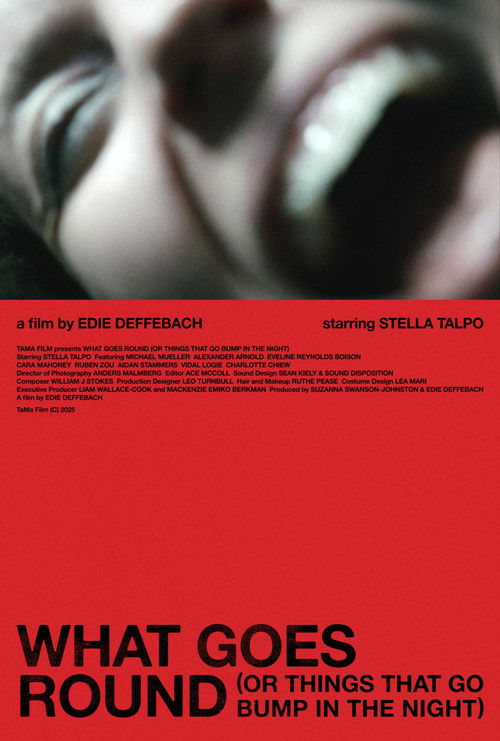
What Goes Round (Or Things That Go Bump In The Night) (2026)
Directed by Edie Deffebach
Edie Deffebach's fourteen-minute short arrives bearing its thesis in both hands.
Consciousness Markers
The film's entire premise is an explicitly feminist reimagining of the Medusa myth, designed, per the director's own statement, to subvert narratives around 'victims, monsters, shame and power' and to explore female rage and reclaimed agency. The feminist intent is not subtextual. It is the text.
The director's stated creative mission is to correct specific cultural narratives about women, shame, and monstrousness. A short film with this degree of declared thematic purpose tends to wear its argument visibly, and the horror genre framing does not appear to be functioning as camouflage.
The film is a deliberate feminist reinterpretation of the Medusa myth, repositioning the monster as a figure of legitimate rage and reclaimed power rather than a cautionary villain. This is mythological revisionism with clear ideological intent.
The film is directed by a British-American filmmaker of Japanese heritage and centers a female protagonist in a female-led narrative. The London night bus setting implies a diverse ensemble of passengers, though no specific casting data is available.
No evidence of LGBTQ+ themes, characters, or subtext in any available material about the film.
Despite the director's Japanese-American heritage and the multicultural London setting, no evidence suggests racial consciousness operates as a thematic driver in the narrative.
No climate or environmental themes are present or implied in any available material.
No anti-capitalist themes are present or implied. The provocation aboard a public bus does not appear to function as class critique.
No body positivity themes are present or implied in any available material.
No neurodivergence themes are present or implied in any available material.
Why it received this score
Edie Deffebach's fourteen-minute short arrives bearing its thesis in both hands. A woman on a London night bus is provoked, becomes monstrous, and discovers herself. The Medusa parallel is not a subtext. It is announced. The filmmaker has stated, with admirable clarity, that the film exists to subvert narratives about "victims, monsters, shame and power," which is the kind of mission statement that removes the burden of interpretation from the audience entirely.
This is, in its way, a generous act. We are not required to do any work. The night bus, that great democratic container of London's dispossessed and merely tired, becomes a mythological arena in which female rage is not only validated but supernaturally ratified. The passengers who provoke our protagonist are presumably not doing so out of idle curiosity. They are performing the ancient function of provokers in feminist allegory: existing to be wrong. The blood, one assumes, is earned.
The film won Best Horror at Brighton Rocks Film Festival, which is a BIFA-qualifying event and therefore a credential worth noting. That it is a genuinely crafted piece of short horror is not in dispute. The question this office concerns itself with is narrower and more specific, and on that question the evidence is straightforward: this is a film that has read its Ovid, disagreed with it, and decided to say so at length in approximately fourteen minutes. We respect the efficiency.
Analysis generated by our Consciousness Algorithm
Synopsis
A woman wakes up on a London night bus and is provoked by a series of passengers; setting her on a bloody journey of self-discovery.