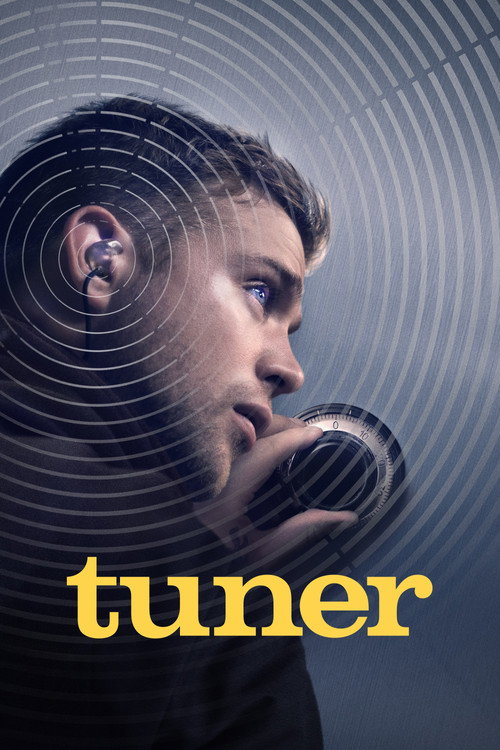
Tuner (2026)
Directed by Daniel Roher
Tuner arrives as a film that, in its bones, simply wants to be a taut heist thriller about a man with very good ears and very bad financial luck.
Consciousness Markers
The inciting premise, a working-class man driven to crime by an elderly mentor's crushing medical debt, carries a clear critique of the American healthcare system. The recurring thread of wealthy New York clients treating skilled tradespeople as interchangeable servants adds a layer of class resentment, though the film does not editorialize heavily about it.
The film's use of hyperacusis as a heist-enabling superpower drew criticism from disability advocates who noted the condition is romanticized beyond recognition. The casting is diverse in a matter-of-fact way, without the film appearing to announce this as a moral achievement.
Hyperacusis functions as the protagonist's defining trait and the engine of the plot, and the film frames his condition as a source of unexpected empowerment. Disability advocates specifically criticized this framing as romanticization, though the film stops short of the full neurodivergence-as-identity celebration common in more explicitly progressive fare.
The healthcare debt premise and the class dynamics between wealthy clients and tradespeople carry some implicit sermonizing potential, but mainstream critics consistently described the film as a genre thriller first. The lecture energy is present in the architecture of the story but does not appear to be delivered from a podium.
A subplot involving a composer seeking heirlooms stolen during the Holocaust touches on historical grievance and restitution. This is treated as character backstory rather than a polemical reframing of history, keeping the score low.
No LGBTQ+ themes, characters, or subplots are present in the available research or plot summary.
No feminist framing or agenda-driven gender commentary is evident in the film's plot or critical reception.
The film engages with Jewish cultural identity and Holocaust memory as organic story elements, not as a vehicle for contemporary racial consciousness discourse. No markers of the modern social-justice framing of race are present.
There is no climate commentary, environmental messaging, or ecological subtext anywhere in the film's plot or reception.
No body positivity themes or messaging are present in the film.
Why it received this score
Tuner arrives as a film that, in its bones, simply wants to be a taut heist thriller about a man with very good ears and very bad financial luck. It largely succeeds at this modest ambition, which in the current climate is either refreshing or suspicious, depending on your disposition. Director Daniel Roher, making his narrative fiction debut after the rather more geopolitically urgent Navalny, has produced something that conservative culture-war aggregators have rated a perfect zero on their proprietary woke scales, a distinction the film wears without knowing it has been given one.
The film's most legible progressive credential is its premise: the protagonist is pushed into a life of crime not by greed or moral failure but by the American healthcare system, which has saddled his elderly mentor with debts that no reasonable person could pay. The commentary is baked into the plot rather than delivered as dialogue, which is the politest possible way to be political. The class dynamics, specifically the spectacle of ultra-wealthy New York clients treating a skilled craftsman as though he were a plumber who had arrived at the wrong address, are observed with dry comedic precision. The film knows what it thinks about this. It declines to explain it to us at length. This is a choice that places it in a small and dwindling category.
The more contested terrain is the treatment of hyperacusis, a genuinely painful chronic condition that the film repurposes as a safe-cracking superpower. Disability advocates have noted, correctly, that the condition involves physical pain and auditory overload instead of the crisp, cinematic sonic acuity the film depicts. The criticism is fair. The film is not making a documentary about hyperacusis; it is making a heist movie that needs a hook. Whether that trade-off constitutes romanticization or simply genre convention is a question Tuner answers by not answering it, pressing forward with its caper while Leo Woodall listens to tumblers click with the focused serenity of a man who has never experienced the actual condition. The Holocaust restitution subplot involving Jean Reno's composer adds genuine weight to the third act. It is handled with more restraint than the premise might suggest. Restraint, it turns out, is this film's most consistent quality.
Analysis generated by our Consciousness Algorithm


Synopsis
A gifted piano tuner's meticulous skills for tuning pianos lead him to discover an unexpected aptitude for cracking safes, turning his life upside down.
Critic Reviews
“It’s a thrill to watch this kind of original, adult movie that are all too rare these days, and Roher hits all the right notes with this move into narrative filmmaking. ”
“Tuner is a distinctly urban romantic fable and tragedy, with a final act that is half-full or half-empty depending on your expectations of how a movie should finish. What’s clear is that Niki is an atypical protagonist, played by an actor who is up to the challenge.”
“Tuner is a small film, but one that will leave a big impact. It truly is one of the most delightful surprises of the fall and deserves to be seen on a big screen with the loudest sound possible. Here's hoping it gets that chance.”
“Beyond representational qualms, Tuner is simply a bad film. The first safe-cracking sequence might be reasonably entertaining, but repeated over and over it becomes extremely dull. ”