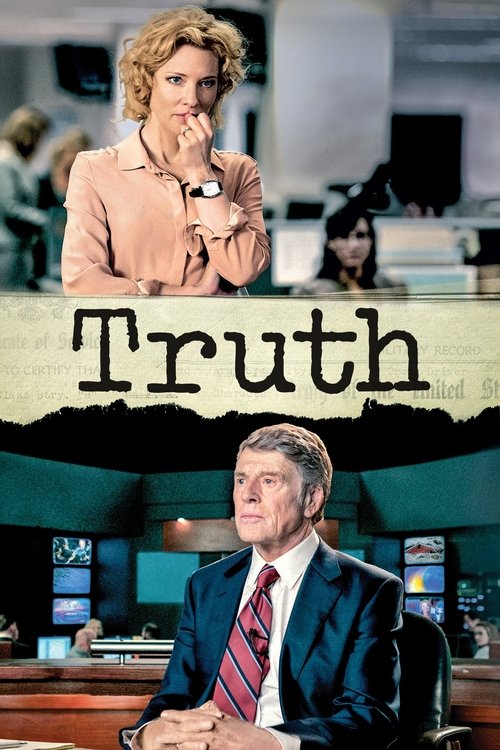
Truth (2015)
Directed by James Vanderbilt
No — Truth is not woke, scoring 19 out of 100 on our wokeness meter.
Truth arrives as a prestige drama about the Killian documents controversy, in which CBS producer Mary Mapes and anchor Dan Rather reported on George W. Bush's National Guard service and then watched the story collapse under questions about fonts, typewriters, and Microsoft Word.
Consciousness Markers
The film is notably didactic, culminating in Mapes's climactic speech about 'fonts and forgeries,' and critics noted the characters serve as mouthpieces for the director's political views.
The film gestures at corporate ownership (Viacom) suppressing a story for business reasons and friendly relations with the Bush administration, a mild critique of media conglomerates, though it is framed as institutional cowardice rather than class warfare.
The film centers on producer Mary Mapes as a woman scapegoated by a corporate news machine, but it frames her struggle as a matter of journalistic integrity rather than gender politics.
The film dramatizes a contested recent event from a sympathetic memoirist's perspective, which CBS publicly condemned as distortion, but it is partisan reframing rather than modern social-justice historical revisionism.
The cast is overwhelmingly white (Blanchett, Redford, Quaid, Moss, Greenwood, Keach, Grace, Mulroney), with no deliberate emphasis on diverse or color-conscious casting for a 2015 prestige drama.
No LGBTQ+ characters, themes, or subtext appear anywhere in this journalism procedural.
Race is entirely absent as a theme; the controversy concerns military records and document forensics, not racial justice.
No environmental or climate content whatsoever.
No body-image or body-positivity themes present.
No neurodivergent characters or themes.
Why it received this score
Truth arrives as a prestige drama about the Killian documents controversy, in which CBS producer Mary Mapes and anchor Dan Rather reported on George W. Bush's National Guard service and then watched the story collapse under questions about fonts, typewriters, and Microsoft Word. James Vanderbilt directs with the sober competence of a man who has studied All the President's Men and taken careful notes. The cast is a wall of pale, familiar faces: Blanchett, Redford, Quaid, Moss. Nobody appears to have been hired with an eye toward reflecting the demographic texture of American newsrooms or the country they serve. The ensemble is white, the framing is traditional, and the film shows no interest in interrogating that arrangement.
Mapes is the emotional center, a woman ground up by a corporate machine, and the screenplay affords her dignity. Her gender goes unmentioned as a political matter. The film treats her downfall as a question of journalistic standards and network cowardice, not as a parable about women in the workplace. There are gestures toward the ownership class: Viacom's business interests, the desire to stay friendly with the White House. The critique lands softly, more institutional nervousness than class anger. Race never enters the frame. Neither does the environment, nor the body, nor the mind's varied wiring.
Where the film does exert itself is in the sermon. The climax hands Blanchett a monologue about fonts and forgeries and the way people scream instead of reading, and the room becomes a pulpit. Critics noticed the characters functioning as mouthpieces, and CBS itself issued a statement calling the whole affair a distortion dressed as martyrdom. The result is a well-acted argument that knows which side it is on and is not shy about saying so, at length, with the camera holding steady.
Analysis generated by our Consciousness Algorithm


Synopsis
As a renowned producer and close associate of Dan Rather, Mary Mapes believes she’s broken the biggest story of the 2004 election: revelations of a sitting U.S. President’s military service. But when allegations come pouring in, sources change their stories, document authenticity is questioned, and the casualties begin to mount.
Questions about Truth
Is Truth woke?
No — Truth is not woke, scoring 19 out of 100 on our wokeness meter. That earns it a verdict of Ultra Based.
Does Truth have any woke elements?
1 of the 10 markers register at 30 or above, led by Lecture Energy (50). On Lecture Energy: The film is notably didactic, culminating in Mapes's climactic speech about 'fonts and forgeries,' and critics noted the characters serve as mouthpieces for the director's political views.
How does Truth compare to other 2015 movies?
It ranks #78 of the 289 films from 2015 we've scored; their average is 15. The wokest is Chi-Raq (78).
How is the Woke Score calculated?
An AI-assisted process researches the film and its reception, scores it 0–100 on ten markers, then combines those into one 0–100 Woke Score. It measures a specific set of 2020s cultural themes, not film quality.