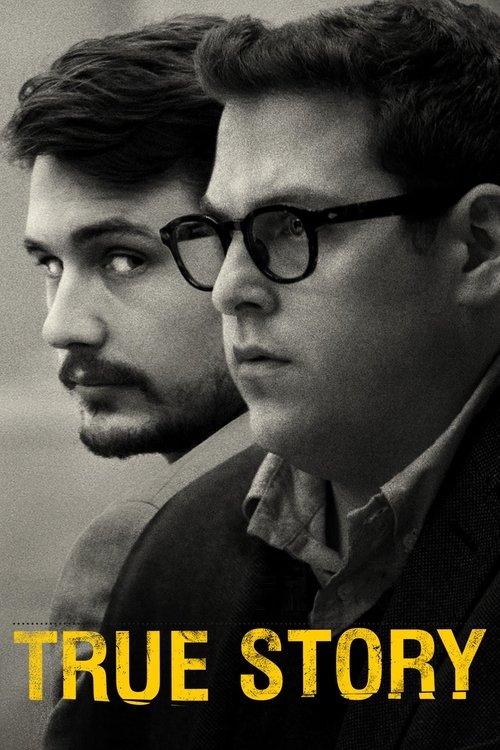
True Story (2015)
Directed by Rupert Goold
No — True Story is not woke, scoring 5 out of 100 on our wokeness meter.
True Story arrives in 2015 with the sober bearing of a film that believes journalism is a moral crucible.
Consciousness Markers
The film moralizes about journalistic ethics, truth, and deception, but delivers its themes through character drama rather than explicit sermonizing.
Felicity Jones's Jill gets a single confrontational scene branding Longo a narcissistic murderer, but the film is otherwise a two-hander between men with no feminist framework.
The cast is overwhelmingly white, led by Jonah Hill, James Franco, and Felicity Jones, with no meaningful diverse representation or commentary on casting.
The film gestures at media industry pressures and a journalist's career collapse, but offers no critique of capitalism or wealth.
No LGBTQ+ characters, themes, or subtext appear anywhere in the film.
Race is entirely absent as a subject; the story concerns white American professionals and a white murderer.
No environmental or climate themes are present.
No body positivity themes or messaging.
No neurodivergent characters or themes are explored.
The film dramatizes a real 2001-2003 case faithfully rather than reinterpreting history through a modern ideological lens.
Why it received this score
True Story arrives in 2015 with the sober bearing of a film that believes journalism is a moral crucible. Jonah Hill plays Michael Finkel, a New York Times Magazine writer fired for inventing a composite character. Finkel then finds his identity borrowed by James Franco's Christian Longo, a man accused of killing his wife and three children. The two men sit across prison tables and trade confessions about storytelling. It is a two-hander about liars, and it takes itself very seriously indeed.
The cultural ledger here is thin. The cast is white from top to bottom, and the film never pauses to consider that fact or anything adjacent to it. Felicity Jones, as Finkel's wife Jill, is granted one scene of moral clarity in which she calls Longo a narcissistic murderer, and then the film returns to its men. Race, climate, class, disability, and sexuality are simply not on the agenda. There is a faint gesture toward media industry precarity when Finkel loses his job, though the film has no interest in wealth or capital beyond the price of a book deal. The film does carry a thesis about truth and deception, delivered through character drama instead of a pulpit, which keeps the sermonizing at a low hum.
Classification: a well-tailored, well-acted piece of moral seriousness that predates the current cultural weather and shows no interest in anticipating it. The film's conscience is real but antique. It belongs to an earlier era of prestige drama, one that assumed a white male protagonist's crisis was universal currency. It is a museum piece, and a decent one, filed under the wrong decade.
Analysis generated by our Consciousness Algorithm


Synopsis
A drama centered on the relationship between journalist Michael Finkel and Christian Longo, an FBI Most Wanted List murderer who for years lived outside the U.S. under Finkel's name.
Questions about True Story
Is True Story woke?
No — True Story is not woke, scoring 5 out of 100 on our wokeness meter. That earns it a verdict of Ultra Based.
Does True Story have any woke elements?
Very few. None of the 10 markers reaches 30, the level where a marker counts as present; the highest is Lecture Energy at 20.
How does True Story compare to other 2015 movies?
It ranks #217 of the 289 films from 2015 we've scored; their average is 15. The wokest is Chi-Raq (78).
How is the Woke Score calculated?
An AI-assisted process researches the film and its reception, scores it 0–100 on ten markers, then combines those into one 0–100 Woke Score. It measures a specific set of 2020s cultural themes, not film quality.