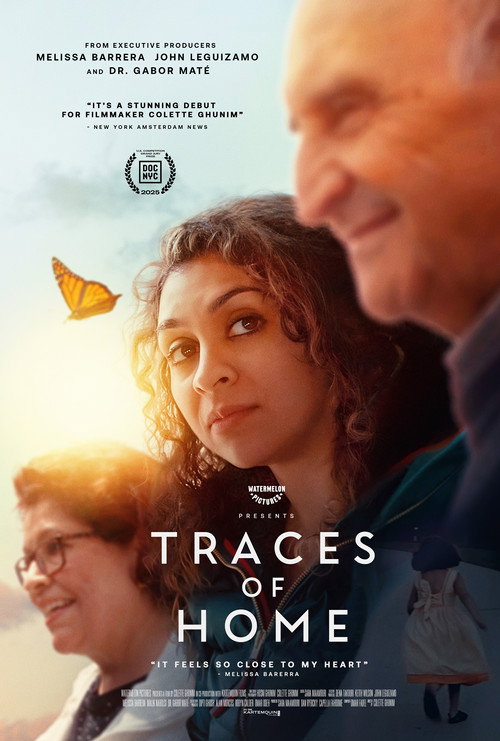
Traces of Home (2026)
Directed by Colette Ghunim
Traces of Home arrives bearing the full credential stack of contemporary documentary filmmaking: a Sundance Fellowship, a Kartemquin Films pedigree, executive producers who are themselves brands of progressive advocacy, and a world premiere Grand Jury Prize from DOC NYC.
Consciousness Markers
The film foregrounds a Mexican-Palestinian American family with deliberate intent, framing their dual heritage as a politically resonant intersection. The director's identity is not incidental to the story but is, in fact, the entire story.
The film was explicitly conceived in response to Trump-era rhetoric vilifying Mexicans and Palestinians, and the director draws a direct structural parallel between the Israeli West Bank wall and the U.S.-Mexico border wall. Racial and ethnic identity are not background context but the film's organizing principle.
Critics specifically noted the film's reliance on explicit narration and inelegant metaphors rather than letting scenes breathe. The director leads post-screening somatic breathing exercises for audiences, suggesting the pedagogical impulse extends well beyond the runtime.
The film centers the 1948 Nakba as a foundational displacement event and explicitly frames U.S. immigration policy as a continuation of colonial dispossession. This is a deliberate counter-narrative to mainstream American and Israeli historical framings.
The mother's storyline centers on fleeing domestic violence and patriarchal abuse in Mexico, and the director herself is a woman reclaiming her family's narrative. The feminist dimension is present but secondary to the broader trauma framework.
The observation that the same company bid on both the Israeli West Bank wall and the U.S.-Mexico border wall carries an implicit critique of the military-industrial and border-security complex, though the film does not develop this into sustained anti-capitalist argument.
The film engages extensively with epigenetic and intergenerational trauma, a framework popularized in part by executive producer Dr. Gabor Maté. This is adjacent to neurodivergence discourse but remains in the realm of psychology and grief, not neurodivergent identity.
No LGBTQ+ themes, characters, or framing are present in the available research or film content. Score is 0.
No climate or environmental themes are present in this film. Score is 0.
No body positivity themes are present in this film. Score is 0.
Why it received this score
Traces of Home arrives bearing the full credential stack of contemporary documentary filmmaking: a Sundance Fellowship, a Kartemquin Films pedigree, executive producers who are themselves brands of progressive advocacy, and a world premiere Grand Jury Prize from DOC NYC. Director Colette Ghunim has assembled a film about her Mexican mother and Palestinian father that is, by all available accounts, genuinely moving and personally vulnerable. It is also a document so precisely calibrated to the current moment of intersectional grievance politics that it could serve as a syllabus. The film was conceived in direct response to Trump-era immigration rhetoric, draws an explicit structural parallel between the Israeli West Bank barrier and the U.S.-Mexico border wall, and frames the emotional distance within her family as a downstream consequence of geopolitical dispossession. The personal is political here, and the political is very specifically the politics of 2017 through the present.
The film's most intellectually ambitious gesture is the epigenetic trauma framework, popularized in part by executive producer Dr. Gabor Maté, which holds that the wounds of displacement are literally encoded in the bodies of subsequent generations. This is presented not as one lens among many but as the explanatory architecture for everything. Some critics found the narration heavy-handed, noting a preference for explicit statement over observed nuance. This is a recurring tension in the socially conscious documentary form: the filmmaker has something urgent to say, and the urgency occasionally overwhelms the saying. The somatic breathing exercises Ghunim leads at post-screening events are perhaps the film's most honest advertisement for itself. The audience, having absorbed the trauma, must now be coached through it. This is a full-service viewing experience.
To be clear: the underlying subject matter is serious and the family's history is real. A man displaced from his home at age four during the Nakba, a woman fleeing domestic violence across a border, a daughter trying to understand what she inherited from both, these are not abstractions. The film earns its emotional weight through specificity. What it occasionally loses is the willingness to let that specificity do the work alone, without the apparatus of contemporary progressive framing scaffolding every scene. The Forward's observation that the film "skirts some of the geopolitical issues at its core" is interesting precisely because the geopolitical framing is everywhere, yet the film retreats to the personal whenever the political might require genuine complexity. It is a meditation on grief that knows exactly which grief is permissible to meditate upon.
Analysis generated by our Consciousness Algorithm
Synopsis
Delving into the past and not shying away from the dug-up pain, a young filmmaker speaks to her Mexican mother and Palestinian father about their trying journeys into the United States. In a society with rhetoric increasingly vilifying Mexicans and Palestinians, the filmmaker picks up her camera in a bid to address the grief at the center of the generational trauma that has underscored her relationship with her family. A meditation of loss and grief relieved, ultimately, through reconciliation.