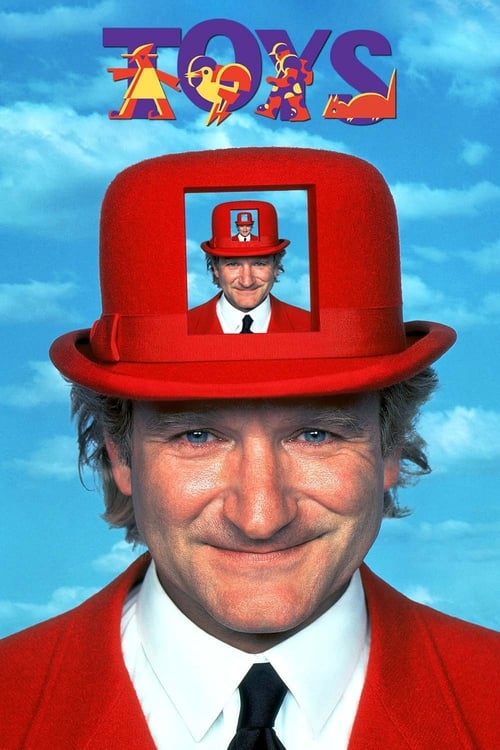
Toys (1992)
Directed by Barry Levinson
No — Toys is not woke, scoring 13 out of 100 on our wokeness meter.
Toys arrives in 1992 with the best intentions and a $30 million set budget, a surrealist comedy from Barry Levinson that the studio never quite understood and audiences never quite found.
Consciousness Markers
The cast includes Black performers LL Cool J and Jamie Foxx (in his feature debut) alongside the white leads, but they exist as ordinary characters without any commentary on representation. A modestly diverse ensemble for 1992, nothing more.
The villain is a war-mongering general who militarizes a toy factory and displaces its workers, giving the film a mild anti-military-industrial-complex streak. It is anti-war rather than a systematic eat-the-rich critique.
The film carries a pacifist message about war toys and militarism that it delivers with some earnestness, though it is wrapped in whimsical comedy rather than direct preaching.
Joan Cusack's Alsatia and Robin Wright's Gwen are capable but largely defined by their roles as companion and romantic interest. No feminist framework is articulated.
No LGBTQ+ characters, themes, or subtext of any kind appear in the film.
The film engages no racial themes whatsoever; its minority cast members are simply present in the story.
No environmental or climate themes are present in the narrative.
No body-positivity themes or messaging appear in the film.
Leslie is portrayed as whimsical and childlike, but this is framed as eccentricity and innocence, not as neurodivergence in any modern sense.
The film is a fictional surrealist comedy and makes no revisionist claims about historical events.
Why it received this score
Toys arrives in 1992 with the best intentions and a $30 million set budget, a surrealist comedy from Barry Levinson that the studio never quite understood and audiences never quite found. Robin Williams plays Leslie Zevo, a toymaker of childlike temperament, pitted against his uncle Leland, a general who converts the family factory into a workshop for miniature war machines. The film failed at the box office and was received with a shrug that has not lifted in the decades since. It is, in the language of our current taxonomy, a modest specimen. The cast includes LL Cool J and a very young Jamie Foxx, both of whom simply exist in the story, Black performers in a white ensemble without a single line drawing attention to the arrangement. That is diversity by presence, not by argument, and it earns only the smallest credit.
The feminist register is faint. Joan Cusack's Alsatia and Robin Wright's Gwen are capable women, but the script assigns them the roles of companion and romantic interest, and no framework is articulated on their behalf. There is no LGBTQ content of any kind, no body-positivity message, no climate concern. Leslie's whimsy reads as eccentric innocence, not as a portrait of neurodivergence in any modern sense. The film's politics run toward the anti-military-industrial-complex: Leland displaces the workers and turns playthings into weapons, which registers as an anti-war gesture more than a systematic critique of wealth. The pacifism is real, and it is delivered with some earnestness, though the whimsy keeps it from becoming a sermon.
The net effect is a film slightly ahead of nothing in particular. It wants to be charming and settles for strange.
Analysis generated by our Consciousness Algorithm


Synopsis
Leslie Zevo is a fun-loving inventor who must save his late father's toy factory from his evil uncle, Leland, a war-mongering general who rules the operation with an iron fist and builds weapons disguised as toys.
Questions about Toys
Is Toys woke?
No — Toys is not woke, scoring 13 out of 100 on our wokeness meter. That earns it a verdict of Ultra Based.
Does Toys have any woke elements?
Very few. None of the 10 markers reaches 30, the level where a marker counts as present; the highest is Eat the Rich at 25.
How does Toys compare to other 1992 movies?
It ranks #22 of the 74 films from 1992 we've scored; their average is 12. The wokest is The Crying Game (62).
How is the Woke Score calculated?
An AI-assisted process researches the film and its reception, scores it 0–100 on ten markers, then combines those into one 0–100 Woke Score. It measures a specific set of 2020s cultural themes, not film quality.