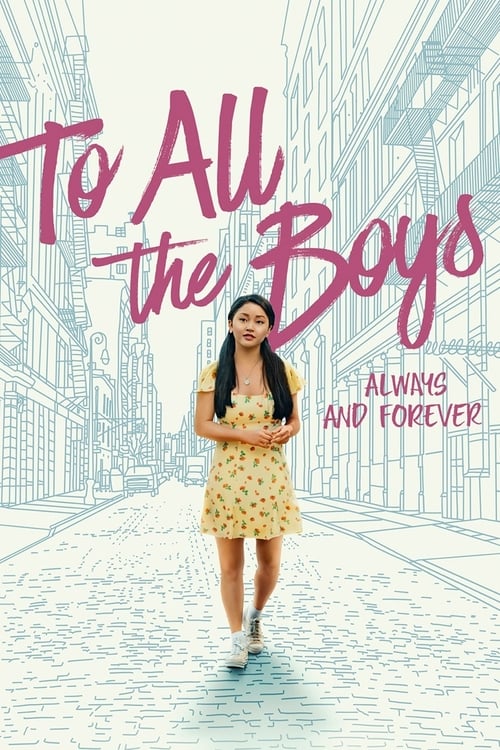
To All the Boys: Always and Forever (2021)
Directed by Michael Fimognari
No — To All the Boys: Always and Forever is not especially woke, scoring 25 out of 100 on our wokeness meter.
To All the Boys: Always and Forever arrives as the third and final installment of a franchise adapted from Jenny Han's novels, and it conducts itself with the mild decorum of a series that knows exactly who it is.
Consciousness Markers
A Korean-American protagonist and her family anchor the film, with a notably diverse ensemble (Lana Condor, Janel Parrish, Ross Butler, Sarayu Blue, Trezzo Mahoro) and a Seoul-set sequence; the representation is organic to the source novel rather than a casting stunt.
The central conflict turns on Lara Jean choosing NYU for herself rather than following Peter to Stanford, a modest assertion of a young woman's autonomy over the relationship's convenience.
Korean heritage and the Seoul trip provide cultural texture and a link to her late mother, but the film never engages racial identity or systemic themes as commentary.
Lucas is described as Lara Jean's gay friend, a background detail carried over from the books with no narrative weight or romantic arc of his own.
The closing voiceover gently pushes back on rom-com stereotypes about long-distance relationships, a light message rather than a sermon.
No environmental themes whatsoever.
No economic critique; the film is a comfortable teen romance with no class or wealth commentary.
No body-image or body-acceptance themes present.
No neurodivergent characters or themes.
No historical revisionism; the film is contemporary and personal.
Why it received this score
To All the Boys: Always and Forever arrives as the third and final installment of a franchise adapted from Jenny Han's novels, and it conducts itself with the mild decorum of a series that knows exactly who it is. Lara Jean's Korean-American family is not decorative garnish. It supplies the film's emotional architecture, especially the Seoul trip and the search for her late mother's lock on a bridge. The ensemble is diverse in a manner that feels inherited from the books instead of assembled by committee. This is pleasant. It is also not a revolution.
The central drama is a college choice, and the film grants Lara Jean the modest dignity of picking NYU for herself instead of trailing Peter to Stanford. That is a small assertion of autonomy, delivered without a megaphone. Her friend Lucas is gay in the way a background character is gay: present, acknowledged, and given nothing much to do. Korean heritage provides texture and maternal memory, though the film treats it as personal history, not as a thesis about race. The closing voiceover offers a gentle correction to rom-com assumptions about long-distance romance, a nudge instead of a lecture.
The rest of the ledger stays quiet. There is no environmental sermon, no class warfare, no body-image crusade, no neurodivergent subplot, no revisionist history. What remains is a comfortable teen romance with a few soft progressive gestures and a sensible amount of self-possession. The result is agreeable, well-mannered, and unlikely to trouble anyone's dinner party. The trilogy ends as it began: pleasant, tidy, and ideologically mild.
Analysis generated by our Consciousness Algorithm


Synopsis
Senior year of high school takes center stage as Lara Jean returns from a family trip to Korea and considers her college plans — with and without Peter.
Questions about To All the Boys: Always and Forever
Is To All the Boys: Always and Forever woke?
No — To All the Boys: Always and Forever is not especially woke, scoring 25 out of 100 on our wokeness meter. That earns it a verdict of Based.
Does To All the Boys: Always and Forever have any woke elements?
2 of the 10 markers register at 30 or above, led by Representation Casting (70) and Feminist Agenda (35). On Representation Casting: A Korean-American protagonist and her family anchor the film, with a notably diverse ensemble (Lana Condor, Janel Parrish, Ross Butler, Sarayu Blue, Trezzo Mahoro) and a Seoul-set sequence; the representation is organic to the source novel rather than a casting stunt.
How does To All the Boys: Always and Forever compare to other 2021 movies?
It ranks #79 of the 242 films from 2021 we've scored; their average is 23. The wokest is The Forever Purge (83).
Is To All the Boys: Always and Forever the most woke To All the Boys movie?
No. It ranks #3 of the 3 To All the Boys films we've scored; the wokest is To All the Boys I've Loved Before (42).